Lehman's 'shenanigans' on hidden leverage may haunt disgraced CEO
Fuld accused of negligence as report claims embattled bank hid losses
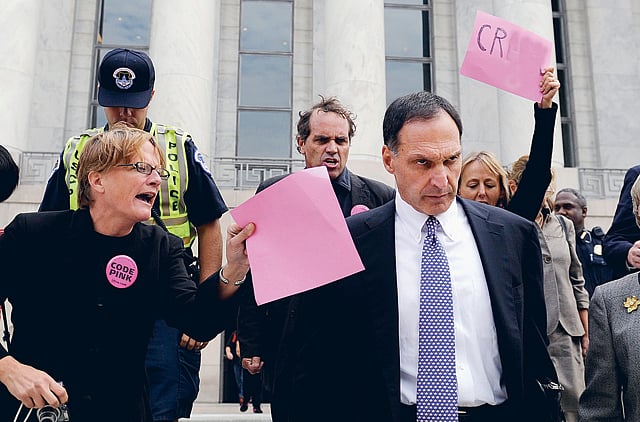
Washington/New York: Lehman Brothers Holdings Richard Fuld exuded confidence as he briefed analysts on June 16, 2008, four days after demoting his firm's finance chief in the wake of a $2.8 billion (Dh10.2 billion) quarterly loss.
"I am the one who ultimately signs off and I'm comfortable with our valuations at the end of our second quarter," then-chief executive officer Fuld said on the conference call.
"We have always had a rigorous internal process."
The rigour was based on a shaky foundation, according to a 2,200-page report about the firm's demise by Anton Valukas, the examiner for the bankrupt firm.
Lehman Brothers "reverse-engineered" a key measure of stability, masking the firm's true financial condition, Valukas said. Some asset valuations were also "unreasonable," he said.
Shrinking ratio
Keen to show that it had reduced leverage, a gauge of a company's ability to withstand losses, chief financial officer Ian Lowitt said on the June 16 call that the firm had shrunk its net leverage ratio to 12 times from 15.4 in the second quarter.
It accomplished the feat by reducing net assets by $70 billion, said Lowitt, who had just replaced Erin Callan in his post.
"We're going to operate conservatively," he said.
Unbeknownst to shareholders, the firm was hiding $50 billion in assets through off-balance sheet transactions known as Repo 105s that temporarily removed holdings until days after the quarter closed, according to Valukas.
In the first quarter, the firm had used the same strategy to hide $49 billion in assets, he said in the report.
Lehman Brothers actions amounted to no more than "shenanigans," said Sanford C. Bernstein & Company analyst Brad Hintz, a former Lehman chief financial officer.
"If all you're doing is hiding something behind the curtain, the financial strength isn't there."
The repos helped prop up Lehman's credit rating, Valukas said. The off-balance dealings required more collateral than if Lehman had opted for ordinary transactions visible to shareholders, he said.
"Repos were just one of many ways to hide losses," said Janet Tavakoli, president of Chicago-based financial consulting firm Tavakoli Structured Finance Incorporated.
"All of the former investment banks used those techniques. All of them borrowed too much money and were overleveraged."
Lehman Brothers bolstered capital by raising about $12 billion from investors during the first half of 2008, a time when Valukas said the New York-based firm's financial statements were misleading.
Investors included Blackrock, the largest publicly traded fund manager in the United States, a venture run by former American International Group chief executive Maurice ‘Hank' Greenberg, and New Jersey government retirees.
Fuld, 63, was "at least grossly negligent in causing Lehman Brothers to file misleading periodic reports," Valukas said.
Fuld's lawyer, Patricia Hynes, disputed the examiner's conclusions.
Not culpable
"Fuld did not know what those transactions were — he didn't structure or negotiate them, nor was he aware of their accounting treatment," Hynes said in a statement.
She also said none of Lehman's senior financial officers, lawyers or outside auditors raised concern about the transactions with Fuld.
Robert Cleary, a lawyer for Callan, didn't return a call seeking comment.
Transactions
Off-balance sheet items
- $50b assets hidden in second quarter of 2008
- $49b assets hidden during first quarter of 2008
- $2.8b Lehman's loss in second quarter of 2008
Sign up for the Daily Briefing
Get the latest news and updates straight to your inbox
Network Links
GN StoreDownload our app
© Al Nisr Publishing LLC 2026. All rights reserved.