Novak's main man
Djokovic reveals how he is coming to terms with the loss of one of the most influential figures in his upbringing
Go back to the late 1990s and they made a familiar sight on the trams of Belgrade: a small, intense-looking boy with a racket bag slung over one shoulder, and his 70-year-old companion. The boy was, of course, the young Novak Djokovic.
The chaperone was Novak's late grandfather Vladimir, whose passing last month caused the family so much grief. The Djokovics are a close-knit bunch, and Novak, inevitably, is their focal point. His mother has described him as "the child of God", while his father and two younger brothers, Marko and Djordje, often accompany him to tournaments.
But his bond with his grandfather was particularly strong — far more so than their 60-year age-gap might suggest.
"It's interesting that I had such a close relationship with my grandfather," Djokovic said.
"Because your parents always judge you: they say, ‘You shouldn't do this, you shouldn't do that'. But with your grandparents you have a feeling that you can say anything or you can do anything, and they will support you.
"That's why you have this kind of connection."
Djokovic was practising at the Monte Carlo Country Club when he was given the news of Vladimir's death. Such is the public nature of sport that he was captured on camera as he left the court in tears, a towel pressed to his face.
A chance to grieve
Djokovic steeled himself to carry on through the rest of that tournament in Monaco, eventually finishing as runner-up to Rafael Nadal. But if he was present in body, his mind and spirit were at Vladimir's funeral in Belgrade.
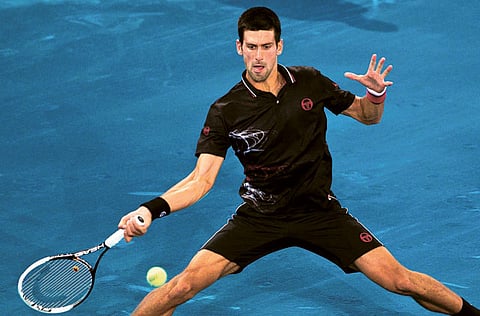
He spent the next fortnight in retreat from the pressures of the tour, even pulling out of his family's own tournament in Serbia to give himself a chance to grieve. Now, after returning to action on the infamous blue clay of Madrid last week, Djokovic is ready to talk about his grandfather — a man whose broad experience of life put the frustrations of chasing a fluffy ball into perspective.
"My grandfather went through a lot in his life," Djokovic said.
"He came from Montenegro, but in the Second World War he went through two or three different countries to get away from the danger. Then he moved to Serbia with my father and the whole family, and they lived in Belgrade, which is where I was born.
"He was 85 years old when he died, and he remembered a much simpler life.
"He was telling me how they lived, how they survived, what they did in their free time when they were young. His advice was always to keep grounded, and look at the basics of life: you need to be happy, you need to be healthy, you need to have a good family and a good relationship with your close ones.
"In my childhood when I was in Serbia he took me a lot of times to practice, we went together in the trams in public transportation. Whenever I would lose he would say, ‘You're not sad, right?' I'd say, ‘No, no I'm not sad,' even though I was. He would say, ‘Don't be sad. Come on, it's just one match. You play so many matches. Life goes on'."
Djokovic projected a huge sense of dignity as he spoke about his loss. Articulate in four languages, and blessed with an instinctive ability to connect with people, he is a natural ambassador. The best piece of positive PR, as one Serbian diplomat put it, that his country has ever had.
It has almost become a cliche to say that Djokovic's determination and work ethic were forged out of a tough childhood. Serbians love to tell the story of his family's response to the Nato bombing raids of 1999: they spent a couple of days sheltering in the basement of Vladimir's apartment block, before deciding to take their chances, and returning to the practice court. But then, true resilience is built on a sense of security as much as it is on overcoming hardship.
As Djokovic puts it: "It's always easier if you have the support of your family, if you're not alone. I came from a country that has been through a lot of troubles in the last 20 to 30 years, but we have been through them together.
Process of learning
"My father, me, my mother, my family, we were all learning about tennis together, because I started to play as the first one in my family. [Marko and Djordje have since become professional players as well.]
"My father had never watched tennis, never liked tennis too much. He said, ‘OK, we buy a racket, we watch together,' because we didn't know anything. It was a process of learning together that made it more interesting."
Perhaps the most testing time came when Djokovic had to leave his beloved family, aged just 12, and spend two years living in a German village near Munich. His parents had borrowed money to send him to a tennis academy run by Niki Pilic, a Croatian who had reached the final of the French Open in 1973. Even at that early age, Djokovic showed a frightening level of motivation, once telling Pilic that he didn't want to wait 20 minutes for a practice court because "I'm not going to waste my career".
The Sports Illustrated writer S.L. Price has observed that he didn't have any choice but to succeed: "The family had put all its chips on him."
Yet Djokovic himself insists that his drive for self-improvement came from within. "My father, my family never tried to put any pressure on me and I am very grateful for that," he said. "But I felt and I knew that I needed to succeed, in order to have a better lifestyle for my family.
"Luckily I succeeded but it wasn't by myself, I did it with all of them together. I was trained by the right people. Pilic, my family, and Jelena Gencic my first coach. Then Marian Vajda later on. I always had great coaches, great mentors, people who I can always consult on anything. Under the situation and circumstances that I was in, I was lucky enough to find my way."
Since returning to the tour, Djokovic has been putting a brave face on his bereavement, telling reporters in Madrid that "whatever happened is behind me and I feel good".
Yet the truth is more complex than such sound bites would allow. "I remember those days we spent together so well now," he said.
"Everything comes back, unfortunately now under these circumstances when he's gone. But I always try to remember the nice moments because this is the first time that I have lost a close person in my life, in my family."
He paused, and, for the first time in our conversation, seemed to be reaching for the right words. "It is a very strange feeling."
— The Telegraph Group Limited, London, 2012


