Racing's dark secret
A rash of catastrophic fatalities are being experienced at Aqueduct casino and racetrack
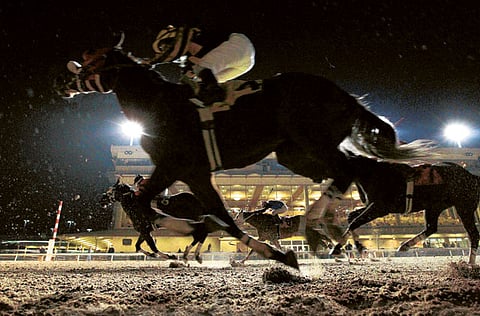
New York: As he trained for his first race at Aqueduct Racetrack in New York, three-year-old thoroughbred Wes Vegas galloped on the track most mornings and had two timed workouts.
But his handlers also prepared him in another way. In the month before the race, records show, he received ten intravenous injections of potent drugs for pain, one the day before he ran; two injections of a drug for joint disease; corticosteroid injections in his two front ankles; a sedative; and an ulcer drug.
For all the preparation, that first race, on March 3, turned out to be his last.As he approached the first turn, Wes Vegas broke a leg and had to be euthanised.
A week earlier, another horse, four-year-old Coronado Heights, who records show had "early degenerative joint disease", suffered a fatal breakdown at Aqueduct after receiving 13 injections for pain and cartilage damage in the month before his race.
Since a casino opened at Aqueduct late last year, offering vastly richer prizes, 30 horses have died racing there, a 100 per cent increase in the fatality rate over the same period the previous year.
Like Wes Vegas and Coronado Heights, many had been injected repeatedly with pain medication in the weeks before their breakdowns, according to veterinary records.
Dangerous incentives
Pain medication during training is legal as long as it does not exceed certain levels on race day.
But the prevalence of drugs is a graphic illustration of how the flood of casino cash has created powerful and dangerous incentives to run sore, tired or otherwise unfit horses in pursuit of that big score.
"If the public knew how many medications these horses were administered after entry time, I don't think they would tolerate it," said Dr Rick Arthur, the equine medical director of the California Horse Racing Board.
Amid the uproar over the Aqueduct death toll, Governor Andrew Cuomo of New York ordered an investigation to "ensure against needless injuries to horses and to riders".
Experts are examining various factors — not just drugs, but issues like track conditions and pre-race inspections.
But what is indisputable is that casinos opening at Aqueduct and a growing number of racetracks in the US have recalibrated the age-old economic equations of the horseracing game.
To survive amid a riot of new, technologically advanced gambling options, track owners have increasingly succumbed to the gambling industry's offer to sweeten racing purses with slot machine revenue.
But if casinos promise to prop up a struggling sport, they can also erode the loyalty owners and trainers feel toward their horses, turning them, in the words of Maggi Moss, a leading owner, into "trading cards for people's greed".
The casinos' impact is greatest at the sport's low end, the claiming races, a world away from the bluegrass pageantry of the Kentucky Derby. In the claiming ranks — where some of the cheapest horses fill starting gates at tracks like Aqueduct; Penn National, near Harrisburg, Pennsylvania; and Evangeline Downs in Louisiana — the casino money has upset the traditional racetrack balance of risk and reward.
"It's strictly self-centered greed of not thinking about the horse but thinking about maybe I can get one more race out of him and get a piece of the game," said Dr Tom David, until recently the chief veterinarian for the Louisiana Racing Commission.
To better protect the horses, some industry experts say, purses should be limited so the potential winnings in any race do not exceed the value of the horses running in it.
That way, the incentive for the owner is to care for the horse over the long haul, rather than risking it for a single payday. A prominent veterinarians group, the American Association of Equine Practitioners, recommends that no purse exceed a horse's value by more than 50 per cent.
Yet that recommendation is widely ignored.
At Aqueduct, horses worth $7,500 (Dh27,540) — at the lowest level of competition — recently raced for a $40,000 purse, nearly four times the recommended maximum.
Two of them broke down and had to be euthanised. Both had been given pain medication in the days leading up to the race. In all, 19 of the 30 Aqueduct deaths occurred in races where the veterinarians' standard was violated.
Nationwide, 57 per cent of thoroughbred claiming races at casino tracks exceeded that 50 per cent standard, and horses broke down or showed signs of injury at a 29 per cent higher rate in those races.
In a statement, the New York Racing Association said "it would be inappropriate and irresponsible... to speculate on the reasons for breakdowns and injuries" before the governor's task force has finished its inquiry.
Big purses have destabilised the racetrack economy in another way. Every claiming race is essentially a marketplace, with all horses for sale at a fixed price.
But the casino money has set off a frenzy of horse trading at Aqueduct, with owners eager to buy and also to sell to slake the surging demand.
Caught by surprise
Since the casino opened late last autumn, nearly 500 horses and $10.7 million have changed hands, more than double the previous year, records show.
Again, the incentive is to push horses, fit or not, out on to the track.
"If horses don't win, people just get rid of them," Moss said.
The turmoil at Aqueduct over the last six months caught many in the industry by surprise. But a cautionary tale played out two years before at Penn National, where nine horses belonging to a single owner died while racing, prompting a boycott by jockeys.
State investigators discovered evidence of serious problems in the owner's operation: trainers and other employees injecting horses with illegal drugs and administering other illicit treatments at an off-track training centre.
When the Hollywood Casino arrived in 2008, Penn National became part of a casino expansion that now encompasses more than a third of the nation's thoroughbred racetracks. Gambling companies, state budgets and some horse owners have benefited, but the spread of casinos has left many people wondering if, in the long run, casino gambling is hurting the sport of racing and the horses themselves.
"In spite of what they say, and they are my friends whom I love dearly, they do not care about horse racing," William Koester, of the Ohio State Racing Commission, said recently of the casino industry. "They care about gaming. That is their mission."
Melodeeman, a ten-year-old thoroughbred, had earned a rest. He raced gallantly for six owners. He set a track record at Aqueduct for the fastest five-and-a-half furlongs and earned more than $250,000 in his career. He raced even after a broken leg was put back together with three stainless-steel screws.
According to one exercise rider who saw the horse well before the race, Melodeeman was clearly lame. But Melodeeman raced anyway that evening.
Necropsy
Turning for home, his front legs buckled, sending his jockey, Angel Quinones, flying. Melodeeman had snapped his right cannon bone and was euthanised at the track, almost four years to the day after he set his Aqueduct record.
State regulators were suspicious. Other horses belonging to the same owner, Michael Gill, had been breaking down in large numbers and jockeys were complaining.
A subsequent necropsy revealed that Melodeeman not only had degenerative joint disease in the lower part of his two front legs, but that his fatal fracture occurred next to the earlier break mended with three screws. The examiners were concerned enough to have snapped a colour photograph of the screws.
A prohibited sedative, fluphenazine, was also found in Melodeeman's brain, according to records. Fluphenazine can calm a horse that becomes agitated because of discomfort or injury, according to two veterinarians.
Melodeeman's fatal breakdown was not quickly forgotten by jockeys at Penn National. A revolt was brewing.
The next morning, Thomas Clifton, a veteran jockey, complained to the state racing commission's office at Penn National that Gill's horses were unsafe. He had been making similar complaints for a month.
"The horses go perfectly sound right up to the second they snap their leg off," Clifton said.
The following day he came back with a warning: "If we have one more horse break down, we are going to have a major problem on our hands."
That night, riding in the fifth race, Clifton heard a bone snap and saw another jockey, Ricky Frazier, vaulting off a horse named Laughing Moon. Clifton yanked his own mount, but they still went soaring over Laughing Moon.
Within minutes, Mr. Frazier was in an ambulance and a veterinarian was administering a lethal injection to Laughing Moon, the ninth Gill horse to die racing in 10 months.
That is when the jockeys decided to take a stand: They would not ride in any race with a Gill-owned horse.
Their boycott cast a harsh light on the Pennsylvania Racing Commission and Penn National Gaming, which owns the track.
"It wasn't the commission or the racetrack or anyone with any responsibility for horses and riders who took action," said George Strawbridge, a prominent breeder and owner.
"It was the jockeys who feared for their life. That's not a shame. That's a disgrace."
Regulators did not have the authority to monitor the treatment of horses on Gill's ranch, but three months before the boycott, the commission and track security officers searched a van delivering Gill's Lion's Pride, who was scheduled to race that day.
They found four syringes, and Lion's Pride tested positive for a corticosteroid used to treat joint inflammation.
In the face of the jockey's boycott, the racing commission ejected Gill from Penn National.
— New York TimesNews Service


