Course conjurer
The PGA European Tour's director of operations David Garland shares the most rewarding and most demanding aspects of his job
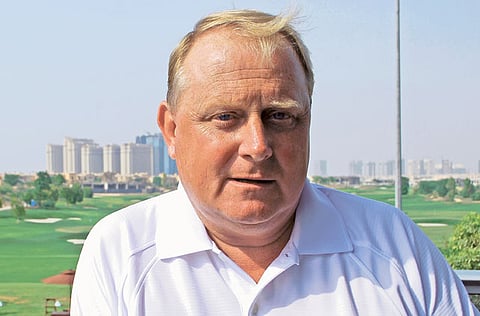
Dubai: As far as the odd round of golf goes David Garland, the director of operations with The PGA European Tour, has the perfect excuse.
His job — for the past eleven of his 23 years on Tour — has been to unite and oversee tournament subdivisions including everything from refereeing to scoring and agronomy to physiotherapy to ensure that all is on track ahead of a major event so that the best players in the world only have their swing to contend with on the day.
If that sounds simple, be reminded that there are as many tournaments on Tour as there are weeks in the year — a staggering 52 across 29 different destinations worldwide. Four of those, last year at least, were in the GCC region.
Garland, originally from the ‘home of golf' — St. Andrews in Scotland — tells you there is an upside: "Sometimes actually playing a course is the only insight into how it will be on the day, in terms of maturity of vegetation and line of sight. You have to conclude: is this how Greg Norman wanted it? Is that tree blocking a bunker? Is it still spectator-friendly?"
For the most part he insists he leaves the rounds to the former professionals now on staff as administrators or referees to report back to him so that he can suggest changes to the committee. But now and again he's required to tee-up himself.
Dubai visit
Last week Garland, 49, was in Dubai to assess developments on the Earth Course at Jumeirah Golf Estates ahead of the Race to Dubai European Tour season-ending Dubai World Championship from December 8-11. It's the third year that this event has decided the European Order of Merit winner from monies earned over the entire season; previously Lee Westwood and Martin Kaymer confirmed their year-long dominance here.
With this being the 40th season of golf tournaments since the European Tour began back in 1972, there's an extra incentive to see this season off without hitch. But is the summer heat expected to be a damper for golf's annual all-star crescendo?
Climate call
"Myself and senior agronomist Graeme MacNiven, both feel the golf course is in its best condition this time of year than we've ever seen it. Mark Tupling the course superintendent has done a fantastic job to maintain standards during the difficult summer months here," Garland says.
"All climates pose a challenge; last week I was at Gleneagles and grass only starts growing in April due to frost and ice. But the challenge for green staff here given the amount of water they need to keep vegetation alive is considerable."
Speaking of tweaks here and there, Garland added: "There will be no material changes, we're just overseeding with ryegrass because Bermuda starts to go dormant in the cooler months, to ensure there's a bit of guaranteed rough to give the guys something to think about."
Tee movements
"We want a bit more definition between the rough and the fairway... We're not going to set it up like a US Open, we still like birdies and eagles, but a wayward shot will be harder to get back on the green and harder to control once you get it there," said Garland.
Summing up his third of four pre-event visits, Garland added: "You don't want your season ending finale to be the toughest. You want to identify the best that week, not trick it up so it's impossible with well over par scores. That's not fun for spectators or players. It should be a celebration of golf."
There may even be some tee movements: "The best par fives in the world are risk reward like Augusta 13 and 15, we may move the tees forward on some holes for a definite tee shotter. It adds variety. The guys are playing the same holes over four days, why not move the tee forward a couple of days."
While the most enjoyable part of his work is getting out on the course and feeling the game, the part he dreads most is stopping: "Making the call for adverse weather is the hardest part at a tournament, when you're unsure whether it's still playable or when to make the call for thunder, rain and wind. Weather causes some real heartaches."
Armchair fans wreaked havoc during last year's Desert Swing by spotting the slightest rule infringement on slow motion replay and ringing the offence in.
Not only did Ian Poulter lose the Dubai World Championship to Robert Karlsson in the play-off after admitting to dropping his ball on the marker but Padraig Harrington (leading) got disqualified for marking his card wrong after unnoticed movement from the marked position. Such instances put officials like Garland, who also oversees rules and regulations, in the spotlight. But he welcomes the couch potato police.
Armchair fans
"The Poulter drop was unfortunate as it took away from an exciting finale. Meanwhile the Harrington rule has been amended. If he marked his card low without realising an earlier infringement again he'd no longer get disqualified, the penalty stroke would just be added to his score.
"The armchair fan can exonerate as well as penalise and over such a field the referee can't be everywhere.
"Rules are there to protect and they have stood the test of time. We review the rule annually with the R&A and the USPGA and both Tours have input with referees on the panel."


