US should negotiate with Iran
Obama needs to look beyond electoral gains and seriously consider Ahmadinejad's offer to restart the P5+1 talks
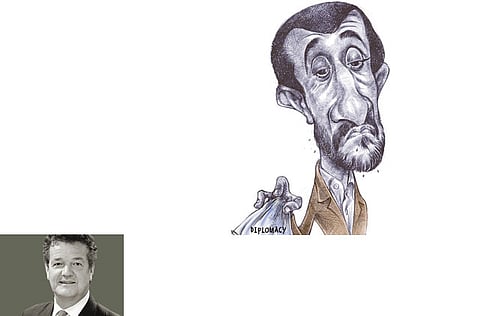
Iran has said that it is ready to talk about its nuclear programme, but the deafening silence from the US is thoroughly dispiriting. The lack of response indicates that the momentum for sanctions (followed by more sanctions) backed by possible military action has taken hold. The Obama administration seems to want a ‘win' which it can report back to its electorate, rather than an answer to the problem.
The tragedy is that sanctions or military action can only be tools to create a political solution, which can only be achieved by dialogue and engagement. This is why it was important during the first week of February, when the Iranian Foreign Minister Ali Akbar Salehi told inspectors from the International Atomic Energy Agency (IAEA) that Iran wanted to restart talks with the P5+1 (the five UN Security Council members plus Germany) about its nuclear programme. "We hope the P5+1 meeting will be held in near future," Salehi said.
The last round of P5+1 talks were in Istanbul in 2011, but were chaotic and ended inconclusively in Istanbul. At that session, Iranian representative Saeed Jalili, apparently under instructions from Tehran, deliberately avoided a bilateral meeting with US Deputy Secretary of State William Burns.
Any new round will have to be better planned, argues John Limbert, who is now professor of Middle Eastern studies at the US Naval Academy, having left the State Department in August 2010, where he had served as deputy assistant secretary of state for Near Eastern affairs.
Limbert argues very persuasively in Foreign Policy magazine that future talks cannot just deal with Iran's nuclear plans, but have to cover a wide range of issues. "For better or worse, the nuclear programme has become highly symbolic for the Iranian side. Exchanges on the subject have become an exercise in ‘asymmetric negotiation', in which each side is talking about a different subject to a different audience for a different purpose.
"For Americans, the concern is technical and legal matters such as the amounts of low- and high-enriched uranium, as well as the type and number of centrifuges in Iran's possession.
For Iranians, the negotiations are about their country's place in the world community — its rights, national honour, and respect. As such, any Iranian negotiator who compromises will immediately face accusations of selling out his country's dignity," says Limbert.
Range of issues
The danger is that if US negotiators focus only on the hardest issue, which is Iran's nuclear programme, then they will find it hard to develop the talks. Limbert lists a whole range of areas where sensible agreement is a possible outcome. He suggests that the talks should cover Afghanistan, terrorism, drugs, piracy, and other areas where, in a rational world there is a good basis for agreement.
As the continuing rhetoric in Washington and Tehran drowns out any rational search for a political solution, it is easy to forget how Iran and the US could share common ground on many issues. For example, they both want a stable Afghanistan, and when the Americans first went into Afghanistan, Iran offered its support.
This embarrassed the Bush administration, which did not want to be seen to be either talking to or relying on America's long-established ‘enemy' and rejected the offer peremptorily. But regardless of American perceptions of Iran, Iran remains deeply disturbed at the possibility of the extremist Sunni Taliban regaining any control of Afghanistan, and shares that interest with the United States.
Even Dennis Ross, the senior American diplomat with Israeli sympathies, who has been the White House's Special Envoy to the Middle East several times, agrees that Iran is trying to start talks. He takes some delight in giving credit to the Obama administration's methodical imposition of "political, diplomatic, economic and security pressure, making clear that the cost of non-compliance would continue to rise while still leaving the Iranians a way out".
Ross has pointed out in an article in the New York Times (see article below) that it is unclear whether Iran's supreme leader, Ayatollah Ali Khamenei, whose regime depends so heavily on hostility with America, is genuine about its willingness to make a deal on the nuclear issue, and it is all too possible that Khamenei may be trying to divert American attention from the crippling sanctions.
But nonetheless Ross argues in favour of restarting talks, while maintaining the strong sanctions programme and expanding them if nothing materialises. He welcomes the possibility that with Iran feeling the pressure, its leaders suddenly seem prepared to talk, but adds that Tehran "tries to draw out talks while pursuing their nuclear programme, they will face even more onerous pressures, when a planned European boycott of their oil begins on July 1".
The real danger is that there is no sense of Obama's administration seeking how a long-term political line could be developed which would define a new relationship with Iran. That would require the next step of sanctions to be matched with a clear political programme that Iran and the US could share.
In the absence of that, all Iran can see is warmongers gathering on its borders, and that is no way to find a solution to the problem.


