What Obama’s speech says about 2012 poll campaign
Gordon Robison writes: US President banks on government while Republicans hope voters detest greater state control
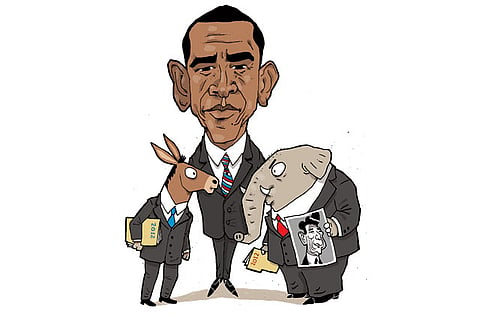
If Barack Obama wins a second term as US president next year we are likely to look back on last week's speech on the US budget as a key moment in his re-election campaign.
The speech was vintage Obama: eloquent and literate. Partisan enough to please the Democratic faithful, but built around a call for compromise and moderation calculated to appeal to centrist voters. Obama made the case that Democrats and Republicans see the country and its future in starkly different terms, but also invited Republicans to meet him half way.
In response, GOP leaders rejected out-of-hand the president's offer of cross-party talks to find a path out of the country's financial mess, insisting that the only possible ‘compromise' involves Democrats agreeing to the Republicans' budget plan in its entirety.
This, I suspect, was almost exactly the reaction Obama was hoping for. Because what really separates Obama from the Republicans is not their ideas over the scope of government, the size of the military or what level of budget deficit is acceptable. It is what each side believes Americans want from their political leaders.
Obama, like most Democrats, believes that government can be an institution for good and believes that voters want to see government work. The modern Republican Party, in contrast, is built around Ronald Reagan's famous dictum: "Government is not the solution to our problem. Government is the problem." Republicans tend to believe in shrinking the government whenever and wherever possible.
More subtle is each party's attitude toward political compromise. Because Democrats believe that voters want to see government accomplish things they tend to accept that a certain amount of compromise is a necessary part of making things happen. Because Republicans believe that less government is almost always better government they have become increasingly opposed to compromising with their opponents on the theory that this merely enables government to do things it probably shouldn't be doing to begin with.
Going into next year's election, Obama is banking on the idea that voters will reward a president who is trying to get things done. His Republican opponent will represent a party whose core voters increasingly believe that standing on principle is the most important thing a politician can do, even if that means bringing everything in Washington to a screeching halt.
Republicans are probably correct that many Americans' gut instinct is to wish for less government involvement in their day-to-day lives. Democrats are on equally solid ground when they counter that people may grumble about government, but value the services it actually provides such as policing food and prescription drug safety, building and maintaining roads and, most importantly, ensuring that a social safety net exists to protect the poor, the sick and the elderly. Indeed, this is where Obama clearly believes he is positioning himself to win reelection.
Pension and health care
Virtually everyone agrees that America's current system of retirement pensions and medical care for the old and the poor is financially unsustainable. The obvious solution to this problem lies in some combination of benefit cuts and tax rises. A generation of Republicans, however, has been unwilling even to discuss tax hikes. Instead, the current GOP budget plan proposes solving these problems by having the government stop paying medical bills. It would, instead, provide older Americans with assistance in purchasing private health insurance and give each state a fixed sum of money with which to take care of the poor as it saw fit.
Obama is banking his political future on the belief that Americans' anger at government is outweighed by their desire to see popular programmes continue, even if that involves a bit of sacrifice by liberals and conservatives alike.
At a more fundamental level, however, Obama is taking a page out of Reagan's political playbook: believing that his innate optimism will stand in marked contrast to a Republican party that has increasingly become captive to its own gloomy rhetoric.
This is not a good thing for the GOP. What Republicans understood under Reagan, but seem to have forgotten today, is that in dark times Americans look to their president for signs of hope. Pessimists often win seats in Congress, but they never make it to the White House.
One of the current cliches among American political pundits is the belief that Obama's reelection is now all-but-reassured. The economy is improving, albeit slowly. The GOP's potential candidates mostly seem like lightweights when placed alongside the president. And those candidates are increasingly captive to a party base that is almost hysterical in its hatred of Obama — views too extreme for the country at large.
Well, maybe. November 2012 is still a very long way off and predictions, at this stage, mean very little. What is clear, however, is that Obama and the Republicans have both found what they believe will be winning narratives around which they intend to build their campaigns.
Gordon Robison teaches political science at the University of Vermont.


