Unicorn of American politics
Uncertainty of Republican campaign fuels talk of brokered convention, but the GOP is unlikely to risk it
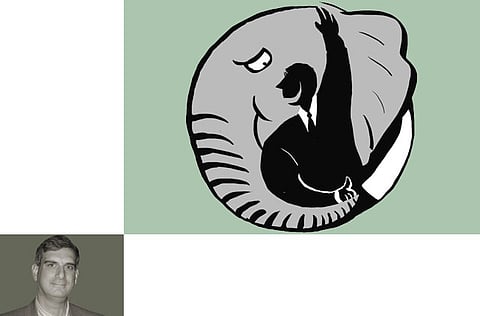
In many recent US presidential campaigns, the clump of primaries and caucuses known as ‘Super Tuesday' have effectively ended the nominating contests. This year that won't be the case.
Mitt Romney, Rick Santorum, Ron Paul and Newt Gingrich are all still going to be running for president when the dust settles. That is why the coming weeks are likely to feature ever-more talk about a ‘brokered convention'.
Brokered conventions are the unicorn of American politics: everyone knows what they look like, but nobody has ever seen one. And while, on balance, a brokered convention remains unlikely when the Republicans gather in Tampa, Florida in August, the uncertainty surrounding this year's GOP campaign makes the appearance of a unicorn more of a possibility than it has been for decades.
First, some background.
American political parties hold four-day conventions (party conferences) during the summer preceding each presidential election. For over a century these were raucous gatherings at which activists from around the nation thrashed out in detail what it actually meant to be a Democrat or a Republican at that particular moment in time.
In recent decades, however, the conventions have evolved into carefully-scripted television extravaganzas designed to introduce the party and its presidential candidate to voters just as the fall campaign begins in earnest.
In decades past, the convention's main job was to pick the party's presidential nominee. Formally, this still happens though, in practice, the nominee is now chosen by voters. Primaries and caucuses during the winter and spring select delegates to the convention, most of whom are pledged to support a particular candidate.
But what if no candidate arrives at the convention with enough delegates to claim the nomination? In that event the delegates themselves debate, bargain and keep voting until someone emerges with a majority.
Importantly, in this scenario the eventual winner does not need to be one of the candidates who was under consideration when the voting began. After the first ballot the delegates are free to vote for pretty much anyone they please.
Numbers game
This is a brokered convention. Once upon a time it was the norm for both parties, but neither the Democrats nor the Republicans have actually had one in half a century. This is partly because of the democratising effect of primaries and caucuses, but mainly because of television.
When TV arrived at the conventions in the 1950s party leaders quickly realized the importance of the national spotlight it offered. The result was the steady removal of genuine politics from the conventions in favour of ever-more-carefully-scripted displays of purpose and party unity.
By the 1980s the conventions had become little more than four-day ads for each party's presidential contender. Anything that made the party look less than completely enthusiastic about the candidate it was meeting to nominate was systematically banished from the agenda.
This made conventions a lot less interesting. It also explains why political journalists yearn for a brokered convention: it would actually be fun to cover.
High stakes
Which is exactly why a brokered convention remains extremely unlikely. Simply put, the stakes are too high. Party leaders may not be the all-powerful bosses they once were, but they are not without influence. They will do nearly anything to ensure that the party's moment in the national spotlight does not turn into an ugly, divisive, nationally-televised mess 10 weeks prior to Election Day.
Thus, no unicorn is likely to appear in Tampa. The problem facing Republicans is that even if things unfold according to a ‘normal' convention script this still promises a gathering fraught with political danger.
The modern traditions of American political conventions require that defeated primary candidates and their supporters be given some time in the spotlight. In theory this is part of the unity and party-building process, but it has been known to backfire.
If Romney is the nominee, his defeated opponents will demand, as the price of their loyalty, an opportunity to use the party's biggest stage for the sort of right-wing posturing that has been commonplace throughout the primary campaign. If Santorum or (not that this is likely to happen) Gingrich comes out on top, the far right can be expected to use the convention to revel in its takeover of the GOP.
Neither of those possibilities will improve the party's chances against Obama in November.
Many ordinary Republicans clearly believe that America's political centre of gravity has shifted so far to the right that extremism will be a winning formula this fall. The question facing party leaders is going to be to what extent they also believe this.
Ironically, after decades of doing everything they can to ensure that a brokered convention never takes place, the political professionals who nominally run the GOP may soon find themselves in a situation where even following the ‘usual' script will be a recipe for disaster.
The unicorn or the troll. It isn't much of a choice.
Gordon Robison, a longtime Middle East journalist and US political analyst, teaches political science at the University of Vermont.


