The widening rift between Obama and the military
America's real problem in Afghanistan is not a loose-tongued general but the resilience of the Taliban and its allies
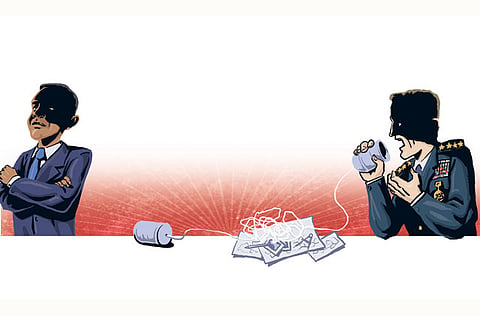
The latest edition of the US magazine Rolling Stone carries an extremely candid profile of General Stanley McChrystal, who was the commander of all US and Nato forces in Afghanistan when it was written.
For a serving military commander to allow the press such close and personal access is unusual in itself. Even more unusual, and significant, were McChrystal's overtly disrespectful pronouncements on his commander-in-chief, President Barack Obama (and his administration) highlighting a widening rift between the US military establishment and the White House.
One of McChrystal's aides told Rolling Stone that the General had been ‘pretty disappointed' when he met Obama for the first time. He told colleagues that Obama seemed ‘intimidated' by the room full of ‘military brass' and that he ‘didn't seem very engaged'.
In the course of a series of jokes about Vice-President Joe Biden, McChrystal pretended not to know who he was, and one of his aides described National Security Adviser, James Jones, as a ‘clown'.
Retaliation was swift. McChrystal was personally sacked by Obama before the magazine even hit the news stands and has been replaced by General David Petraeus who masterminded the counterinsurgency (Coin) strategy in Iraq.
McChrystal first incurred the ire of the White House as he assumed command in Afghanistan in June 2009, making a ‘bullying' speech demanding that President Obama immediately deploy 40,000 extra troops or face ‘mission failure'. Bowing to McChrystal's (and the Military establishment's in general) insistence that an Iraq-style Coin offensive was the only way to go, Obama obliged with an additional 30,000 soldiers.
The appointment of General Petraeus may refocus America's efforts and place more emphasis on the second stage of the Coin strategy — an ‘Awakening'-style project, which has been ongoing for some time, whereby influential war-lords are recruited to the ‘counterinsurgency' camp.
The majority of Afghan tribesmen are Pashtun, like the Taliban, with a deeply entrenched code of honour (Pashtunwali). Even where tribal leaders succumb to the abundant financial incentives on offer, the outcome is counter-productive, amplifying already rife corruption and undermining the credibility of President Hamid Karzai's government.
The real problem for the Obama administration is not who commands the troops in Afghanistan, nor that US military strategy is mired in confusion and chaos, it is simply that the war is unwinnable. This month (June) has been the bloodiest of the conflict so far; more than 1,000 US soldiers have been killed in action and the conflict now outstrips Vietnam as the longest lasting in US history. Western economies are still teetering at the brink of the abyss and yet the Obama administration secured an unprecedented $708 billion (Dh2.60 trillion) defence budget for 2011. The long-suffering Afghan people are scarcely ever mentioned in commentaries and debates, but General McChrystal reminded Rolling Stone that the USSR killed more than a million Afghans and still failed to win their war with that fierce and resilient nation.
New alliances
Meanwhile the Taliban expand their influence and control, becoming increasingly difficult to target since they are entrenched within a largely sympathetic population, and greatly emboldened by deadly new alliances with Al Qaida and the Pakistani Taliban. The Improvised Explosive Devices (IEDs) and suicide bombers which are responsible for the majority of western troop deaths are the legacy of the war in Iraq and were delivered to the Afghan theatre by Al Qaida and ex-members of Saddam Hussain's Republican Guard.
The US is increasingly isolated in its war in Afghanistan. Obama's election pledge to withdraw troops from Afghanistan by July 2011 is mentioned less these days. Polish leaders, however, are demanding that Nato produce a ‘quick plan' for a full withdrawal; Canada and Holland have already announced their intention to pull out their troops and in May German President Horst Koehler was forced to resign over comments in support of the war which 85 per cent of his country oppose. If the US persists, it may threaten the integrity and cohesion of Nato itself.
Another growing cause of division between the military and civil establishments in America is Israel. Whilst the pro-Israeli lobby exerts enormous influence in the Capitol, in April this year General Petraeus, then commander of US security interests in the Middle East, briefed the Pentagon that Israel had become a liability rather than an asset in the region. Antipathy towards the rogue state was putting American soldiers' lives at risk — an observation that must have become even more pertinent in the wake of the Gaza flotilla massacre.
No US president had sacked a serving commander for 50 years when Obama relieved two of their command in the space of 14 months. McChrystal replaced General David McKiernan who was fired in March 2009. President Obama should perhaps concede that his real problem in Afghanistan is not a loose-tongued general but the resilience of the Taliban and their allies. Ultimately talks with the Taliban will have to include their role in a future government if they are to succeed; the insurgents have shown little appetite for the kind of dialogue President Karzai has attempted to engage them in.
The widening rift between the White House and the military establishment only serves to weaken their campaign in Afghanistan and brings the prospect of defeat ever closer.
Abdel Bari Atwan is editor of the pan-Arab newspaper Al Quds Al Arabi.


