Shadows of Afghan conflict in Syria
Unrestrained hate speech and incitement for murder between Sunnis and Shiites
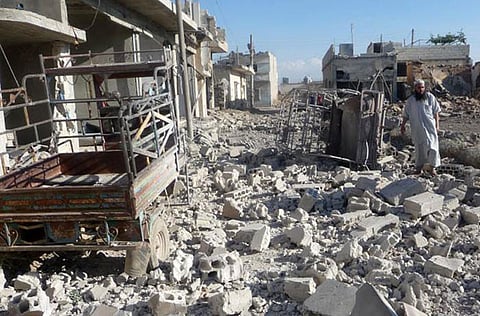
During the Russian invasion of Afghanistan in the 1980s, the fighting between Afghan Mujahideen and the Russian troops witnessed its turning point when the US supplied the Mujahideen with short-range anti-aircraft missiles. After a long time of Russian air superiority, the Stinger missiles paralysed Russian war helicopters and jet fighters and the Mujahideen gained a tactical advantage in the battlefield. Can we expect the same scenario in Syria now after the US decision to arm Syrian opposition fighters?
It is not only the armament of Syrian opposition that reminds us of Afghanistan, but the prevailing atmosphere in the area after Syrian government forces captured the town of Al Qusayr with the help of Hezbollah fighters from the hands of opposition fighters.
Soon after the battle of Al Qusayr, the calls by Sunni clerics for jihad in Syria resound vociferously all over the Arab world and the bells ring loud enough to remind us of the calls for jihad in Afghanistan in the early 1980s.
Furthermore, reports of military build-up in Syria are increasing. According to the Independent (June 16), Iran decided to send 4,000 fighters from the Revolutionary Guards to Syria, adding that around 3,000 American military experts were in Jordan in what seemed to be a prelude to establishing a no-fly zone south of Syria. Reports also said that Britain was planning to send 350 Royal Navy personnel to Jordan. And in Egypt, the ruling Muslim Brotherhood joined these moves by declaring, through President Mohammad Mursi, the suspension of diplomatic ties with Syria. Meanwhile, rumours are spreading on social networks about tens of thousands of volunteers from various Arab countries ready to go to Syria for jihad.
Weeks before these moves, and only to justify their involvement alongside the Syrian regime, Shiite leaders in Lebanon and Iraq told fellow Shiites that they were forming a brigade to defend the Shiite shrines in Syria from the Wahhabis. Apparently, the town of Al Qusayr has no Shiite shrines, but sectarian excitability is badly needed on both sides to inflame this war. It is becoming a pure sectarian war and nobody in the modern Arab history has ever witnessed this amount of unrestrained hate speech and incitement for murder between Sunnis and Shiites.
So, amid this rising tension, is an arms game being played out to maintain the balance of power before heading to the ‘Geneva 2’ conference, due within a few weeks? Some will say maybe, but for many it sounds like wishful thinking. Obviously, the battle of Al Qusayr was an effort to gain a strategic point for the regime and its allies, but for the US and its western and Arab allies and the Sunni world, it was an escalation and maybe marked the crossing of a “red line”.
There is no doubt that the worst in this war is gradually unfolding. And while governments deeply involved in this conflict have a margin of manoeuvre, diplomacy and secret channels of communication with the ability to force compromises, then fears of the breakout of a full-scale regional war come from somewhere else — perhaps from unexpected quarters.
Compromise or a deal can be reached only through the G8 summit as Barack Obama’s administration is still hesitant about greater involvement in the complicated sectarian conflict. However, this is just a possibility. On the other hand, is the issue of an Iranian gesture. For the Iranians, maybe this is the right time to seek a break after eight years of unceasing confrontation with the West and its Arab neighbours. The newly-elected Iranian President, Hassan Rouhani, tagged as a “moderate”, has sent some signals showing a willingness to ease the tension between his country and its opponents. The heavy burden of sanctions being a good reason for this apparent change in stance. A shift in Iranian policy may be aimed at containing a potential dash from Syrian opposition and its allies in the Arab world to compensate for the recent military losses. However, as long as the sectarian war has its own dictionary, compensation in this conflict has no meaning beyond retaliation.
At this point, we also have the other players who are out in the open — the jihadists: Whether the young, Sunni, Lebanese jihadists steadily growing in number in the north or those who are already in the field in Syria or those who are heading towards the besieged nation. That way, Syria is fast becoming another Afghanistan for the Sunni fighters and the last frontier for Shiite fighters — so long as the Syrian regime is merely fighting for its survival.
The situation in Syria resembles the situation in Afghanistan during the resistance against Russian occupation, with hundreds of fighting battalions in the field. Syrian opposition fighters are reminiscent of the Afghan Mujahideen in the 1980s in terms of their fragmented state. However, while the Afghan Mujahideen were very independent, the Syrian opposition (as well as the Shiite fighters) are victims in a game in which a peaceful civilian uprising has been hijacked by sectarianism and regional interests and turned into a dirty sectarian war.
Mohammad Fadhel is a Bahraini writer and media consultant based in Dubai.


