Region's promise is worth holding onto
As the year begins, there are myriad challenges but also potential for growth and wide-ranging reforms
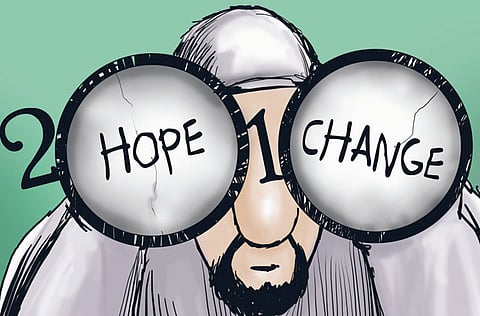
What does 2010 have in store for the region? A lot, one can safely say. Since there is no shortage of predictions, whether by fashionable psychics, inspired foretellers or dedicated analysts, I have decided to jump into the fray and compile my own list of forecasts.
It is a foregone conclusion that we will continue to witness political and military upheavals in Iraq, Afghanistan, Sudan, Yemen and Palestine. Iraq will have its general elections in March, but once again the stability of the country will be trounced by sectarian frictions, ethnic quarrels, separatist ambitions, terrorist violence and foreign interventions. Iraq's future has become such an issue for Iraqis, the US — which still occupies the country and dictates its political and economic future — and its neighbours, that it is unlikely to find peace any time soon.
Biggest threat
But it is Afghanistan that today poses the biggest security threat to America's standing in the world. Barack Obama's military surge will only exacerbate the military quandary faced by Nato forces. Nine years on and the war on terror is yet to be won in a primitive and awkward country. The Taliban and their allies will carry out military operations throughout 2010 that might succeed in denting the solidarity of the international coalition and maybe causing its collapse. The biggest loss will not be Afghanistan, though, but Pakistan, a country already in tatters, facing mounting local and regional threats. It's the double whammy that could end up defining the Obama presidency. Pakistan's downfall will almost certainly accelerate the drive towards chaos and mayhem in West Asia, with reverberations being felt in India, China, Iran and the Arabian Gulf.
Iran will definitely occupy centre stage in regional and international politics in 2010. The West is yet to decide on ways to coerce Tehran into yielding to conditions imposed on its controversial nuclear programme. But the fact that Iranian reformists are taking to the streets in a bold challenge of clerical authority is a new element in the confrontation that will affect Western attitudes. Iran's internal problems will not go away and the opposition's latest waves of defiance will have repercussions for the future of the Islamic Republic.
As the Iranian regime decides on whether to suppress or contain reformists, it will probably commit blunders before realising that it cannot win through sheer force. Iran's leaders face a fork in the road. Will they fan the ambers of another revolution by unleashing the militias, or seek dialogue and compromise? What they decide will determine the fate of one of the biggest and most influential regional powers.
Yemen's troubles will be a major threat to the stability of Arabia and the region. The war against the Al Houthis will not be decided on the battlefield. Many analysts have already added Yemen to the list of failed states. A dysfunctional central government in Sana'a is battling a civil rebellion in the north and the threat of separation in the south. Added to this is the fact that Yemen is again a thriving base for Al Qaida.
Yemen could be described as the Afghanistan of Arabia. It is a complex country, with distinct tribal characteristics and difficult mountainous terrain. Like Afghanistan it is a country that has thwarted foreign control and subdued empires. Unless the Arab world, and in particular Gulf states, take the crisis in this country seriously, the ramifications of Yemen disintegrating into fiefdoms will be calamitous. This could very well be the year that sees the Yemen problem festering into a major regional disease.
Penultimate fight
Palestine's woes will come again to haunt both Arabs and Israelis. But it is the entire world that will end up paying the price of allowing this conflict to go on for so long. The derailing of the peace process along with the increase in the pace of Jewish colonisation will almost certainly spark a third intifada. But unlike the two previous ones, this rebellion will represent a penultimate fight by the Palestinians to stay alive. With no hope in sight, the coming revolt will underline Palestinian hopelessness and despair. It will also usher in the demise of the Palestinian National Authority and the rise of militancy across the Occupied Territories, and beyond.
But aside from regional conflicts and confrontations, the Arab world must still face up to chronic problems: rising unemployment, poverty, failed development projects and economic woes. The economic crisis has not gone away, although it may have eased. The road to recovery will not be easy and 2010 will probably generate more problems for Arab governments.
On the other hand, 2010 can still be a year of change and renewed hope. The Arab world remains one of the globe's most rich and promising regions. With a very young population, there is genuine potential for growth and wide-ranging reforms. Nowhere else in the world is there such vibrant and lively debate. The future holds a promise, a feeble one, but for millions of Arabs, and others in this region, it is a promise worth holding onto.
Osama Al Sharif is a veteran journalist and political commentator based in Jordan.


