Purple is the new colour of freedom
We are witnessing a growing cold war between the GCC states and Iran
The Arab world continues to adjust to the new realities of the outcome of the Arab Spring which has heralded major and unprecedented changes in the socio-political Arab landscape and introduced new dynamics of paradigm shifts by toppling authoritarian regimes, and unleashing peoples’ power. The showcase of such transformational power is manifested in the tectonic shift by the historical victory of Mohammad Mursi the head of Egypt’s Muslim Brotherhood Freedom and Justice Party, a banned and harassed party under Mubarak, who could only watch on speechless as his nemesis sat in his old palace while he lay on his death bed.
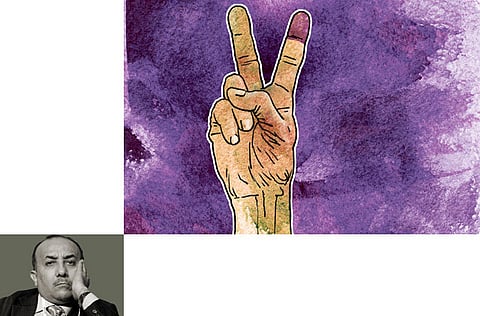
The purple fingers are popping up all over the place, one Libyan was quoted as saying as he waved his finger proudly after voting for the first time in his life, “this is the colour of freedom.”
We saw those purple fingers in Tunisia, Libya, and Egypt and in other corners in the Arab world. Such scenes will be forever etched in the minds and hearts of the new generation who are more mobile, more active and intrepid than their parents and grandparents were; such spirit and boldness won’t be crushed.
These historical changes and new trends and dynamism are at play in the new Arab world. They are worth watching and worth understanding to forecast where the region is heading.
The end of one party rule, the end of the indispensable ruler, the end of the Pharaoh-like figures and tyrannical rulers in Egypt, Tunisia, Libya, Yemen and hopefully soon in Syria and in other quarters of the Arab land are welcomed developments.
The landslide victories of Islamists at the polls shows the new rising and formidable socio-political power is changing the face of the Arab polity and moving it more towards the right with a more conservative face.
From Morocco to the Gulf, we saw how Islamists triumphed in Morocco, Tunisia, and the huge victory by Islamists in Egypt, and as I write this column elections are being held in Libya for the first time in decades. It seems Libya won’t eschew that trend as the Transitional Council approved few days ago a proposal making “Islamic Sharia the only source of legislation.”
How does this bode with the relations between the intra-forces within each society and between the more conservative Islamist polities and the regional and international players?
What adds to the intrigue and mystery of these fundamental changes sweeping the Arab world is the uncertainty of the trajectory of these fast moving trends. How will political Islam reconcile itself when in power and ruling, rather than being an opposition party? How will the new ruling elites deal with the formidable and, what seems, insurmountable challenges by emboldened masses with high demands and hopes and fearless ambitions? How will these new elites who, by and large, have no governing experience handle the challenges related to employment, diversification of the economy and other woes associated with transitional periods?
At the strategic level, we see a power vacuum in the Arab world today. The traditional major Arab powers such as Egypt, Iraq and Syria are all marred in their own domestic upheavals and bogged down with a restless populace with high demands and hopes.
In the case of Syria it is undergoing the bloodiest of revolutions pitting a determined public against an outlaw regime that is bent on crushing the rebellion at any cost before bewildered Arab and international worlds that are reduced to pathetic bystanders and false witnesses to mayhem and massacres carried out by a thuggish regime.
Saudi Arabia is the only major regional Arab country that seems to have been able to escape the onslaught of the Arab Spring by means of co-optation and adjustment owing to its deep pockets and financial resources to appease its population. Saudi Arabia and its GCC partners have emerged as the de facto leaders of the Arab world under the GCC umbrella, where the Saudis have proposed to move it from its cooperation defunct stage to a more robust and agile stage of a more coherent union to deal and better handle the host of challenges and threats. The GCC states have shown a valiant resilience. Their initiatives and their robust and active role in staving off the winds of the Arab Spring — even being buoyed by their soft power — have helped the Arab Spring people’s see their efforts come to fruition.
If it is true that the forces of the Arab Spring have weakened and pre-occupied the strategic powers of the Arab world powerhouses such as Egypt, Iraq and Syria, on the other hand, for the non-Arab regional powers such as Israel, Turkey and Iran it has been a mixed bag and not a boon. Although, non-Arab states have been emboldened, but at various levels; Israel and Iran are losers in terms of the Arab Spring and are more worried of the its impact on security — particularly in the case of Israel. Iran sees its strategic ally Syria teetering on the brink of collapse or chaos and civil war, and is worried about the crashing of its grandiose plan as a regional hegemon. Turkey though has gained and saw its stocks rising in the region, yet it finds itself dragged into the Syrian mayhem.
In the midst of these changes we are witnessing a growing cold war between the Arab GCC states and Iran, with serious consequences and ramifications. This takes the shape of intervention by Iran in the GCC states’ affairs, bellicose statements, military manoeuvres and saber-rattling warnings threatening to shut down the strategic Straits of Hormuz. Iran is certain to compensate for its losses in Syria and the Levant. I have highlighted the Iranian meddling in GCC states’ affairs in many columns in this space. I argued in a recent column: “Iran has loomed large for decades and has been a force of instability with the capacity for mischief in the region. Sidelining Iraq exacerbated the situation where Iran stepped in to fill the vacuum with its grand project, proxies and ideological-sectarian twist. The cold war between the GCC states and Iran… is impacting the whole region and pushing it towards the abyss.”
These fundamental changes and trends are here to stay and it is advisable for the decision-makers in the Arab world, along with the non-Arab regional players and international players to take stock and heed these changes and trends. So, we all are better equipped and prepared in dealing and handling these trends and understanding where the region is heading and what to expect.
Professor Abdullah Al Shayji is the Chairman of the Political Science Department at Kuwait University. You can follow him on Twitter at www.twitter.com/docshayji


