Nato’s not-so-lofty summit
The war in Afghanistan was lost a long time ago - mostly because the Bush administration invaded Iraq and let the Taliban come back
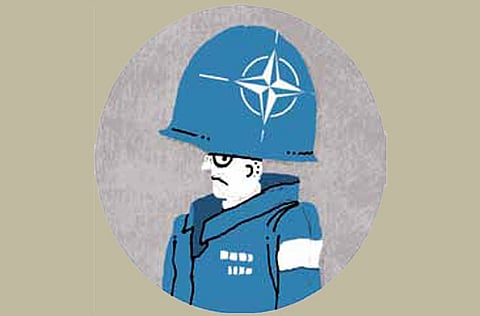
What’s the most useless waste of time, money and fuel that you can think of? A NASCAR race? A Star Trek convention? The Burning Man festival? Well, right up there with these is the recent Nato summit in Chicago. I’ve now read the official statements and White House press releases, and it’s tempting to see the whole thing as a subtle insult to our collective intelligence.
To paraphrase Churchill, never have so many world leaders flown so far to accomplish so little. Along with the usual boilerplate, there were three big items on the summit agenda. First, the assembled leaders announced that Nato will end the war in Afghanistan by the summer of 2013, and gradually turn security over to the Afghans themselves. This decision sounds like a significant milestone, but it’s really just acknowledging a foregone conclusion. Popular support for the war has been plummeting, and the Obama administration has been lowering US objectives for some time. In fact, the war in Afghanistan was lost a long time ago (mostly because the Bush administration invaded Iraq and let the Taliban come back), and US President Barack Obama’s big mistake was failing to recognise this from the start. The 2009 ‘surge’ provided a fig leaf to enable the US and Nato to get out, but the cost has been billions more dollars squandered, more dead Nato soldiers and dead Afghans, and a deteriorating relationship with nuclear-armed Pakistan. It’s nice that Nato acknowledged these realities, but it doesn’t take a summit to figure this out.
Second, Nato has piously declared that its members will enhance their military capabilities by improved intra-alliance cooperation. This step is justified in part by highlighting the alliance’s supposed recent achievements, to wit: “The success of our forces in Libya, Afghanistan, the Balkans and in fighting piracy is a vivid illustration that Nato remains unmatched in its ability to deploy and sustain military power to safeguard the security of our populations and to contribute to international peace and security.”
Nato is “unmatched” because the US maintains a global military presence, but the self-congratulation here seems misplaced. Libya hardly looks like a success story right now, success in Afghanistan has been downgraded not to what US originally wanted but to whatever America thinks it can achieve, and the Balkan operation now appears open-ended.
Capabilities
More importantly, how many times have we seen this movie? Ever since the 1952 Lisbon force goals, Nato’s European members have promised to improve their capabilities and then failed to meet their agreed-upon goals. This pattern has continued for five-plus decades, and it makes you wonder why anyone takes such pledges seriously any more. If EU countries can’t find the money to backstop a proper firewall for the fragile Greek, Italian and Spanish economies, it is hard to believe Nato’s European members are going to make significant new investments in defence. I’m not saying they should, by the way, given that Europe faces no significant conventional military threats.
Last time I checked, the US was spending about 4 per cent of its GDP on defence and the rest of Nato was averaging about 1.7 per cent. Both halves of the trans-Atlantic partnership will be trimming budgets in the years ahead, no matter what they said in Chicago. So I wouldn’t put much stock in item #2. Third, Nato reaffirmed its commitment to the wasteful missile defence scheme. Never mind that the Defence Science Board recently concluded that existing defence technologies are still easily spooked by inexpensive countermeasures.
Please overlook the tens of billions of dollars America spent chasing the Holy Grail of missile defence since the 1980s, without ever getting there. Ignore the poisonous effect this programme has on relations with Russia, which has to assume the worst and take US efforts seriously. The summit did give Obama the opportunity to show off his hometown to his European friends. As a former Chicagoan, I’m glad they had the chance to look around a great American city, and I hope everyone had a good time. But both the attendees and the various groups protesting the summit seem to have missed the most important fact about the gathering: It just wasn’t a very important event.
— Washington Post
Stephen M. Walt writes Foreign Policy’s “A Realist in an Ideological Age.”


