Islamabad did what it could
It appears Pakistan's government responded as efficiently as possible to the Airblue disaster
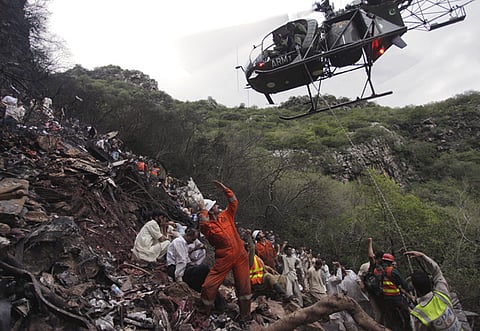
The Airblue crash in Islamabad has brought tragedy to the families of the 152 unfortunate victims and plunged the entire country into mourning. Leaving aside the question of what caused the plane to crash — whether it was the cloudy conditions and heavy rain, some sort of malfunction, inadequate ground support or a proximity alarm failure — the next question on everybody's mind is whether the disaster response was as timely and effective as it should have been.
Natural disasters by their nature are unexpected and despite planning, the response is dependent on the emergency resources available and the location of the crash site.
The magnitude of the October 2005 earthquake disaster galvanised the entire Pakistani nation, leading to the creation of a new disaster-response mechanism.
When the earthquake struck, the National Crisis Management Cell in the Interior Ministry initially took responsibility for coordinating the response, before handing over to the Cabinet Division's Emergency Relief Cell. Both lacked the resources to adequately respond and under Major General Farooq Ahmad Khan, who was already in the Prime Minister's Secretariat, a fully empowered coordinating structure was established — the Federal Relief Commission. This subsequently became the National Disaster Management Authority (NDMA). The Foreign Ministry's Emergency Coordination Cell, set up to interface between generously offered international assistance and relief efforts on the ground, utilised some 25 per cent of the ministry's headquarters' strength for several months into 2006.
However, it became clear that the only organisation with the self-contained ability to carry out relief work in the affected areas and with logistical backup to take in relief supplies, take out the injured and also coordinate national and international relief efforts was the Pakistan Army, assisted by naval and airforce units. Other countries have had the same experience. The Military Operations Directorate was responsible for coordinating and putting resources into the field.
Subsequently, the NDMA set in motion a process of capacity building, setting up provincial sub-offices and preparing a comprehensive manual to coordinate responses to all types of disasters. However, the test of such plans and procedures is judged by how they deliver when disaster strikes.
In the case of the plane crash on Wednesday, the location was close to Islamabad. However, the heavily wooded and steep hills overlooking the city presented unique problems for the relief workers.
The prime minister immediately ordered the mobilisation of all relief efforts, charged the NDMA with coordinating and personally surveyed the site by helicopter. Relief units from the nearby emergency services from the capital and the NDMA swung into action. An Army Aviation helicopter was the first to overfly the site to assess the damage.
On the spot
At such times, the chief of general staff through the Military Operations Directorate and possibly the engineer-in-chief would be expected to take charge.
The chairman of the NDMA called in the Army to lend assistance. More helicopters were sent and a battalion of 800 troops moved in to secure the area and to help the relief effort, along with a naval special services contingent.
In all such tragedies, there is always some speculation and criticism that the relief effort could have been more timely — especially if it could have helped to transport survivors to hospital facilities, even though tragically this was not the case due to the kinetic nature of the crash into a hill side.
One can only go by what one knows. When the plane passed very low over our house, I feared the worst and tried to contact the Air Force Operations Centre — forgetting that I no longer have access to the inter-governmental telephone system as I did before I retired. Nonetheless, I spoke to people in the Prime Minister's Secretariat, the MO Directorate and others in the GHQ to check that Army assistance was on the way.
The army was gearing up to send in relief assets and personnel. The lesson drawn from one's knowledge is that the top civilian officials should always keep at their side a list of the key military policy makers to be able to call them in immediately. Conversely, the military should have no hesitation in offering assistance, as one hopes was the case in this instance.
Disasters of any type severely test a nation's capability to respond. On balance, it appears that what could be done was done. This has been generally recognised by the extensive national and international media coverage. However, both civilian and military policy-makers, including the Civil Aviation Authority, should examine this tragic incident in order to refine the system for improvement in the future. This is the least that is owed to the unfortunate victims and their grieving families.
Former ambassador Tariq Osman Hyder headed the Ministry of Foreign Affairs Emergency Coordination Cell in the national response to the 2005 earthquake disaster.


