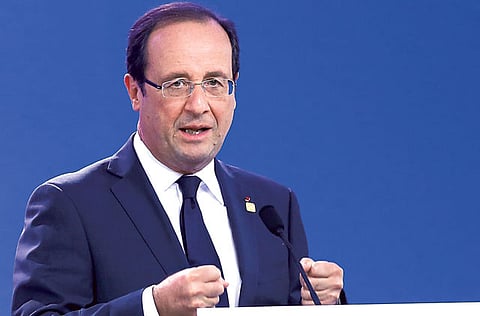
Hollande makes a point
The French president’s decision to intervene in Mali has shown that states remain the ultimate decision-making entities
Globalisation is a process which, in one way or another, affects daily the economies of every country in the world. The progressive dismantling of all kinds of barriers (tariffs, protective local regulations, immigration flows, etc) favours economic growth and supposedly brings in better living conditions, especially to the less fortunate ones. Easier communications is another advantage that would lead people to understand each other better and thereby diminish the risk of wars.
As often happens with widespread beliefs, the dark side is underestimated. Unless there is a financial crash and the states are urgently called upon for rescue, as happened in 2008-09, a widely accepted belief is that concept of the nation-state is gone. Long live the markets! The disappearance of local industries, especially in Europe, or increasing inequalities between the rich and poor, especially in emerging countries, are just considered as side effects which will be settled sooner or later, once “structural reforms are made in order to increase competitiveness”, to quote the prevailing official rhetoric. Will that take place at the expense of the population? Probably yes, but few world leaders worry. Markets take care of everything, as Big Brother used to do in George Orwell’s novel.
It partly explains why the international community cannot but be shocked when an unexpected event, such as a military intervention, is launched unilaterally by a state such as France. International relations, indeed, commonly move along well-defined avenues and for the recent past, have been marked by what have become recurring events — North Korea bargaining with nuclear tests; continued savage occupation of Palestine and development of illegal colonies by Israel; Israeli Prime Minister Benjamin Netanyahu’s renewed lucubration about Iran; selfish regional games in Syria, at the expenses of the population, etc. The eruption of a political act undertaken by a head of state seems rather incongruous and the decision by French President Francois Hollande, in that respect, is rather unusual.
After the US Representative at the United Nations had lambasted, for some months, the French plans in the Sahel, what has recently happened shows that the comment was probably exaggerated. France decided to move into Mali because its interests in Africa and at home itself were directly threatened by the activities of a mix of smugglers and jihadists who had teamed-up with, notably, the material support of would-be rogue states. Reaction was swift and successful, though the war remains to be won. The most difficult phase probably lies ahead of us. The good thing is that France woke up and was listening to the liberated populations of Timbuktu or Gao. Hollande took a unilateral decision to intervene — before being supported by the UK government; before the $50 million (Dh183.9 million) aid package from the Obama administration; and of course before the cheering words from German Chancellor Angela Merkel. For the first time in his tenure, Hollande conveyed the impression that he was proactive.
Not surprisingly, this move benefits Hollande much more than the consequences of some ill-conceived economic and fiscal decisions or hazardous societal reforms. The French indeed have many things on their minds these days. Rising unemployment and weak growth and difficulties in the industrial sector are issues that are miles away from Mali. Another worrying factor was rightly pointed out by the Financial Times in a recent front-page article: While so many states are struggling with the crisis, a million French people are demonstrating on the streets against a controversial law raising a societal issue, ultimately putting at stake the natural right of children to know about their parents. It obviously goes far beyond French concerns, even though a politically-correct thinking environment has regularly avoided what it considers as a taboo topic.
One could have even thought that the sudden decision by Benedict XVI to pass his duties on to a successor who is physically fitter could have paved the way for people to stop and reflect — are all opinions equal and valid? In our present world, there is no time for reflection. The prevailing motto today is ‘move forward — faster and faster’, even though one does not know where one is going. This why Hollande’s decision on Mali and the urgency to stop the risk of seeing unscrupulous elements spread over half a continent is an ambivalent one: Mali is not a top priority for the French. Going through the local newspapers in France, nobody will believe that the country is at war. On the other hand, the move is appreciated by a population that sees it as a sign of hope because they realise that they have not been abandoned in time of need. Hollande’s decision has signalled that states remain the ultimate decision-taking entities, although the general feeling is that so often, in a market-driven economy, a decision-maker cannot be identified. This is certainly for Hollande a much greater point for respect than his inappropriate jokes about the departure of the Pope or his hazardous and untimely societal initiatives.
Luc Debieuvre is a French essayist and a lecturer at IRIS (Institut de Relations Internationales et Strategiques) and the FACO Law University of Paris.


