Gordon Brown: World fails most vulnerable children
Equal rights must accompany resources devoted to reducing inequalities
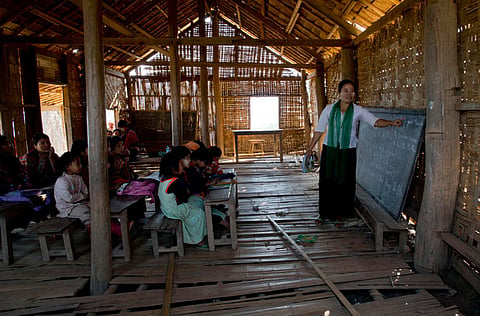
The world’s newest and youngest liberation movement will make its presence felt at a summit in Washington this week. The Common Forum for Kalmal Hari Freedom, the Nilphamari Child Marriage Free Zone, the Ugandan Child Protection Club, the Upper Manya Krobo Rights of the Child Club and Indonesia’s Grobogan Child Empowerment Group may not yet be household names outside their own countries, but schoolgirls demanding an end to child labour, child marriage and child trafficking — and inspired by the sacrifice of Malala Yousufzai, the Pakistani girl shot for wanting to go to school — are borrowing the tactics of the US civil rights movement.
Once cowed and silent, these young civil rights leaders in the making have become defiant and assertive, and they are linking up across the world to demand justice for the 32 million girls and 29 million boys still denied places at school. A petition signed by 1 million out-of-school Pakistani children demanding their right to education is to be presented today to UN Secretary General Ban Ki-moon and Pakistani President Asif Ali Zardari. The same day, a coalition that includes the Global March Against Child Labour, Walk Free, Girls Not Brides and members of Plan International’s “Because I am a Girl” campaign will lay out their plans to end child slavery by 2015. They intend to petition all governments over the next year and will be led by Kailash Satyarthi, the head of India’s Bachpan Bachao Andolan (“Save the Childhood”) movement, who last month persuaded parliament to pass India’s first laws against child trafficking. In a sign that young campaigners will become as significant as the young bloggers of the Arab Spring, they plan to reassemble July 12 in New York, where, on her 16th birthday, Malala will make her first public speech since her lifesaving treatment.
Every year, 10 million girls marry between the ages of 11 and 13. Fifteen million children are condemned to working full time in mines and sweatshops, on farms and as domestic labour. No scientific discovery or technological breakthrough is needed to build the four million classrooms and employ the two million teachers necessary to achieve universal education - just cash. But global education spending — only $3 billion (Dh11 billion) a year at its peak — has been frozen for three years and is being cut.
With progress stalled, young civil rights leaders who represent the world’s most marginalised children are questioning core assumptions that were the basis of our decade-long crusade against poverty. They are asking why the very people the Millennium Development Goals were designed to help most have become those most likely to be left behind. With fewer than 1,000 days left until the goals’ deadline, Adam Wagstaff of the World Bank has shown that, despite commitments to reduce infant and maternal mortality among the poorest, death rates for poor infants and their mothers are falling far slower than among the rest of the population. Even when we have the power to target donor resources directly to the most marginalised — with immunisation and antenatal care, for example — the top 60 per cent are making more progress than the bottom 40 per cent. Similarly, progress toward the Millennium Development Goal of universal education by 2015 has stopped because of a failure to reach the marginalised, including child labourers and child brides. While the public justification for all our efforts is to offer the most help to the poorest and most vulnerable, setting a universal goal without targeting the most disadvantaged is a recipe for them to be left behind. And when the next set of Millennium Development Goals — with more ambitious universal targets for learning outputs and secondary education — raise the ceiling before we have put the floor in place, then they will continue to lose out.
This weakness in the Millennium Development Goal process was foreseen by the authors of Bangladesh’s latest five-year education plan. Children in the country’s flood zone and hill areas and among all ethnic minorities, they discovered, had missed out on the country’s general progress. So they decided to target payments for education and social protections for the poor on the most marginalised, but they also set an explicit “equity goal,” resolving to close the gap in school attendance between the richest and poorest and to close the learning gap between the best and poorest-performing areas. They understood that providing a malnourished child of illiterate parents the same level of per capita support as children from the richest homes is a prescription for inequality and that if children with very unequal starting points were to enjoy “equivalent freedoms,” more resources had to go to those most in need. Unless a foundation of equal rights is accompanied by resources devoted to reducing inequalities, millions of marginalised will still be left behind.
Progressive universalism demands that governments and the international community deliver the resources needed to convert the right to equal treatment in health and education into real opportunity. Wagstaff and Kevin Watkins of the Overseas Development Institute have put forth a worthy proposal for binding targets not just for the whole population but also for greater progress to be made by the poorest deciles. For education, this would mean commitments to reduce, by 2020 and 2025, the gaps in school attendance and school completion rates between the lowest and highest deciles and between the worst and best-performing areas.
Change happened in 1960s America only after public anger escalated against the sheer scale of injustice and only when people were prepared to consider dramatic new remedies. World leaders have to consider as radical a programme of reform and incentives to meet the noble aims of 2013’s newest civil rights struggle. Certain that right is on their side, the world’s most marginalised young people will remain silent no more.
— Washington Post


