Does Qusayr really matter?
The fall of Qusayr to the Syrian army is unlikely to affect the situation in Syria's north and south
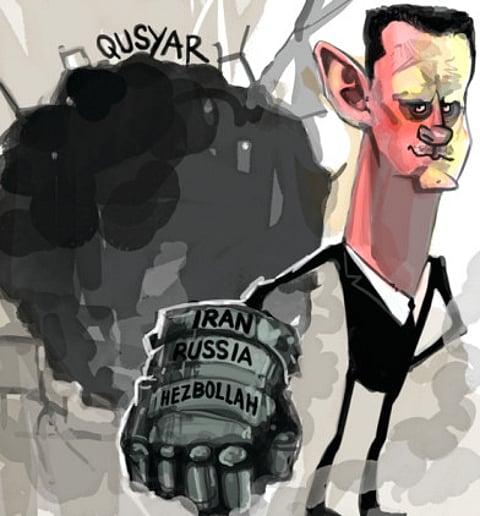
As Syrian tanks rolled into the border town of Qusayr last Wednesday, backed by regular army troops and Hezbollah elite fighters, US, Russian and UN diplomats meeting in Geneva were unable to resolve issues related to holding a proposed peace conference on Syria in June. The fall of Qusayr marked a qualitative shift in the course of the Syrian civil war, which has been raging on for more than two years. It was the first major breakthrough for regime forces on the ground in many months. They have been battling armed rebels in most parts of the country with mixed results. Some reports said that President Bashar Assad’s troops were in control of no more than 40 per cent of the country.
As diplomats tried to sort out problems in Geneva, it became clear that the fate of the proposed conference will depend largely on the outcome of military confrontations taking place on the ground. The battle for Qusayr and its surrounding villages, which have been in rebel hands for more than a year, is supposed to mark a change in the course of the Syrian civil war. The regime celebrated its success and the rebels, who admitted defeat, said the war was not over. But does Qusayr really matter?
The strategic town on the Syrian-Lebanese border is not far from the besieged city of Homs, on the Damascus-Aleppo highway. Its fall will open the road for additional Hezbollah fighters to cross the borders and help regular army troops retake the city of Homs. It also opens the way to the coastal towns of Latakia, Tartus and Banyas, strongholds for the Alawite sect to which President Al Assad belongs.
But its fall is unlikely to affect the situation in the north or the south. The Free Syrian Army (FSA), a loose military umbrella for tens of brigades and groups, can still rely on Turkey to supply it with much-needed weapons and munitions. The FSA and other militias remain strong in most northern areas including Idlib, a key supply route to Aleppo where neither the rebels nor the regular army has managed to make a decisive victory.
The regime has bolstered its position in and around the capital and it now appears that the rebels are under pressure to retreat from positions they gained in the Damascus countryside.
In addition to the Hezbollah factor, the regime has been able to convince Iraq to tighten control of its borders with Syria. Most foreign fighters, such as those belonging to Jabhat Al Nusra, have crossed into Syria from western Iraq. Most importantly, the regime has proved that it still has the support of Syria’s minorities such as Alawites, Kurds and Christians, who are afraid of a takeover of Syria by radical Sunni Salafists.
In addition to this the political opposition in the form of the National Syrian Coalition (NSC) has shown deep signs of divisions and internal competition. The influence of foreign countries, such as Saudi Arabia, Qatar and Turkey, on the NSC has eroded its credibility especially inside Syria and among groups affiliated with the FSA and others. The NSC is yet to adopt a unified position on the so-called Geneva 2 peace conference.
Internationally, Europeans and Americans remain divided on the issue of arming the opposition. The EU has lifted its arms embargo and Britain and France appear to be ready to send weapons to the FSA, but Washington is sitting on the fence, with the Obama administration still divided on the issue.
With more than 90,000 casualties and over 4 million refugees inside and outside Syria, it is difficult to see the conflict decided on the ground or resolved in a peace conference. President Al Assad has been clear about his refusal to abdicate or hand over his authority to a transitional government. He still wants to run for president in the 2014 elections. An initial US-Russian agreement to hold a peace conference is now facing problems over who will attend and the preconditions set out by the opposition.
Certainly some of Washington’s close allies, such as Turkey and Qatar, want to see a military conclusion to the conflict to force President Al Assad out. But Al Assad’s diplomatic assets are huge. He still enjoys the support of Russia, China and Iran, among others. He has bolstered his position at home and his regime remains intact despite heavy pressures.
In a political sense Al Assad’s camp looks the more stronger and harmonious in contrast to a looser coalition of the Syrian president’s opponents. The battle for Qusayr will strengthen Al Assad’s cards if the peace conference finally convenes, which looks highly unlikely for now.
In reality the Syrian popular uprising is over. The war for Syria has become a war on Syria. With Hezbollah and Iran now fighting along the regime’s forces, one has to take into account the role of Israel and the possibility of a regional spillover that could involve Lebanon and Jordan.
The outlook for Syria is grim. The partition scenario is real and Al Assad’s refusal to compromise, coupled with the opposition’s inability to unite, will further complicate the conflict. Diplomatic efforts will continue but they are likely to fail in ending the civil war, which is slowly turning into a proxy war. Will Al Assad survive? He could remain in power even over a smaller part of Syria. Meanwhile, the Syrian debacle will have dire effects on the entire region.
Osama Al Sharif is a journalist and political commentator based in Amman.


