Are new provinces poll gimmick?
Bid to restructure Pakistan, without tackling people's fundamental issues, will not work
As Pakistan's ruling elite braces for the country's next parliamentary elections, their penchant for debating futile issues is unending.
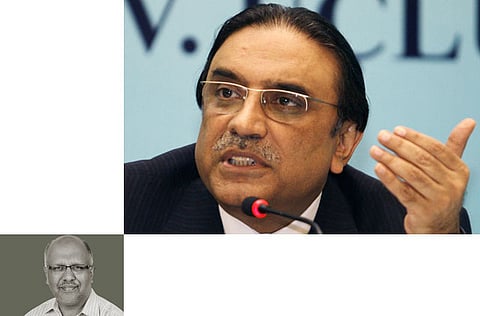
One such matter is that of carving out new provinces across the country. For President Asif Ali Zardari, Prime Minister Yousuf Raza Gilani and their ruling Pakistan Peoples Party (PPP), creating a new province in the southern parts of Punjab will be a definite vote earner.
In the past week, though, the opposition Pakistan Muslim League-Nawaz (PML-N) of former prime minister Nawaz Sharif also jumped into the fray as it passed a resolution in the provincial legislature of Punjab to create not one but two new provinces. For a country as vast and as populated as Pakistan, there is indeed merit in creating new provinces.
Yet, the debate coming from the PPP and the PML-N appears to be largely an attempt to upstage each other and win votes. Where is the zealous determination to improve lives of ordinary Pakistanis? To that compelling question, there are just no answers at the moment.
Indeed, there is a danger that new provinces will add to the cost of running Pakistan's government as new ruling structures are created. Pakistan's history is also riddled with examples of provincial governments becoming spendthrifts and running huge debts for reasons that have much to do with seeking cheap popularity.
Gimmicks of such kind, and they are indeed gimmicks, may work in the short haul during an election, but the reality on the horizon will quickly dawn upon Pakistanis. Without an aggressive push to reform Pakistan, ventures such as carving out a new province will only be a further exercise in futility.
If the public good was indeed the most pressing issue, Pakistanis must urge their rulers to reform the existing structures of government. Across the country, the most fundamental issues ranging from education to health care and personal security, all suffer from deep neglect. This neglect has only deepened in the past four years as Pakistanis have suffered from ever-growing electricity shortages, a declining quality of health care and public education.
The standard excuse from many in the ruling structure is indeed Pakistan's sorry past. "It's all because of the rulers before our time." This line has become a never ending ‘official argument' in the ongoing debate, and yet, this line alone doesn't make sense. Going forward, Pakistanis will suffer endlessly and perhaps even more than today, for as long as the country is in the hands of the present political structure.
Military rule
The time has now come for Pakistanis to firmly reject gimmicks such as the creation of new provinces and demand fundamental rights. In the months leading up to the elections, they will have plenty of scope to register their protests in ways ranging from boycotting of political gatherings to protesting for their rights on the streets. Opposition political groups outside the ruling structure will also have more opportunities to stage large-scale protests in order to put pressure on the rulers.
At the same time, there are also stakes involved for Pakistan's external partners, notably those who claim to have an interest in the country's stability. In the past decade, Pakistan has lived with the fallout of a systematic dismantling of a carefully built civil service structure, when General Pervez Musharraf, the former president, chose to take the country for a ride in the name of devolution of the government.
In his determination to seek popularity for his military rule, the former general ignored calls for a review of his plan. For Musharraf, the key consideration was only to build popularity for the regime which was established through a coup in 1999. At the time, Musharraf's devolution plan was warmly welcomed by key external players who believed that Pakistan could see a transformation for the better.
Years later, Pakistan's increasing internal disarray and disorder must serve as an eye opener. Any attempt to restructure Pakistan as a country, without tackling the crisis at the centre of the challenge, will simply not work. A government run by leaders whose legacy of corruption has left them devoid of moral authority is just not going to succeed in lifting Pakistan's worsening prospects.
Farhan Bokhari is a Pakistan-based commentator who writes on political and economic matters.


