Annan's April 12 deadline and mindset of Syria regime
In the absence of Plan B, Damascus has written off chances of military strikes by the international community
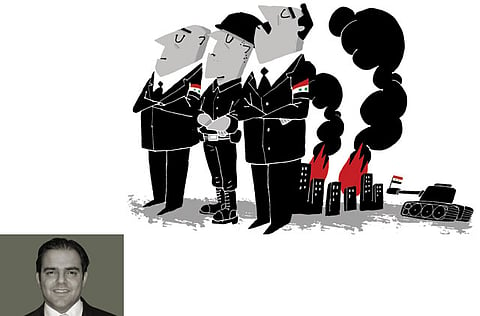
In theory, the Annan plan for Syria has all the right ingredients for success. Countries in all four corners of the globe have endorsed it. The government must withdraw troops and heavy weapons from towns, cities and villages by today and a deadline for its implementation has been set— 6am on April 12. A team of international observers has started to arrive in Damascus, headed by the Norwegian Major General Robert Mood, charged with overseeing the truce. Both the Free Syrian Army (FSA) and the Syrian government have “agreed to respect the ceasefire.” True, all ingredients for success are indeed there, but so are all the ingredients for thundering failure. On Sunday, the Syrian government made a new demand that its opponents provide ‘written guarantees’ to lay down their arms before regime forces begin withdrawing from cities. First, it is crucial to understand the mindset of Syrian officialdom today, in order to predict what will happen after UN-Arab League envoy Kofi Annan’s plan deadline passes. Syrian officials feel victorious. The word ‘victorious’ is actually an understatement. They mistakenly feel that the Syrian regime has overcome the crisis, and is on its way towards a slow, but steady recovery. They also argue that world leaders have amended their rhetoric, from calling on President Bashar Al Assad to step down, into calling on him to stop the violence, and implement the Annan plan, which is de facto recognition, rather than the opposite.
If the Annan plan fails, there is no Plan B, they argue, completely writing off the chances of a military strike, claiming that the Russians will never allow it. One reason for their confidence is the rise of Islamists in Egypt and Libya, which they believe has led many to start re-considering the Arab Spring. Because of the chaotic Egyptian scene in particular, they believe that apart from lip service to Arab rebels, the US has decided to amputate the Arab Spring, bringing it to a halt at the gates of Damascus.
The Americans, they argue, will never do anything serious about Syria and so long as Washington doesn’t lead an international coalition against Syria, then this regime is staying, “at least until 2014” (the date of Syria’s next presidential elections). They feel that the US will not get involved in a new Middle East adventure during election year, and will only focus on Syria after a new president comes to the White House, meaning February 2013 and beyond. Syrian officials believe that so much can happen in the Arab world between now and then, which would eventually drown out the Syrian uprising altogether.
Hotbeds of uprising
The fragmented Syrian opposition is another reason for the big smiles on the faces of Syrian officials. The international community will not pass a UN resolution against Damascus, Syrian officials believe, thanks to the Russian veto. Nato will not be striking Syria because there is no appetite for a new war in Europe. If the Turks decide to impose a buffer zone or no-fly zone, the Syrians argue that this would be a declaration of war, and that they would strike back at Turkey. They point to that when asked why the Turks have not put a single one of their threats into action since mid-March 2011.
Syrian officials, it must be noted, understand the Annan mission in a completely different light from how the international community sees it. They have agreed to withdraw troops from the cities, but does that mean rural districts as well, in villages surrounding places like Homs, Idlib and Damascus? It is these places after all that are hotbeds of the Syrian uprising, and where according to government reports, the largest stockpiles of arms are being stored by the rebels. They made it clear to Annan that they won’t be withdrawing completely until the other party withdraws first, and have asked for written guarantees to this effect too. And the rebels have no intention of laying down their arms, as demanded by the Syrian regime. They have already gone to great lengths in their anti-regime activity, and any truce or retreat would be an open invitation for revenge.
Where would these people go if they lay down their arms? They cannot re-assimilate into Syrian society if the regime stays, or re-join the official army, for example, or the civil service. If they are not punished by law, they will be outcasts for the rest of their lives. As far as they are concerned, they will continue fighting until the curtain falls. Additionally, the armed rebels are not a cohesive group that takes its orders from FSA commander Riad Al Asaad. He doesn’t command all armed groups on the streets, and even if his men abide by Annan’s truce, other rebels will not.
What happens then when the April 12 deadline is written off as history by all stakeholders in the crisis? Syrian officials believe that nothing will happen, thanks to Russia, China, and Iran. The opposition, however, is certain that the international community will take the matter to the UN yet again, issuing a resolution that calls for “protection of civilians.” They feel that the international community actually wants the Annan mission to fail.
The ambiguity in any such upcoming resolution, just as was the case with Libya, will open the doors for international intervention in Syria. The Libya resolution after all did not explicitly call for Nato strikes to oust Colonel Muammar Gaddafi. Advocates of this theory argue that there is no U-turn for the international community with the Syrian government — especially for Saudi Arabia — which is seemingly more serious than any other country at seeing regime change in Syria. They did not go to great lengths against Syrian officialdom, only to announce failure that easily. These countries are willing to go to walk an extra mile on Syria, which does not exclude building an international coalition that is funded by Riyadh, and “led from behind by the Americans.” If the Russians veto such a resolution, these countries are willing to go ahead without a UN mandate, a la Iraq in 2003.
Opposition figures point to the Syrian-Soviet treaty of friendship signed in October 1980, arguing that it does not include a clause for military defence. The Moscow Times recently put it bluntly, saying: “Russia has made it clear that it will not be able to stop other countries from launching a military intervention if they try to do it without UN approval.”
We will only find out which theory is correct — that of a ‘no Plan B’ or that of a military strike — when and if Annan raises a white flag over his Syria mission.
Sami Moubayed is editor-in-chief of Forward Magazine in Damascus, Syria


