South African civil servants strike for higher wages
Unions are demanding 8.6 per cent wages and a 1,000 rand (Dh502.79) housing allowance. The government is offering 7 per cent plus 700 ($96) for housing
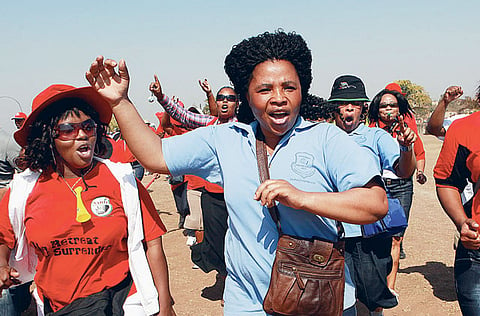
Cape Town: Teachers left their classrooms and trials were postponed after court workers walked out when hundreds of thousands of civil servants went on strike for higher wages across South Africa Wednesday.
The South African Democratic Teachers Union, the biggest in the country's public sector, says all its 240,000 members left class early Wednesday to attend meetings to discuss the strike.
The South African Press Association reported that trials were postponed as court workers joined the strike.
No date for more talks with management was set.
Unions are demanding 8.6 per cent wages and a 1,000 rand (Dh502.79) housing allowance. The government is offering 7 per cent plus 700 ($96) for housing. Public service minister Richard Baloyi says he can't afford more.
Fierce pressure
"We question how a responsible [union] leadership can advocate for an indefinite strike action knowing why the demand cannot be met in this financial year, knowing the impact such action would have on the delivery of services to all the citizens of the republic, knowing the adverse effects it would have to the very members whose interests they represent," Baloyi said.
In his budget speech earlier this year, Finance Minister Pravin Gordhan said that in the wake of the global recession, the government needed to spend money creating new jobs, instead of giving higher wages to those already working. Gordhan said civil servants would have to moderate their wage demands.
Gordhan said 900,000 jobs were lost last year in a country where a quarter of the work force is unemployed.
South Africa's public service strikes are often characterised by violent protests. A strike in 2007 lasted a month.
The strike was announced late Tuesday after four days of consultation in which the state's offer was rejected with backing from unions representing 1.3 million teachers, nurses and government workers.
"The response has been very good especially in the schools," Fikile Majola, general secretary of the National Education Health and Allied Workers Union, said.
"The announcement was made late last night and we expected there would be a slow start. By lunchtime we should see an even better turnout and starting tomorrow, a complete shutdown."
A one-day strike last Tuesday was only partially observed with union leaders warning that a full-blown strike would follow if the government did not deliver.
The state has insisted it cannot meet the unions' demands without trimming public services, amid fierce pressure to improve schools and expand access to water and electricity.
The public services ministry on Tuesday said it remained committed to a solution but that "any further movement would require tradeoffs on service delivery programmes and job creation".
It called on workers to demonstrate peacefully, condemning disruptive protests, and warned that a "no work, no pay" principle applied to those who went on strike.
Workers in essential services like health, police, prisons and ports of entry are expected to report for duty, it added.
The government is looking to avoid a repeat of a crippling four-week strike three years ago which was the longest and most widespread since the end of apartheid in 1994.
The strike led to school closures and hospitals running skeleton services with the help of army medics and civilian volunteers as hundreds of thousands of workers stayed away.


