China astronauts take space closer to youth
60m schoolchildren watch 51-minute class from aboard the Tiangong 1 space station
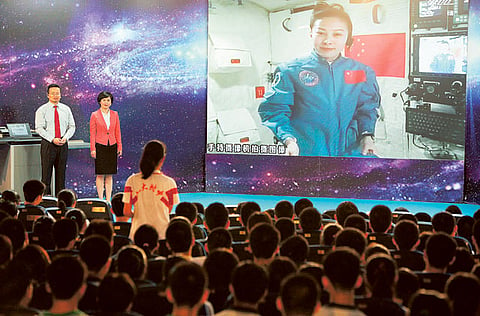
Beijing: Astronauts struck floating martial arts poses, twirled gyroscopes and manipulated wobbling globes of water during a lecture on Thursday from China’s orbiting space station that’s part of efforts to popularise the space programme among young people.
Wang Yaping demonstrated principles of weightlessness and took questions live from among the 330 schoolchildren gathered at a Beijing auditorium during the 51-minute class from aboard the Tiangong 1 space station. Her fellow crew members Nie Haisheng and Zhang Xiaoguang answered questions about living, working and staying fit in space.
“I want to know how you know which way is up,” said one student.
During one playful moment, Nie adopted the mythical cross-legged lotus position familiar to all fans of Chinese martial arts films.
“In space, we’re all kung fu masters,” Wang remarked.
In a later demonstration resembling a magic show, Wang injected droplets into an increasingly larger suspended ball of water, drawing exclamations of “wow” and polite applause from the students, another 60 million of whom were watching the live television broadcast in their classrooms. The astronauts also spun gyroscopes and swung a ball on its tether to show how weightlessness affects objects in motion.
The lesson was “aimed at making space more popular,” Zhou Jianping, designer-in-chief of China’s manned space programme, was quoted as saying by the official Xinhua News Agency. “The spirit of science among youth is an important drive for the progress of mankind,” Zhou said.
China’s second female astronaut, Wang smiled her way through the carefully rehearsed class, which more closely resembled a children’s television science programme than Canadian astronaut Chris Hadfield’s recent free-wheeling YouTube videos from the International Space Station.
The lectures come as China’s human space programme enters its second decade, after going from a simple manned flight to space lab link-ups in a series of methodically timed steps in just 10 years. China launched its first manned mission in 2003, becoming the third nation after Russia and the US to achieve that feat.
The current Shenzhou 10 mission is the second manned trip to the Tiangong 1, launched in 2011 and due to be replaced by the larger, three-module permanent station, Tiangong 2, seven years from now.
The future station will weigh about 60 tonnes, slightly smaller than Nasa’s Skylab of the 1970s and about one-sixth the size of the 16-nation International Space Station. China was barred from participating in the International Space Station, largely on objections from the United States over political differences and the Chinese programme’s close links with the military.


