Sickly India needs universal healthcare by 2020
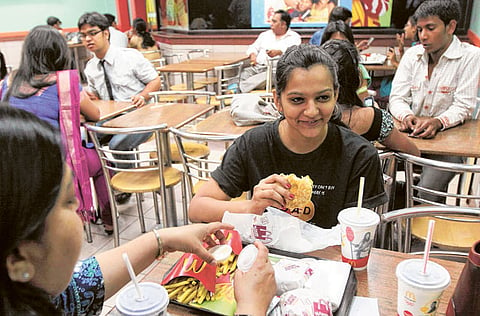
Indians face shorter lives as they exercise less and turn to fatty foods
Hong Kong: Despite rapid economic growth, India's healthcare system remains blighted by high rates of infant mortality and deaths in childbirth, malaria, tuberculosis and a growing problem with chronic diseases, experts said.
In a series of seven papers published in The Lancet on Tuesday, they said India's healthcare system was unable to cater to the needs of its population and out-of-pocket health bills were pushing 39 million residents into poverty each year.
Among the proposals produced in the reports was a call for universal healthcare by 2020.
They warned that chronic diseases like heart and respiratory ailments, mental disorders, diabetes and cancer will account for nearly 75 percent of all deaths in India by 2030, and urged the government to produce a comprehensive plan to meet the healthcare needs of its 1.16 billion-strong population.
"The number of years of life lost because of coronary heart disease deaths before the age of 60 years will increase from 7.1 million in 2004 to 17.9 million in 2030," researchers led by Vikram Patel at the London School of Hygiene and Tropical Medicine wrote in their paper, the third in the series.
"(This) means that by 2030, more life years will be lost as a result of this disease in India than is projected for China, Russia and the United States combined."
One article, produced by a team led by Srinath Reddy at the Public Health Foundation of India, concluded that only the creation of a national health service could tackle the issue.
"We propose the following targets to be achieved by 2020 through the creation of the Integrated National Health System with three overarching goals: ensure the reach and quality of health services to all in India; reduce the financial burden of healthcare on individuals; and empower people to take care of their health and hold the healthcare system accountable," the team wrote in the seventh article in the series.
In comparison, China, also a fast-growing major economy, implemented healthcare reforms in 2003 and gave it an additional boost in 2009 by injecting $124 billion.
It said 92 percent of China's population was now covered by basic healthcare insurance
Recommendations
Infectious diseases such as tuberculosis and malaria account for 30 percent of India's disease burden, according to a team led by Jacob John, a retired professor at the Christian Medical College.
Their paper highlighted the gaps in health information as autopsies are rarely performed and scarce attention is paid to infectious diseases by the medical profession.
Even though India met the World Health Organisation's target of eliminating leprosy by 2005, new cases have been creeping up at a rate of 1.17 per 10,000 population a year and they warned that the disease may surge anew in the future.
India also carries the world's largest burden of maternal, newborn and child deaths, according to a paper authored by Vinod Kumar Paul at the All India Institute of Medical Sciences.
In 2008, 1.8 million children below age five, including one million neonates (four weeks old and under), and 68,000 mothers died. India also has the greatest number of undernourished children, and about 52 million of them are stunted.
Paul and colleagues also pointed out a tendency to neglect female babies in a country where boys are preferred.
"Financial incentives for care seeking need to be considered, particularly for female infants and children," they wrote.
To tackle the rise of chronic illnesses, the experts called for population-wide programmes to promote lifestyle changes, such as reducing salt intake and tobacco and alcohol consumption. Better management of diabetes, exercise and dietary changes should also be encouraged.
To strengthen the public health system, incentives can be used to encourage healthcare workers to work in poorly served rural and remote areas, they wrote.
Another paper, led by Y Balarajan at the Harvard School of Public Health, said more than three-quarters of health spending was paid privately and that such high out-of-pocket expenditures pushed 39 million Indians into poverty every year.
Factbox: India's state of health
Indicators of India's state of health and comparisons with China and other countries:
- India had 2 million new cases of TB in 2009, and it killed 280,000 people that year.
- About 1.4 million people in China fall ill with TB each year and it killed 160,000 people there in 2008.
- India had 963 confirmed malaria deaths in 2005 compared with 48 in China, according to the World Health Organisation.
- India’s infant mortality rate was 53 per 1,000 livebirths in 2008, while China's stood at 16.5 in 2010.
- This figure is well below 10 in advanced nations. It stands at 6.1 in the United States, 4.7 in Britain, 2.9 in Hong Kong and 2.3 in Singapore.
- India’s maternal mortality rate was 230 per 100,000 live births in 2008, compared with 26 in China.
- The figure was 24 in the United States, 12 in Britain, 5 in Italy and 3 in Ireland in 2008, according to UNICEF.
- Chronic diseases killed half of the 10.3 million people who died in India in 2004, and they are projected to make up 75 percent of all deaths by 2030.
- In China, 83 percent of all deaths are because of chronic diseases, in particular heart disease and strokes, hypertension, cancer and respiratory diseases.
- In India, there is practically no financial protection for most people against medical expenditures.
- China implemented healthcare reforms in 2003 and gave it an additional boost in 2009 by injecting $124 billion.
- It says 92 per cent of its people are covered by basic healthcare insurance, but critics say that coverage is barely enough.
Sources: The Lancet India series, World Health Organisation, UNICEF, China's Ministry of Health, CIA World Factbook.
Have your say
Do you think people become less health conscious as they become wealthier? What do you think is the biggest health concern is in India today?


