Syrian opposition seeks legitimacy
Success relies on greater involvement of opposition figures inside Syria, say experts
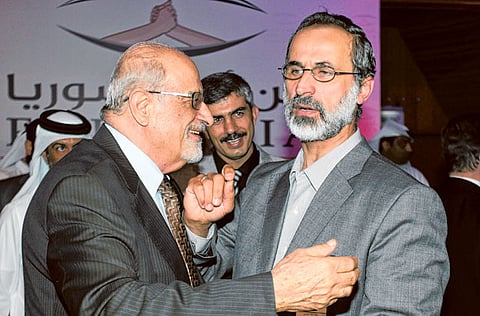
Dubai: Soon after establishing a new, more representative body, the Syrian opposition set forth on the path to international recognition — a precursor to the establishment of a provisional government.
A day after Syrian opposition groups announced their agreement to form a new body, the United States declared its support for it.
“We look forward to supporting the National Coalition as it charts a course toward the end of [Syrian President Bashar Al] Assad’s bloody rule and the start of the peaceful, just, democratic future that all the people of Syria deserve,” State Department deputy spokesman Mark Toner said in a statement. “We will work with the National Coalition to ensure that our humanitarian and non-lethal assistance serves the needs of the Syrian people,” he said.
Syrian and Arab analysts, however, expressed doubt about the new organisation and its chances of success. Realisation of opposition goals relies heavily on the greater involvement of the opposition figures inside Syria, they added.
“In my opinion, the new coalition could face the same fate as the Syrian National Council or even worse,” said Sobhi Asseila, an expert at the Cairo-based Al Ahram Strategic Studies Centre.
“This is because the motive behind forming the new coalition was external more than internal,” Asseila said in an interview with Gulf News, adding that US Secretary of State Hillary Clinton had spoken clearly about the need to unite the Syrian opposition as a precondition to gain Washington’s support.
Meanwhile, press reports from Cairo said the leader of Syria’s newly united opposition Muath Al Khatib, 52, was scheduled to head to the Arab League headquarters accompanied by Qatari Prime Minister Shaikh Hamad Bin Jasem Al Thani, to push for diplomatic recognition on Monday.
Full recognition
The Qatari premier said he would press fellow Arab ministers in Cairo to do the same. “We will seek a full recognition of this new body,” Shaikh Hamad said.
The Arab League suspended Al Assad’s government as part of sanctions it imposed last year and Syria’s seat in the 22-member bloc is currently vacant.
Qatari Minister of State for Foreign Affairs Khalid Al Attiya was quoted as telling Al Jazeera television that recognition would remove any obstacles to the opposition’s securing arms for rebel fighters on the ground.
“When they get legitimacy from the international arena, they can go and contract whatever they want themselves because they would be recognised as full legitimate government whether in exile or whether inside Syria,” he said in an interview to be broadcast on Talk to Al Jazeera.
According to the published agreement of the opposition, the parties agreed to work “for the fall of the regime and of all its symbols and pillars”, and rule out any dialogue with Al Assad’s government.
They agreed to unify the fighting forces under a supreme military council and to set up a national judicial commission for rebel-held areas. A provisional government would be formed after the coalition gains international recognition and a transitional government after the regime has fallen.
“I say that any opposition will not be operational unless the internal opposition is given a leading role in the opposition ranks,” Asseila said, noting that the Syrian Free Army should be given a bigger role in directing the way for all developments in Syria. The Free Army has been leading the fight against troops inside Syria for nearly two years.
“What I see is that substituting a body with another body is not the ideal solution for the Syrian crisis,” said veteran Syrian media expert Abdul Fatah Awad. “It is another image of the Syrian National Council and will pass on the same diseases the previous body had,” he told Gulf News in reference to the existing gaps among the different opposing groups.


