Artillery fire continues to batter restive city
Regime avoiding use of air force fearing Nato intervention, rebel leader says
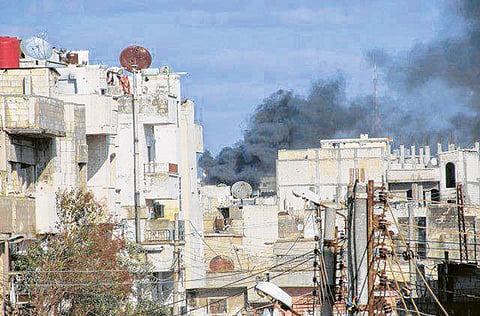
Artillery shells fell sporadically on Syria's third largest city yesterday while gunfire rang through its deserted streets as Syrian Army forces tried to quell anti-regime fighters entrenched in enclaves there.
After two weeks of fighting, which has claimed approximately 500 people so far, Syrian military appeared to be preparing for a major offensive on the Baba Amr and Inshaat districts.
A convoy of about 30 Soviet-era heave tanks on flatbed trucks, accompanied by truck loads of fresh troops, moved into Homs last evening.
A Free Syrian Army leader contacted by Gulf News in Baba Amr yesterday said the government forces were deliberately choosing to bombard the city with heavy artillery rather than using its air force for surgical air strikes. "If [President Bashar] Al Assad uses his planes, that will be the tipping point for the West," the commander said. "When [Muammar] Gaddafi used his planes on civilians, there was a no-fly zone in days. That's why they use artillery and tanks. They are afraid of Nato planes."
Access to, from and around the city is virtually impossible, with checkpoints and machine gun positions at every corner. Sandbagged position, fortified with oil drums filled with sand provide some cover against the bursts of automatic fire that rake its streets.
Battered skyline
Shelling and mortar fire shake the city's downtown districts, sending up clouds of dust and smoke over the battered city's skyline. "Tell the West we will not stop until every last traitor is dead," one commander said as his men searched cars and checked papers. "These are terrorists," the commander said. "They are mercenaries. They are being paid 20,000 Lebanese pounds (Dh48.76) a month to fight. There are Al Qaida [fighters] with them."


