Resident says he will not ride the rail system
UAE-born web designer describes effects of the tram on daily life
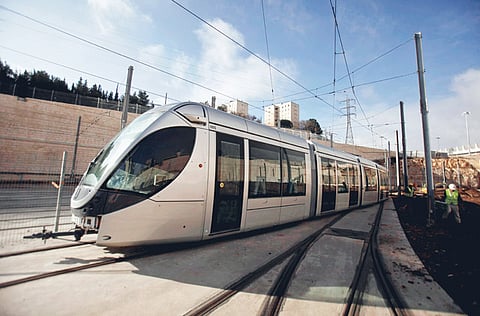
For the past three years, digging work has been carried out on the main road of my neighbourhood, Shu'fat, in Occupied East Jerusalem. During these operations, Arabic, English and Hebrew signs were put up to inform residents that this was for a railway that would link our district with other areas in the Old City of Occupied Jerusalem. This has been taking place only a couple of metres away from my house, and I can see it from my eastern window.
Since the digging began, my family and neighbours made jokes about the project, including one that concerned ancient relics. Yes, relics. While this may sound strange, there is an Israeli law that forbids excavation until the area is inspected by Israeli archaeologists to ensure that is free of any ancient antiquities. In Shu'fat, the inspections revealed remains of tombs and houses.
Consequently, all construction work on the railway was halted for almost a year while scientists carefully carried out digging operations, extracting simple things such as pots and jars.
What is amusing, however, is that the relics were apparently not Jewish, which is why a decision was made to re-bury the findings and continue with work on the tram.
While shopping for groceries, I jokingly asked the shopkeeper, "So, what did they find?" Laughing, he replied, "Relics. But of course, none of them were Jewish, thank God, otherwise we would have a Jewish [colony] built right in the middle of the street." Of course, we were not given the right to know what was found. In fact, the archaeologists were being protected by Israeli guards.
The digging continued, demolishing the walls of some houses in different areas and narrowing the street in the process. The main street, an important commercial street in the neighbourhood, was reduced from two lanes to a single lane.
It used to take me 10 to 15 minutes to drive from my home to the Old City during normal hours on the ring road, Street 1. Currently, however, it takes up to an hour or more. Turnings on the side of the of the road have also been completely closed, which means a motorist may have to exit Shu'fat completely in order to reach the opposite side of the road.
Now, as a Palestinian "Jerusalemite", you are forced to use Jewish streets in order to avoid traffic jams and congestion in Palestinian neighbourhoods. Ask any Palestinian shop owner on Palestinian streets, and he will complain that the diversion of traffic to Jewish streets has had a dire affect on Palestinian-owned businesses. All this is on top of the closures imposed on their streets during the excavations and the effect of the building of the tram on their businesses, for which the Israeli municipality has refused to pay them compensation.
And then, you laugh as your gaze shifts to the project's workers. A majority of these workers are Arabs, while only the companies' engineering and supervision teams are Jewish. Ask the Arab worker and he simply replies, "I don't have a choice. I need to feed my kids." The Jews, on the other hand, are guarded by the Israeli police and border guards. Try to approach them, or even pass by them, and they would eye you suspiciously, as if you were a fugitive. You can see the hatred and fear in their eyes.
I read in the newspaper that the trains will be bulletproof and stone-proof, and a voice persists in my head: "If they are so afraid of us, why did they build the railway here? They could have built it in any of their colonies, without the train having to pass through our neighbourhood. If they are so scared of us will they allow us to board the train? Will they set up a military checkpoint at the stop?"
Israeli bus stops located near our neighbourhood contain checkpoints where anyone that fits the Arab profile is thoroughly frisked in the most degrading manner. Will the same measures be enforced at the train stop? It's funny when they tell us that the train is built to serve us, too, while they treat us like criminals. In other words, "If you want to ride the train, you must accept the humiliation".
Finally, who will be riding this train? That's another question I ask myself.
The bus fare for an Arab bus costs four-and-a-half shekels (Dh 4.5), while the Israeli bus fare costs 10 shekels (Dh10). Most Palestinians in Occupied Jerusalem don't ride Israeli buses because they are expensive, and because we are usually harassed by the guards under the pretext of security, which usually leads to a vulgar and abusive exchange with the soldiers. The train fare is estimated to be around 12 shekels. If we never rode their buses, why would we ride their trains? If we suffer humiliation due to a few colonists that use the bus, then what about a train that's filled with them?
We are already suffering because of them from a distance. I wonder how it willbe when they are among us?
- The author was born in Abu Dhabi and graduated from UAE University in Al Ain but now lives in his hometown of Shuafat in occupied East Jerusalem, where he works as a web designer.


