Hariri's killing still haunts Lebanon
Analysts believe end of Syrian hold over nation was the ‘top' outcome of assassination
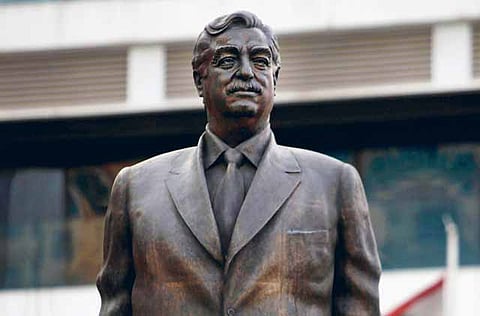
Dubai: Five years since the killing of former Lebanese Prime Minister Rafik Hariri, the consequences of the assassination continue to shape the country's political, economic and social mosaic.
The murder led to the end of nearly three decades of Syrian military presence in Lebanon, and to a "historic" rapprochement among many Muslim and Christian groups.
But it also created "unusual" alliances in the multi-ethnic country, and deepened internal divisions within Muslim sects and Christian denominations, experts and Lebanese analysts said.
In the aftermath of the assassination, "a bewildering number of profound changes occurred, but Lebanon remains in a period of transition", said Peter Harling, senior analyst with the Middle East Program of the International Crisis Group.
"The Sunni-Shiite split continues to haunt a political landscape traditionally structured around a Christian-Muslim fault line... The Beirut-Damascus relationship has been transformed by the crisis, although it is unclear where exactly it is headed," Damascus-based Harling told Gulf News.
Hariri was killed in a massive blast that targeted his motorcade on February 14, 2005, while it was passing through the western part of Beirut.
The explosion, which was strong enough to blow out apartment windows within a one-kilometre radius, killed several people and injured scores. It destroyed many cars in the motorcade, including Hariri's bullet-proof car, and several buildings nearby.
Many Lebanese, including supporters of the slain premier, accused neighbouring Syria, which dominated Lebanon for decades. Damascus denies any involvement.
Historic significance
However, in the aftermath of the killing, Syria withdrew its troops from Lebanon, ending its domination. The move, according to Lebanese analysts, "tops" the changes resulting from Hariri's killing.
Another huge change occurred when an "important alliance formed between the Future movement [Hariri's supporters] and large segments of Christians", Paul Salem, Director of the Carnegie Middle East Centre in Beirut, said in reference to what is being called the "March 14 alliance" led by the Future movement, which includes many Christian political parties.
"This alliance has a historic significance because there were clear divisions between Muslims and Christians throughout the history [of Lebanon]," Salem added.
"In parallel, a strong alliance between Shiite Hezbollah group and Amal movement and some Christians parties was formed," Salem said. He was referring to what is being called the "March 8 alliance" led by Hezbollah and Free Patriotic Movement party headed by Christian leader Michel Aoun.
The Syrian withdrawal has, according to many analysts, encouraged all the religious sectors — Sunnis, Shiites, Druze and Christians — to seek a stronger role in the decision-making process. This has led to increased sectarian tension.
As a result, efforts to form a consensus and make decisions is very cumbersome, analysts explained.
However, the Sunnis' role in particular has passed through a major transitional phase. It shifted its leanings from "traditional nationalism to Lebanisation" in the aftermath of Hariri's killing, analysts noted.
"The Sunni sect in particular has become attached to Lebanon's independence, sovereignty and freedom more than it used to be before," said George Nassif, a Lebanese columnist and political analyst.
Commitment
Hariri's supporters are expected to renew their commitment to his slogans during the mass rally scheduled to take place in downtown Beirut today to mark the fifth anniversary of his assassination.
Previous rallies were attended by hundreds of thousands of people. Meanwhile, while it is still unclear who was behind Hariri's killing, the Lebanese seem divided over the fate of the international tribunal formed one year ago after nearly four years of investigation.
Some strongly believe the tribunal's progress has been slow, while others fear it might be an object for a trade-off pending improvements among regional and international powers, including Syria, Saudi Arabia and the US.
Last week, the tribunal's president, Antonio Cassese, visited Beirut and assured the Lebanese that the investigations are on track.


