Hariri: Man who rebuilt nation remembered
Assassinated prime minister hailed for his efforts to reconstruct war-torn country
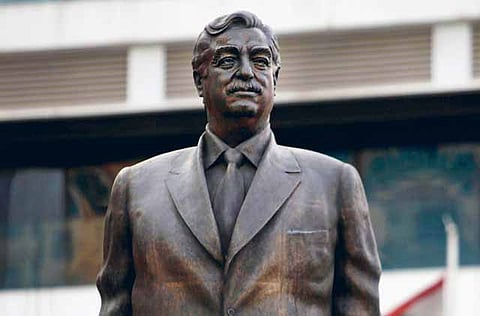
Dubai: The words of the Lebanese Druze leader Walid Junblatt said it all: "Rafik Hariri does not belong to a certain faction. He would have preferred for the event [his assassination anniversary] to be an occasion for the entire country."
Junblatt's comment resounds with many Lebanese from different backgrounds and sects, as hundreds of thousands are expected to take to the streets today to commemorate the fifth anniversary of Hariri's assassination.
"What Junblatt meant was that Hariri was a leader who received unanimous support of the Lebanese," Lebanese columnist and analyst George Nassif said. "He was bigger than just a head of a political party, he was a reconciliation leader in the Lebanese arena," Nassif explained to Gulf News in an interview.
The former Lebanese Prime Minister, who was killed in a massive explosion, will be remembered as the second prominent Sunni leader in the country after Riad Al Solh, the first prime minister in Lebanon after its independence in 1943, some Lebanese analysts said.
At the same time, Hariri will, definitely, go into history also as the man who led the reconstruction efforts of a country decimated by 15 years of civil war, many Lebanese stressed.
Though both Hariri and Solh lived in different circumstances, they share an elevated status in Lebanon's history, analysts said.
Solh is among the most important personalities in Lebanon's struggle for independence and unity.
Solh and Hariri are Sunnis and both are from Sidon in southern Lebanon.
Coincidentally, both were assassinated. Solh was assassinated in Amman, Jordan, in July 1951 by a member of the Syrian Nationalist Party.
Hariri was "for several years, really a skeleton which connected the Lebanese of different backgrounds together… he was a wise man in this field," Paul Salem, director of the Carnegie Middle East Centre in Beirut said.
"When he came to power, he was a businessman with some [political] experience, but later he greatly grew up politically. He knew how to communicate with Lebanese, regional and international leaders for the benefit of Lebanon. He successfully turned into a statesman, in the eyes of many Lebanese," Salem noted.
It was in 1992, when Hariri, a businessman, became prime minister, and put Lebanon back on it's feet.
Hariri launched the biggest reconstruction programme in Lebanon's history. He formed five governments in his two tenures from 1992 to 1998 and from 2000 to 2004.
He will go into history as the rebuilder of the country, most Lebanese say. However, some blame his cabinet for the multiplying debts of the country.
"When you reach [Beirut] airport, you will remember that Hariri built it. When you see the stadium, you will remember that Hariri built it. When you drive over bridges and in tunnels, you will remember that Hariri built them. He was the man who built the infrastructure of the country, rebuilt Beirut," Nassif said.


