Art Attack!
Do more galleries, artists and auctions signal a growing art culture in the UAE?
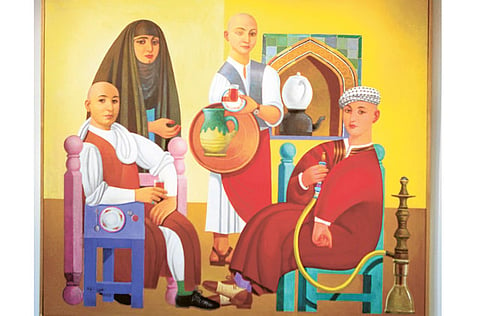
Dubai: Graffiti, street art, and sculptures are not likely features of the Versailles like tree-lined streets of the UAE. Whether that void translates into a city lacking a deep-rooted art culture is questionable however.
Taking into consideration that Dubai is establishing itself as the Mena art gallery hub, with Abu Dhabi attracting the legendary Louvre and Guggenheim, and Sharjah continuing to host the 20-year-old art event, Biennial, art seems to be on everyone's agenda.
Home to only five art galleries in 2006, Dubai now boasts more than 85. Isabelle de La Bruyere, Director of Christie's in the Middle East explained the country must be experiencing some form of artistic development.
Christie's, the renowned art auctioneer, set several world auction records at their latest sale in Dubai. The majority of the buyers were from the Mena region however almost 40 per cent were international buyers. "[It is] a sign that Middle Eastern art is growing internationally, it's becoming global," Isabelle said. The sale also showcased the work of several Emirati artists to the international market for the first time.
Isabelle believes there's a long term plan in place for the UAE's art scene. "I think we're seeing the development but our children's generation will see it the most with the changes happening" she said.
Accessibility
Several factors have set the wheels in motion according to the connoisseur. "Now in the UAE culture it's more acceptable to be an artist, secondly arts education programmes are offered in school. It's about making art more accessible."
After all the country has attracted the foremost names in art such as the Louvre. However the controversial price tag on that brokered deal raises an important question. Is there a substantial art culture in the country or is it just another passing trend?
Bashar Al Shroogi, owner of one of the first art galleries to hang its paintings in Dubai, Cuadro, believes the emirates are playing their role in establishing a mature art scene.
"You've got Sharjah on the one side, it's the curatorial hub working on art projects for the sake of the art itself, on the other side is Abu Dhabi with its massive public investment of funds in large scale museums, and then you've got Dubai in the middle and it serves as the commercial hub not only for the country but for the region as a whole," Al Shroogi said. These combined efforts have brought about change, "If we look back to 2003 if we were to have an exhibition in Dubai you have a lot of people who initially come in and say ‘umm yeah ok that's good'. A couple of years later that dialogue started becoming more sophisticated where they come in and say I like it or I don't like and that to me is a step forward.
"Now we're at a point where they say I like it because or I don't like it because. The audience is becoming more sophisticated because they're seeing more," Al Shroogi said.
Who is seeing more and is it enough? Galleries and exhibitions offer leisurely excursions for those conscious of their presence however the accessibility of art to the mass public is still in doubt.
"It's a matter of engaging everyone around you whether we do it with public art or public education programmes." Al Shroogi explained. Through mass outreach art binds itself into the fabric of everyday life weaving stories and sights of children admiring colourful walks and walls and couples strolling past monumental status, he said.
More exposure
"Plans were in place to assign each Dubai Metro Station to an artist, art museums are in the process of construction. Such public projects and more of the same would ensure every member of society is exposed to art but of course [government] budgets are very tight at the moment." Khalid Samawi, founder of Ayyam Gallery explained.
In his view public art already exists in the UAE. "If you look at the architecture in Dubai it's pretty amazing, if you go look at the fountain, that's art in the end. How many people line up every single night and wait for the fountain? Thousands and thousands. You would be surprised how many people come to Al Quoz and walk around the galleries. Dubai is building the art culture of the future as opposed to maintaining the culture of the past," he said.
Part of building an art culture is producing the art itself. Local artists are competing with international names for an inch on a dauntingly crowded platform.
Saeed Khalifa, one of the young Emirati artists showcased in a Christie's sale believes the time has come where artists are getting a chance to display their work in their own country.
"It's never been taboo to be an artist here. The problem is there weren't many opportunities especially since most of the galleries before used to just represent international artists. The galleries came from a different country they never started here," he said. "The only outlet for local artists like us was to upload our work on some website page like deviant art or Flikr," he added.
Efforts by organisations such as Tashkeel and Art Dubai are helping local talent access information and resources which may not have been offered in schools. "It's sports that boys want they thought but not entirely because we were a group of six or eight boys in our class who would rather go to the art classroom. But it never stopped us from drawing and sketching in class." Saeed explained.
Hisham Malek, a Pakistani artist based in Dubai has seen art buyers become savvier. "I get asked questions now that I never got asked before like will the paint fade, how can I transport the painting, will its value increase.
"This means the buyers are genuinely interested," he said. "There is one important question that I always get however and I still don't have a response for it. They ask me where's the art museum?"
That divide between what may be available to the public and what is offered privately appears once again.
Melting pot
The internationally renowned Syrian artist, Safwan Dahoul, has showcased his paintings in Dubai several times. His emphasis is on the opportunities the UAE offers as a melting pot for artists of the region. "Dubai itself is the gallery. I don't ask for it to be like London or Paris. As the place is, I am accepting it. I don't want to see another city in Dubai, it wouldn't suit."
Welcome addition to the Abu Dhabi skyline
The Louvre Abu Dhabi is a key institution in the development of the Saadiyat Cultural District and will play an important role in achieving this goal and to achieve Abu Dhabi's ambition to become one of the world's top five cities by 2030.
The mission: The plan is to establish a cultural hub of international significance in Abu Dhabi, including a vibrant art scene, which will both celebrate the multicultural nature of Abu Dhabi society and create a platform for dialogue and exchange, where conventional paradigms of artistic understanding are rigorously challenged.
A secondary objective is to create educational opportunities in the field of the arts for the UAE community on the vision and collection of Louvre Abu Dhabi as it continues to develop.
The museum: Designed by Pritzker-prize winning architect Jean Nouvel, the piling was completed by Bauer International of Germany in August, 2010, with almost 5,000 piles driven into the ground — equivalent to the distance from Abu Dhabi to Dubai. A prototype of the dome, 15 metres in diameter, was erected on Saadiyat Island in 2009 to test the intensity of ambient light conditions on site prior to fabrication of the final structure. The aluminium dome prototype pivots to stimulate different conditions throughout the day.
Source — Tourism Development & Investment Company


