Satire is not insulting or offensive: Egypt writer Mohammad Fat’hi
Red lines and freedom of expression discussed
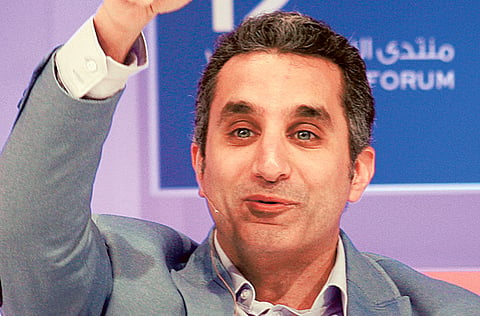
Dubai: “In my opinion … the secret behind why the UAE does not have a satirical show like Bassem Yousuf’s is because the UAE does not have a ruler that deserves to be satirised,” a speaker at the second day of the Arab Media Forum said during a session on satirical media.
Mohammad Fat’hi, an Egyptian writer, satirist and journalist at Al Watan newspaper, said, “If the ruler is just, why would we make fun of him or satirise him? We have never heard that a just ruler was made fun of, but if the ruler is unjust or is undeserving of the people he is ruling, then he really deserves to be criticised and satirised – that is to say the least.”
Fat’hi was referring to the show of Egyptian heart surgeon and satirist Bassem Yousuf, “Al Bernameg”, which is similar to the American show The Daily Show hosted by Jon Stewart.
Fat’hi explained that “the moment when the Egyptian citizen realised that the ruler is not a god, that is when the art of satire started.” He added that when you look at the walls of ancient Egyptian temples, “you will find caricatures depicting all sorts of possible ways to make fun of a ruler… the Egyptian people invented satirising rulers.”
Yousuf, who also spoke at the session, said that people criticise satire and say that it is insulting, offensive and rude, but he said that that is not true.
“The problem is, in the Arab world, they define satire depending on their position; in other words, if I am making fun of someone they do not like, then it’s great, but when it comes to them, then satire becomes rude, wrong and indecent.”
He explained that when, for example, he makes fun of Egyptian President Mohammad Mursi, he does not make fun of his person, but of his decisions and the political situation. “I don’t say he is ugly or fat.”
On drawing the line
Moderator Toni Khalifa, renowned Lebanese show host, asked the audience about the “freedom of expression ceiling” and what are the “red lines”.
Khalaf Al Harbi, satirical writer in Okaz newspaper in Saudi Arabia, said that in Saudi Arabia it is easier to talk about what is not a red line than what is a red line.
“However, satire’s role is to fight those red lines and challenge them … most people who take up satirical writing or performance, seek satire as a way to break the taboos.”
Yousuf and Fat’hi both agreed that in Egypt there are almost no red lines any more and that the “freedom ceiling” is too high. Fat’hi said that he is not worried that they will ever lose this freedom as he said once freedom is given it can never be taken back.
Sami Al Reyami, Editor in Chief of Emarat Al Youm newspaper, said that the clearest red lines in the UAE are culture, religion and traditions.
Hind Khlifat, Jordanian satirical writer at Al Rai, said that she believes that there should be some red lines, but not lines that hinder the message, just maintain some public decency.


