Four eland antelopes make their debut at Al Ain Zoo
Herbivores at African exhibit set to draw crowds
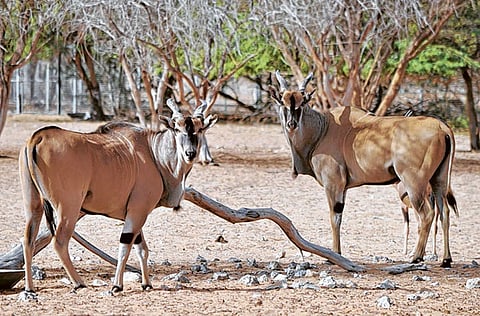
Al Ain: Animal lovers are in for a treat after Al Ain Zoo took delivery of four eland antelopes from east and southern Africa.
Eland antelopes are considered to be among the slowest in the species but they make up for their sluggish nature with a remarkable ability to jump up to heights of 2.5 metres.
"We are delighted to announce the addition of four eland antelopes to the diverse array of African wildlife in the African Mixed Exhibit," an Al Ain Zoo spokesperson said.
Eland antelopes are spiral-horned and live in the savannah and plains of east and southern Africa. They are the largest antelopes on the African continent.
The African exhibit is one of the zoo's most popular exhibits, with a total of eight mammal species, which include the Nubian giraffe, the Southern White rhinoceros, Grant's zebra, the fringe-eared oryx, the Mhorr gazelle, the Dama gazelle, the Thompson gazelle, as well as two bird species, that is, the marabou stock and ostrich. All animals roam freely on more than five hectares of open landscape.
Majid Al Qasimi, Al Ain Zoo assistant associate veterinary, said the addition of these antelopes provides an exciting opportunity for animal lovers across the country to encounter this beautiful species first-hand.
"Mixed species' exhibits are an excellent way to educate the public on the complexity of the interactions among different animal species of specific ecosystems," he added.
Elands are herbivores and usually eat grass, branches and leaves. They tend to be inactive during day because of the heat.
Feeding habits
They feed for long periods of time at night, even in hot weather and sleep for long periods during the day. They can also conserve water by increasing their body temperatures.
Al Qasimi said eland antelopes are not endangered but their numbers are gradually decreasing owing to a loss of habitat loss — caused by expanding human settlements and poaching for their superior meat.


