Mohammad meets Biden in Washington
General Shaikh Mohammad Bin Zayed Al Nahyan, Abu Dhabi Crown Prince and Deputy Supreme Commander of the UAE Armed Forces met with US Vice President, Joe Biden, in Washington on Monday
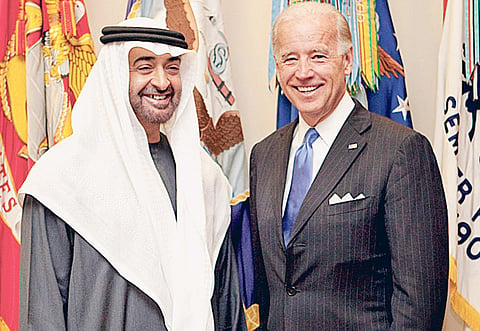
Washington: General Shaikh Mohammad Bin Zayed Al Nahyan, Abu Dhabi Crown Prince and Deputy Supreme Commander of the UAE Armed Forces met with US Vice President, Joe Biden, in Washington on Monday.
The two discussed mutual relations between the two countries on economic, diplomatic and security levels, on the sidelines of the Nuclear Security Summit which kicked off on Monday under the patronage of US President Barak Obama.
Shaikh Mohammad and Biden also discussed the situation in Iraq and the latest peace process developments ion the Middle East.
The meeting was also attended by Shaikh Abdullah Bin Zayed Al Nahyan, Foreign Minister.
Shaikh Mohammad was at the head of the UAE delegation to the Nuclear Security Summit, which was attended by 47 world leaders, also attended by Shaikh Abdullah
Shaikh Mohammad commended the "friendly relations and constructive cooperation" between the UAE and the US. He said that the UAE, under the leadership of President His Highness Shaikh Khalifa bin Zayed Al Nahyan, is proud of its relationship with the US and is keen to develop and strengthen it at all levels in a way that meets the aspirations of both friendly nations.
For his part, the US Vice President welcomed Shaikh Mohammad, saying that the two nations are bound by friendly ties and that they will keep working together to achieve their common interests.
The Vice President thanked Shaikh Mohammed for the UAE's significant contributions in Afghanistan. He also commended the UAE's support to Yemen's unity and stability as well as its economic and political reforms. The US Vice President also renewed the United States "steadfast commitment to Gulf security."
The two sides discussed means to further enhance relations between the two countries. The talks also touched on the summit's agenda as well as regional and international developments and issues of mutual interest.
The Nuclear Summit focuses on the need for international cooperation to combat nuclear terrorism as one of the most challenging threats to international security. The world leaders participating in the summit discussed taking measures to prevent nuclear weapons and technology from falling in the hands of terrorist and criminal organisations. They also renewed their commitment to nuclear disarmament, nuclear nonproliferation and the peaceful use of nuclear energy.
In a document released in April 2008 with regard to the UAE's planned peaceful nuclear energy programme, the UAE Government outlined its commitment to operational transparency; highest standards of non-proliferation; highest standards of safety and security; working directly with IAEA and conforming to its standards; and working in partnership with the governments and firms of responsible nations.
The UAE made it clear that its plans to establish a peaceful nuclear energy programme were motivated by its need to develop additional sources of electricity to meet future demands and ensure a sustained and rapid economic development.
The document, titled "Policy of the United Arab Emirates on the Evaluation and Potential Development of Peaceful Nuclear Energy", stated that the UAE's national annual peak demand for electricity would to rise to more than 40,000 MW's by 2020, reflecting a cumulative annual growth rate of roughly 9% from 2007 onward.
The meeting with the US Vice President was also attended by Khaldoun Al Mubarak, Chairman of Abu Dhabi Government's Executive Affairs Authority, Mohammad Mubarak Al Mazrouei, Undersecretary of the Crown Prince's Court, and Yousef al Otaiba, the UAE Ambassador to Washington.


