UAE natural history museum to open in Al Ain
University building houses 10,000 specimens of flora and fauna specific to the UAE
Al Ain: If you went to the Museum of Natural Resources, a facility at the UAE University (UAEU), you probably wondered why such a splendid collection of UAE plants, animals, and birds was hidden from public view.
Now given the status of a museum, the Department of Biology has recently opened its gates for general visitors and school students.
Housed in Al Jimi boys' campus at the UAEU, the museum maintains a collection of more than 10,000 specimens of indigenous flora and fauna. All of these specimens are documented and catalogued to serve to the interests of scientists, students, and the people who love nature.
The facility is more than two decades old, established in 1989, and was used only by teachers and students at the Department of Biology.
"It's a great collection of plants, birds, reptiles, mammals, and insects but with limited usage. Now we have decided to reach out to the wider UAE community," said Dr Tawfiq Ksiksi, Associate Professor of plant ecology at the UAEU's Department of Biology.
Importance
The building has now been named the Museum of Living Resources (MLR) and the facility will shortly be inaugurated with a redefined objective: "Combining Education and Learning to Serve the UAE Community".
The museum will be open during weekdays from 8am to 2pm said Dr Ksiksi.
He said wildlife is very import to the ecological system and that the UAE government has a strong interest in the protection of wildlife and the environment. "Our initiative will help in raising public awareness on the importance of plants and animals, along with imparting knowledge on the importance of UAE's plants, especially their importance to UAE culture and heritage," said Dr Ksiksi.
The MLR, he said, is an important tool in teaching students the difference between plants, leaves, and stems, their value, and the identification of plants, along with teaching them how to preserve their different species.
The able hands of Dr Nael Fawzi, a herbarium specialist, have been helping the MLR to continue to document and build up its plant's collection. He is has played a key role in compiling a book, in two volumes, on UAE flora. It took him and a partner 15 years to complete the research, which was published in 2007 by the UAEU.
"The country has around 630 species of plants and we have more than 10,000 professionally prepared specimens of them here at the MLR," said Dr Fawzi. Many of the plant specimens are framed and displayed with details of their leaves, stems, flowers, and roots, while a large variety is archived.
Dr Ksiksi said an overwhelming response has been coming from schools and the community. "We are fully booked for the next several weeks though we have not yet officially opened the museum," he said. All visitors are accompanied by museum staff, including the department's faculty, to answer their queries and brief them on the items on display. "Visits are completely free of charge," he added.
The MLR has launched its website that can be viewed by logging onto www.cos.uaeu.ac.ae/departments/biology/biology_museum/. Interested people can get passes by filling the Visit Us form available on the website.
"We are also planning to issue a memorabilia to the visitors that will keep their memories of the MLR visit alive," said Dr Ksiksi.
Fossil Specimen
The museum has a fossil specimen of 195 million years old bird called Archaeopteryx. "This is one of the world's few places that have the specimen," said Dr Ksiksi. It is an important fossil that enabled the scientists to establish evolutionary link between the prehistoric birds and reptiles.
The specimen was gifted to the museum by a Pakistani taxidermist Abdul Hafeez Aziz who spent many years with the UAE University before retiring. In an interview with Gulf News in 1994, he said the original Archaeopteryx fossil is placed in the Natural History Museum of Berlin but a copy of it was also available at the museum of the ILE-IFE University, Nigeria.
During his stay in Nigeria, the taxidermist made a legal copy of the specimen and later brought it to the UAE in 1986. The Department of Biology has now closed down the taxidermy laboratory and Aziz has returned to his native country.
Scientists said the human knowledge of Archaeopteryx is due to this fossil that was found in a limestone quarried in Bavaria, Germany, in the 19th century. But its true identity was not recognized until 1970 after a century of being labelled as a fossil of Pterosaur -- the first real flying lizard on earth.
New Discovery
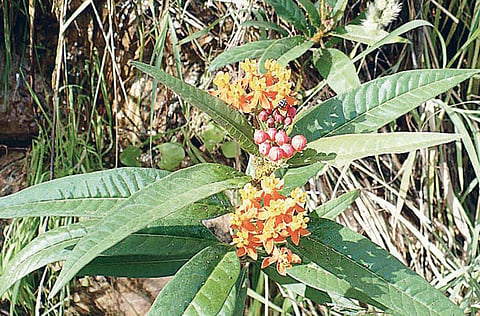
Dr Nael Fawzi has recently discovered a new plant in the UAE that was not earlier found and documented. "It's a small plant that is scientifically known as Aschepias Curassavica," he said.
He was on a routine study of the plants when he came across the plant in a Wadi near Jebel Hafeet in Al Ain.
This is an ornamental plant found in China and certain other countries. "I believe its seeds came with soil or through winds from the neighbouring Oman," he said, noting that the plant's seeds can fly with winds to long distances.


