Sound of violins
Debate and speculation about what makes the Stradivari peerless when compared to other violins rages on, thanks to modern day testing
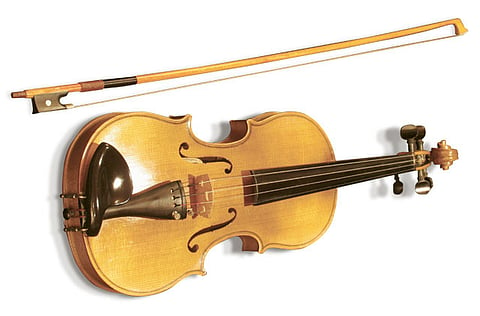
Andrew Hooker did not blink when yet another ‘double blind' violin test was conducted early this month at a university in Indianapolis in the US by a sound researcher working in Paris.
"Ah! I thought, another one," he says. "Such tests have been carried out in the past from time to time, often with the same results. However, the public has a short memory for such things, and the expensive violin trade is generally embarrassed by the results, so tests like this are quickly forgotten."
The embarrassment, of course, is entirely understandable, but only for those who believe the Stradivari is the only way to convince people of their genius. For them, such meddling experts would be denied entry to their concerts. For the rest, these debunkers should be accorded front row seats.
The melodic tyranny of the Stradivari is legion. It has acquired the status of an absolute. And absolutes, as we know, always draw attention from sceptics.
Hooker says: "I'm not surprised by the reactions to these tests. Of course the trade in very expensive violins is horrified at the idea that modern, comparatively cheap, violins can sound as good as the old-master instruments that they deal with. And equally, of course those that cannot afford old instruments are delighted. However, both parties miss the point: old violins are expensive, not because of what they do, but because of what they are."
The Stradivarius, he says, is clearly beyond the exceptional, and for three good reasons. "Design, workmanship and originality. Of the three, originality is the most important, just as it is in the field of old-master paintings. For example, there are many imitators of the work of say, Rembrandt or Canaletto, but the originals are worth intrinsically more. After all, the others are just copies."
The long-standing debate — and endless speculation — about what makes the Stradivari peerless centres around unsurprisingly non-provable theories such as the formula of varnish and its chemical constituents, the type of wood, the climate it was subjected to, etc. Can a type of varnish affect the tonal qualities of a violin? Just what role did the Little Ice Age, as the first 50 years of the 1800s are referred to, play in the quality of wood used by the violin families of Italy? (Stradivari, Amati, del Gesu and other legendary violin makers are all from Italy).
Hooker says: "I don't think varnish, wood or workmanship particularly affect the tone of a violin by Stradivari. Rather it is a subtle combination of these things, plus, of course, the basic design — which has been copied ever since. It might make a tiny difference to the sound if a varnish is inelastic — that is, if it does not stretch a little — or it is applied too thickly, but the chief function of the varnish is protection and, of course, to enhance the visual appeal of the instrument. As for the Little Ice Age theory, I don't believe in it. From time to time, scientists try to make sense of the beauty of the sound of a violin — and that is fundamentally unscientific: beauty is in the eye and ear of the beholder, and cannot be quantified."
‘Miracle of craftmanship'
What are we to do then? How are we to trick ourselves to putting a value on an object? "The value of an object — certainly a violin — is real," says Hooker. "There are market forces which define the prices. However, if you mean, should violins be worth so much, then I think yes, they should. An old-master violin is a miracle of craftsmanship, and more beautiful than most sculptures: one cannot hear a bronze statue. A violin takes a very long time to make. It lasts for centuries, and with the passing of time gains associations with moments of the highest art by famous musicians. I think violins are still undervalued."
Hooker's words would certainly be music to some ears, while others might want to put on a pair of sound mufflers.
The truth about human ability, however, is that it is driven by perception. If you believe you can do something, you will. So, if you know you are playing a Stradivari, you will probably touch celestial heights in your performance. Having said that, playing a new violin believing it to be a Stradivari will also produce the same results.
"This is sometimes true," says Hooker. "Such is the power of the myth of Stradivari… I have, on more than one occasion, heard a player, believing they were playing a fake, state that the instrument did not sound well. And, on being told that the instrument was indeed a genuine Stradivari, they corrected themselves, declaring the violin to be very fine indeed."
What's the truth beyond this perception? It's elementary — crafting anything by hand is not the same as pushing something through a tube in an assembly plant. In Stradivari too, variances were the norm.
"Even allowing for condition, Stradivari violins vary. The early ones, around 1665-1690, show the influence of his teacher, Nicolo Amati, and are not considered to be as perfect solo instruments as his later examples. Stradivari experimented with the length of his violins in the decade between 1690 and 1700, and again, these instruments, while possessing great charm, are not considered his most powerful. But after 1700, and in particular after about 1707, his instruments become extraordinarily beautiful, and can sound extraordinarily well… it's not surprising that these are the most sought-after, and the most expensive. Stradivari's workmanship remained consistently magnificent through most of his very long life — he died aged 93. Only in the final few years is there any sign of the age of the maker."
As for the rest of the violins made during that period, the instruments were honed to make musical magic in different spaces. The debate about old instruments successfully filling cavernous concert halls with their magic and the newer models failing to enrapture audiences beyond the middle rows is handled by Hooker thus: "The earlier models of violin, those by the Brescian school, and those of Stainer and Amati, did not adapt so well to the demands of modern music and performance. But they were not designed to. They were perfect for the use intended for them, that is, intimate performances in private rooms. Guarneri del Gesu and Stradivari instruments work superbly well in large concert halls."
‘Do not improve with age'
So, what do such tests achieve? "They are valuable because they remind us not to distort the truth too much," says Hooker. "Old violins are wonderful and undervalued. But they don't necessarily sound better. The public should understand this, but they don't: it is the public who demand to know that the soloist they have come to hear is playing on a violin by Stradivari. They could not tell from the sound, however." Is that the clincher? Not quite. It is this: "New violins can sound just as good as old violins. Most violins are made of well-seasoned wood, and do not improve with age. Stradivari never made an old violin."
For the violinist on an eternal hunt for the Stradivari to seal his success, Hooker has this advice, "Buy the instrument that sounds the best, without worrying too much about other considerations. Consider. I know a well-known virtuoso who owns a very expensive violin by a famous 18th-century Italian maker, but who prefers to play a cheap modern instrument for his recordings. Why? Well, on a recording, nobody can see the instrument, and the modern one sounds better.
However, players are not the only ones interested in violins. The world is fairly choked with those who look to violins as an investment. For them, Hooker suggests, "It is for the investors to worry about the value of old-master violins. Consider now the case of the investor with over 20 violins by Stradivari in the bank … they cannot be played; some of them don't even have strings. It doesn't matter; they appreciate in value more safely if they are kept away from players."
Veteran violin dealer
Andrew Hooker worked in the Musical Instruments department at Sotheby's in London from 1977 until 1991. A vast majority of his work involved the violin family. In 1991 he started his own business and in 1999, he eventually moved his office to a redundant Georgian church from where he operates today. As an independent dealer, Andrew has sold many important instruments, Stradivari amongst others.


