Meet Dubai judge Maher Salama Al Mahdi: exclusive interview
Egyptian national puts all efforts into serving justice fully in Dubai courts
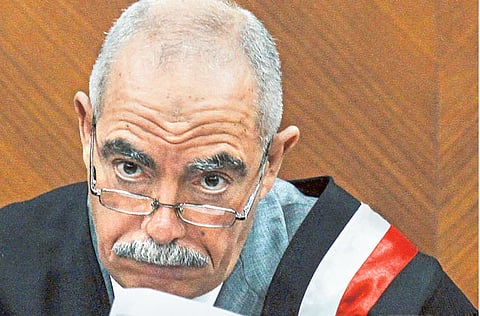
Dubai: A quick glance reveals a full house today, a courtroom full of defendants, their relatives and lawyers, victims, their companions and advocates, policemen and other court staff.
A court policeman firmly announces: “Mah-kama,” meaning Arabic for court, signalling that everyone in the court should rise to pay their respect to Judge Maher Salama Al Mahdi who is entering the room.
All rise as the judge takes his seat in the centre of the bench at the front of the courtroom.
“Bismi Allah al Rahman al Rahim (In the name of God the Merciful),” says 58-year-old Presiding Judge Al Mahdi at the beginning of each hearing over which he presides Sundays and Wednesdays of each week.
Usually when a hearing schedule includes pronouncement of judgments, the Egyptian national judge starts with the reading out of court verdicts or decisions ahead of reviewing the adjourned cases.
All signs point to another extremely busy day for the judge.
Judge Al Mahdi has helmed the Court of First Instance’s third bench since summer of 2011.
Similar to all expatriate judges - the majority of which hail from Egypt - Judge Al Mahdi works on a three-year contract subject to renewal.
He has become very well-known to have presided on a continuing basis over a three-judge bench that has probed several high-profile criminal cases in recent memory that drew national media attention and sparked wide-ranging public interest across the UAE.
Indeed, Judge Al Mahdi issued the final judgment in the Wudeema child-abuse case that moved the country to such a degree that new child protection laws are named after the case.
“My colleagues (two deputy judges) and I have handled many important and major cases that incited the public opinion. However, the most important of those cases, and which I still remember until this moment, was that of three Indian suspects who were charged with molesting a four-year-old Indian schoolgirl on a school bus in 2011. The three suspects were acquitted. I still remember that case because its proceedings took a long time and we heard many defence statements,” recalls Judge Al Mahdi in an exclusive converation with Gulf News.
“It consumed so much work, but I thank God for His graces ... and today I feel very content, like I always do while studying a case file and writing the judgment. Hamdilla, I’m a God-fearing person and constantly write judgments with all judiciousness and piety. I always seek for the acquittal of a suspect and do my best, like any other judge, to fish out any piece of evidence that helps in finding the innocence in the suspect,” Judge Al Mahdi told Gulf News.
Judge Al Salama is a father of two daughters and grandfather of one girl.
An early-riser, he wakes on a daily basis before the Fajr [morning] prayers and performs the ablution, then he heads to the mosque to pray the Fajr prayer near to his residence.
Then he drives towards the Dubai Courts Department [DCD] around 7am.
Before entering his office, he heads to the DCD’s prayer room where he sits and performs his personal rituals then prepares himself to go to his desk and start his daily routine.
On his daily routine work, Judge Al Mahdi said: “Since I started working as a judge many years ago, I’ve taken up this habit of performing the ablution before I start work. After performing my rituals of reading the Quran and reading some prayers, I head directly to my office. I prepare whatever is needed for the scheduled cases. I look into the litigating parties’ requests and go through the files. Then I sit down and write the required decisions or review the case files that have been made ready to be sentenced. On each day our bench of judges receives a batch of new cases. So I look into the cases and distribute the cases as per our schedule and the availability of my program and that of my two deputy judges. Before walking into the courtroom by 9am, I either copy/paste the rulings and print them or print out the decisions that have already been reached to hand them over to the court’s secretary or the litigating parties [lawyers or defendants or claimants’ in civil right]. Then I revise my personal remarks until my deputies come to my office. We make our final preparations and head to the deliberation chamber.”
A deliberation chamber is a small office located behind every courtroom and is set up for judges to convene before, and after, each hearing to study instant decisions or review their work.
A DCD clerk is assigned to carry the present-day case files from the judge’s office into the deliberation chamber.
Judge Al Mahdi said he and his deputies read their files courteously ahead of each trial to serve justice at its best.
“I read thoroughly the present-day files and particularly those in which the bench is scheduled to hear statements of witnesses. Meanwhile, with the new cases, I constantly take them home with me and read them there to have a closer look at all the file details. Ahead of each hearing, my deputies and I also go through the required administrative procedures,” he said.
The judge says he spends most of his time at home reading the case files and working.
Most of his hours are spent on his computer typing the judgments or investigation reports or reading court minutes that are registered by the court secretary.
To pursue his job vigilantly and have a constantly clear-mind and purified soul, Judge Al Mahdi goes out walking for one hour daily. He believes that a good walk in the fresh air helps him think clearly.
“I strongly believe that a suspect is innocent until proven guilty. I always seek to acquit a suspect before finding him/her guilty. I always do my best to serve justice perfectly. Hence, I always try to assist the lawyers to meet their demands and fulfill their requests such as questioning prosecution witnesses or hearing defence witnesses, whenever any are available. My main concern is to find the truth behind each crime,” said Judge Al Mahdi.
He says that the foundation stone of his work as a judge is that a suspect is always innocent [since birth] until proven otherwise.
“I always pray for God to help me succeed in doing my job prudently while serving justice and enforcing the law. I also thank God for His graces and keeping me gratified,” he said.


