Mum's the world on Mother's Day
On the eve of Mother's Day, gauge the vibes mums share with sons and daughters
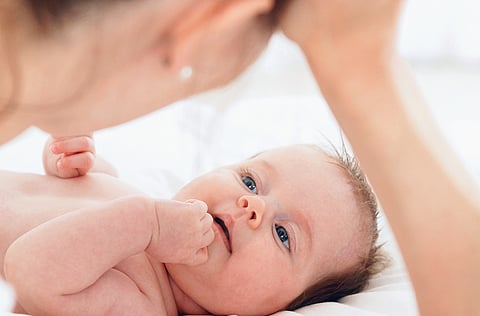
It has been said that a woman changes three times in life — when she enters puberty, when she's married and when she becomes a mother. The most arduous of these changes is, of course, the last one. When a woman gives birth, it's not just to the child. She reincarnates herself. Motherhood not only alters the body physically but psychologically and emotionally, too.
"It's interesting that the first thing we ask when a child is born is ‘boy or girl?'," says Helen Williams, who is a counsellor with www.counsellingdubai.com
"Somehow, we just cannot contemplate the new baby without knowing the gender. Research has repeatedly shown that mothers relate differently to gender. Maybe this is because mothers simply follow their instinct about the important biologically programmed differences between how boys and girls think, feel and act."
Points to ponder
Fourteen years ago, that moment came to me. Today as I look at my teenage daughter, I often wonder what it would have been like if she were a boy. As Williams says, research has clearly shown that mothers have different relationships with daughters and sons. Today, on the eve of Mother's Day, Unwind attempts to understand the scientific reasons behind the phenomenon called motherhood.
"A mother's presence deeply affects the lives of children," says Roxanna Syed, family counsellor and special educator at the Dubai Homoeopathy Health Centre. "Boy or girl, she loves them all equally. The only difference, if any, could be the age at which intense attachment happens between the two. It has been seen that daughters establish a very close relationship with their mothers before the onset of teenage and adulthood onwards. The turbulent time during adolescence happens due to the daughter's struggle to emerge as an independent personality.
"For a boy, a mother is a pillar of support, encouragement and strength, and a figure to hide behind, during his childhood. With adolescence he begins the journey of self-discovery. In boys, this process takes longer than in girls but is possibly a less turbulent time for the mother as she still remains close to her son. Their relationship begins to change with the introduction of a new female figure in the son's life," Syed says.
Williams says our parenting techniques are often influenced by our experiences as a child. In other words, it's the mother, or the mother figure, that shapes how we are and how we look, besides our mannerisms.
"The poet William Ross Wallace says, ‘The hand that rocks the cradle rules the world' in a poem that celebrates mothering and motherhood. This sums up quite well that she is the influence that shapes, protects, teaches and enables children from the beginning. Parenting is influenced by the way we were nurtured, which in turn, is influenced by our cultural conditioning apart from environmental factors," Williams says.
Mirroring the mother
Syed concurs. "There is an old saying, which goes ‘a daughter is the reflection of her mother'. This provides subtle insight into how mothers influence and shape our personality, appearance and gestures, among other things. Physical attributes are inherited genetically but at a subconscious level, children adopt as much as possible from their mother, since she is one person they spend possibly the greatest amount of time with since their birth. This forms the foundation of the child's character and personality, eventually shaping who they will be in the future".
So, what people say is true — that a woman will eventually turn into her mother? Is there any genetic proof of this? Williams and Syed agree that for a woman to turn into her mother over time is more of a psychological, adaptive nature, rather than genetic.
Williams says: "A woman can turn into her mother over time through the mirroring of beliefs, behaviour and feelings. However, a woman with self-awareness is also free to choose not to model herself on her mother and make choices about how she nurtures, teaches and raises her children."
According to Syed, "It is natural for a woman to gradually take on her mother's attributes at different stages of her life, eventually taking on her mother's parenting style, her femininity, thought processes, behaviour and her family recipes."
"Despite any conflicts or differences of opinion they might have had earlier from childhood to adulthood, the love they shared, the lessons learnt, the time spent together and the advice passed down, all become an innate part of a woman's being and form who she is over time," Syed says.
Finding strength in sorrow
However, the absence of a mother can also be just as strong an influence. Speaking from personal experience, Williams says: "Mother's Day brings sadness to any child who has lost their mother. Whether it happened during childhood or later, Mother's Day can be a profound reminder of the loss of her love, direction, nurture, guidance and closeness.
"But there is also a silver lining to this cloud of sadness — motherless daughters often feel freer to roam outside their natural boundaries, have the courage to ‘go it alone' and frequently appear to have greater creative drive, living fearlessly to fulfil their passions," she adds.


