'We froze our baby to keep her alive'
UK-based Laura Manton had overcome so much to conceive her IVF baby
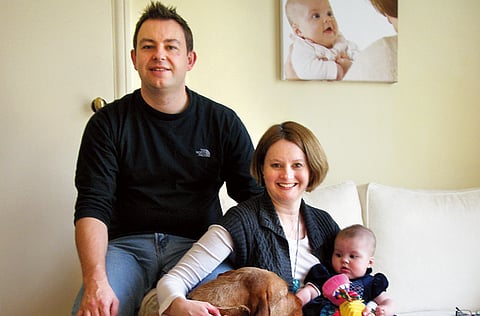
For as long as I can remember I’ve wanted to be a mum. I thought, like most women, that I’d have two or three children by the end of my twenties. But I never met the right man.
So I kept myself busy juggling a hectic social life with my career as a solicitor. As each year passed it became a little harder though and my hope of having a family began to fade.
Then my close friend Justine asked me to be her bridesmaid and I looked across the room at the wedding reception and saw Andrew. He was handsome with kind eyes and the biggest smile. I’m not normally very forward, but I walked over and started talking to him.
By the end of the night, I knew I’d met the man I was going to marry. Our wedding was 18 months later. I was 34, and we started trying for a baby as soon as we came back from our honeymoon. Every month I was devastated when I wasn’t pregnant. After six months, I went to see my GP and was referred for investigative tests.
The tests revealed I had endometriosis. My ovaries were affected, so it was unlikely I’d conceive without fertility treatment. We agreed to try IVF straight away. We didn’t care how we made the baby, just that we had our own family.
No one told me the treatment would be such an emotional roller coaster. Luckily, I’m not squeamish and injected myself with hormones every day, but when the first cycle of IVF didn’t work, I was distraught.
I cried non-stop and hated the wait before I could try again. This time seven eggs were harvested but they were of mediocre quality so I didn’t hold out much hope.
I knew my baby was a fighter
Miraculously, the second attempt worked. Andrew and I were so happy, but I bled on and off for the first ten weeks. I was in and out of hospital having scans to check that the baby was still there. Each time, I willed our baby to still be alive, and every time it was good news. My baby was a fighter.
After that, the bleeding stopped and I loved being pregnant. My bump was ridiculously huge. I was only a size ten before but swelled to an 18. I was so healthy, I glowed. I sang Good Morning to the baby in the shower to wake it up and I was impatient to become a mum.
Andrew and I chose names for a boy or a girl and had everything ready at our home in Eastbourne, East Sussex, UK. But there was no sign of the baby.
At 42 weeks I went into Eastbourne District General Hospital to be induced. I was more excited than nervous. I was 37 and my dream of motherhood was finally about to come true.
My contractions started immediately and were very strong. Four hours after my waters broke, I asked for an epidural as I was in agony.
I assumed my waters had broken but when I looked down I saw blood everywhere.
Of course, I began to panic, but the midwife reassured me that it happened sometimes and closely monitored the baby. With each contraction my baby’s heartbeat was falling. More worryingly, it wasn’t recovering as it should. The midwife looked concerned and called a doctor.
Suddenly my room filled up with people telling me they needed to deliver the baby immediately. It would be a crash Caesarean – I would be put under general anaesthetic – so I understood we were in a life or death situation, though no one knew why.
Andrew, 37, and my mother Tanya weren’t allowed to come into the operating theatre and I was praying that the baby and I would survive as I was whisked away.
What none of us knew then was that I had a rare condition called vasa previa. One of the baby’s blood vessels didn’t go into my placenta but went into the amniotic fluid surrounding it instead. When my waters had broken, the blood vessels had ruptured and the baby and I were losing blood with each contraction. It was less than 20 minutes from a problem being first detected to the baby being delivered but she had lost half of her blood and was stillborn.
Andrew and Mum were outside and doctors kept them up to date with the terrible news. “There’s no heart beat,” one said, and “the baby’s not with us.” It was awful for them – they were both so worried and, of course, I was still unconscious. They knew the baby was dead and were desperate for news of me because I’d lost a lot of blood too.
Doctors refused to give up on our baby though. They drilled her shins and injected fluids and adrenalin directly into the bones to get it into her system quickly. They gave her mouth to mouth, and heart massage and after 23 minutes she took a breath.
Even then doctors told Andrew they’d detected a faint heartbeat but that he shouldn’t get his hopes up. Our baby, Charlotte, was taken to special care, and put on a ventilator to breathe for her.
Luckily she was 8lbs, and battling so hard. When I came round I was frightened. I asked the nurse where my daughter was but she said she didn’t know anything about her. It seemed an eternity before Andrew arrived, looking very pale, to tell me Charlotte was critically ill.
Doctors advised us to have her christened, just in case. I begged to see her and was wheeled down to special care.
Staring through the glass of her incubator, I gasped, shocked. She looked so ill I didn’t think she could possibly survive. She was so tiny, with wires and tubes snaking all over her. “Fight, Charlotte,” I whispered. “Mummy loves you.”
This was Charlotte’s only chance
Doctors told us they were trying a very new technique to try to save Charlotte. They were worried that even if she did survive she could be terribly brain damaged, because she’d been starved of oxygen for so long.
So they said they were going to use a cooling blanket to take her temperature down to 32 degrees C – which induces hypothermia.
All of her organs would be slowed down so they needed less oxygen, and her brain would be able to repair itself. They were going to freeze my baby. I’d never even heard of it before. But we knew it was Charlotte’s only chance.
They couldn’t do it at our hospital so she had to be transferred to Trevor Mann Baby Unit in Brighton, Sussex.
The hospital priest christened her before she left as I couldn’t go with her. I’d had a blood transfusion and couldn’t even stand up.
The midwife took a picture of Charlotte for me, which I clung to. I didn’t sleep all night, asking the nurses to ring every hour for news. I wanted to do something for Charlotte so recorded me singing Good Morning on my phone. Her brain was being monitored and when Andrew played it to her the activity went mad.
First thing the next morning, I was transferred to Brighton to be with Charlotte. She was lying on a white cooling blanket. I touched her face. It was icy cold.
I expressed milk for midwives to put into her feeding tube and Andrew read her stories. Charlotte looked like she was asleep. Her eyes were closed, her skin cold but she was battling to stay with us.
After three days, the doctors began raising her temperature half a degree at a time. They took her off the ventilator, but Charlotte couldn’t breathe on her own.
The next day, they tried again and we all held our breath waiting for her to take one. Her tiny chest rose, then dipped, then rose again. She’d done it. I wanted to hug her then, but pulled back my hand, alarmed. Her skin was boiling.
“She has a fever,” I said, panicking, and all the medical staff laughed. That was her normal body temperature but I’d never touched her without the cooling blanket before.
Charlotte surprised us all after that by making an amazing recovery. A week later I was allowed to take her home – the moment I’d waited for all my life. Andrew and I were warned she may have some brain damage or other problems but she’s a happy, clever little girl who’s developing normally. She sat up at six months, said Dada at five months, Mamma at six months and is now tearing around.
She had an MRI scan that was all clear, and a CT scan showed she’d suffered a trauma to her brain but there was no seizures or other damage. Charlotte is 22 months now and our little miracle. When I go into her room in the morning and she gives me the biggest smile, my heart melts.
She defied all the odds to survive so, of course, she has a strong personality and is already fiercely independent. But I’m grateful for that – it helped her stay alive.
How cooling treatment works
Cooling blankets – mattresses filled with cold air or fluid – induce hypothermia, similar to hibernation, in which all the body’s systems dramatically slow down. The body’s demand for oxygen is lessened and less energy is needed to keep going. Crucially, it slows the rate of any damage to the brain.
Dr Topun Austin, a neonatologist at Addenbrooke’s Hospital Cambridge, UK said, ‘It was originally thought that if you were starved of oxygen the damage to the brain was instant. Actually it takes a few days. It’s very important that infants eligible for this treatment are identified early, as the sooner cooling starts the better.’ The treatment works for one in nine babies starved of oxygen.


