Meet the teenage shark whisperer
Madison Stewart has been swimming with sharks since the age of 12
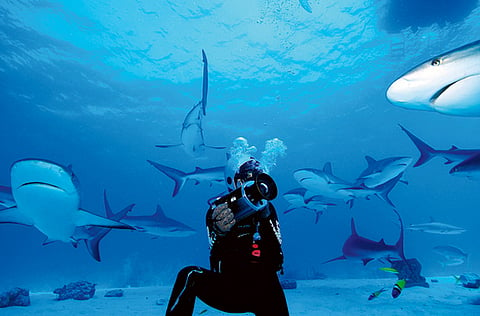
Gently, almost lovingly, Madison Stewart strokes the snout of a metre-and-a-half-long reef shark. She doesn't hurry as she sweeps her hand along the wriggling predator's body down to its dorsal fin. The shark could snap her hand off in an instant. But instead it gradually slows its movements and, finally, as if hypnotised, the creature sits cradled in her arms.
Biologists call this trance-like state ‘tonic immobility'. The death-like freeze is perhaps some kind of defence mechanism.
Madison, an accomplished underwater camerawoman, is one of a rare breed of divers and scientists able to induce this paralysis. They are known as ‘shark whisperers'.
What's even more surprising is that Madison is just 18, has been diving with sharks for six years, and is rapidly making a name for herself as a passionate advocate of the creatures.
"Sharks are like family to me and people have totally the wrong idea about them," she insists. "More people are killed by falling vending machines each year than by sharks and yet we slaughter millions annually. It has to stop." This is why she's been making documentary films and campaigning against the killing of sharks for their fins, which are considered a delicacy in parts of Asia .
"In places where sharks have been killed off, fish stocks have collapsed. In recent years, around 175,000 sharks have been killed annually on the Great Barrier Reef so that people can have a fin in their soup. It's wrong."
If ever a person was born to a cause, it is Madison.
"When she was a newborn her dad Ernst tried to bathe her," remembers Madison's mother, Jeni Nicholls, 51, a psychologist in Brisbane, Australia.
"He accidentally dropped her in the water. I freaked out, but her dad scooped her out and she didn't make a murmur. We've always joked that dunking set her on her career path."
Water baby
For the first four years of her life Madison's parents lived aboard a yacht cruising the Great Barrier Reef.
"We'd find little bays where Madi could swim with sea creatures," says her dad Ernst, 54, formerly a university lecturer in physiology and now a dive master in Australia's Byron Bay. She was captivated, and wanted to spend all her time in the water, he recalls. When her parents later split, Madison, passionate about marine life, was raised mostly by her dad. "We loved watching shark documentaries together," she says. "My dad would tell me they were beautiful and that we needed them in the ocean because they took the sick, weak and injured fish so the rest of the fish population stayed healthy. I couldn't wait until I got older and could scuba dive with sharks like dad did."
On her 12th birthday, she got her wish, with her mother's approval. "I'd been a diver myself and I trusted Ernst's judgement," Jeni says.
As Madison and her father hovered in the water, two huge figures appeared out of the gloom: grey nurse sharks. They swept past the pair with a beat of their powerful tails.
"I'd never seen anything so perfectly adapted to its environment," says Madison.
She was so thrilled, she didn't want to leave. "I had to drag her out while she still had air in her tank," recalls Ernst.
Not long afterwards, she did her first shark night-feeding session on the Great Barrier Reef. "We were staying aboard a boat and the dive crew threw a mix of fish pieces and blood in the water to attract the sharks. Then we jumped in," Madison says.
"Most girls my age spent their time at the mall or talking about boys," she says. "I chased sharks with my dad! I was academic and a teacher's pet too. I didn't fit in."
By the time she was 14, Madison knew she wanted to spend her working life underwater in some capacity, preferably with sharks.
"My dad had always dreamt of travelling to the world's best dive spots, so I put a proposal to him," she remembers. "I told him, ‘You want to dive, I want to leave school. Home-school me and we can travel together.'"
Fortunately for Madison, her father was anything but conventional. Having given up a promising university career to pursue his passion for diving, he respected and understood Madison's need to follow her instincts.
He agreed and enrolled her in distance education. "That way we could continue with mainstream education and experience the wonders of the natural world at the same time," Ernst says.
Her mother was supportive too. "I would have liked Madison to go to university, but I knew she was an intelligent girl and her father would be able to help her with her education," says Jeni. "I thought it was important we listened to her and helped her explore her passions. She was never going to find them in a suburban shopping mall."
An eye-opening experience The following year Ernst sold his home and he and Madison started travelling, interspersed with spells of work as a dive master. Their first big trip was to Fiji.
"I persuaded dad to buy a video camera with underwater housing so I could make films while diving. I said he could afford it because he was saving so much on school fees," she laughs.
In Fiji the weather closed in and, unable to dive, Madison watched a documentary called Sharkwater. It was about the trade in shark fins, prized for shark fin soup in Asia.
She found herself crying as she watched live sharks having their fins hacked off, before being thrown back into the ocean to die.
Stunned, she soon learnt that sharks were caught for their fins in Australia too.
Back home, she did some research and learnt about the East Coast Inshore Fin Fish Fishery. The fishery allowed for the capture of tropical sharks on the Great Barrier Reef.
"Taking them for their fins was illegal. But, providing fishermen kept the shark body to sell, the fin could be taken and sold as a by-product. It was a disgrace," Madison says.
The fin ‘by-product' could fetch AU$300 (Dh1,175) a kilo in Asia while the flesh, sometimes labelled ‘flake', sold for far less at just 10 or 15 dollars a kilo in supermarkets and fish and chip shops.
Saving sharks
Madison decided she had to do something. Her resolve was bolstered when she and Ernst dived the Great Barrier Reef and saw just one shark at the site where she'd seen 30 just a couple of years earlier.
The dive boat crew told her poaching and fishing were decimating shark numbers.
In February 2009 the licence for the fishery was due to be renewed.
Madison decided to edit some of her shark footage together and send it to Peter Garrett, the then Minister for the Environment, Heritage and the Arts in Australia. "I wanted him to know how beautiful and important sharks are," she says.
She sent him a DVD but didn't get a reply. And, to her horror, the licence was renewed.
Madison continued making films, now sending the footage to conservation groups like Sea Shepherd and the Australian Marine Conservation Society so they could use it.
Later in 2009, she and her father went to the Bahamas in the Caribbean to dive and film. Sharks were protected there and, to her surprise, Madison first saw a shark whisperer in action.
"While feeding a reef shark, our dive guide stroked its snout," she remembers.
"The shark stopped moving, almost hypnotised, and stayed like that for over ten minutes. The guide told me it was a reflex action called tonic immobility. Right then, I knew I wanted to be able to do it too."
But no one would teach her as she was considered too young.
"It was very frustrating," she says. "I wanted to get close to them - I wasn't scared."
In September 2010, diving off the coast of New South Wales, Madison proved her lack of fear when she saw her first great white shark. Spooked, the three-metre shark slid between her and a reef to get away - and Madison chased after it. She wasn't fast enough but, excited and thrilled by the close call, Madison texted her mother the moment she stepped back on dry land. "This time, she was nervous," Madison laughs.
But the teenager was determined her love of sharks was going to make a difference. So, just a couple of months later, Madison decided to stop distance education so she could focus on filmmaking and step up campaigning against the renewal of the fishery this year. Her father agreed she could pursue underwater filmmaking. She set up her own film company, Elements 5, and a campaigning facebook site called The Great Barrier Reef Resistance.
Then, in April 2011, she and Ernst flew to the Bahamas again. By then she'd logged over 450 dives, and was finally experienced enough to learn shark whispering.
"Underwater, an inquisitive small reef shark approached me. I was wearing a chain-mail dive suit and had been told how to shark whisper by the guides," she recalls.
"As the shark swam towards me, I slipped over and onto the top of it, running my hands slowly back along its snout towards me. Mesmerised, it actually relaxed its body in my arms and I got to hug it for a few minutes! It was incredible."
Ernst agrees. "It was like watching her pat a dog," he says.
Close shave
Afterwards, Madison stayed in the water to film some tiger sharks that had turned up. They are fearsome man-eaters by reputation.
"As I filmed, my monitor went dark. A tiger shark had latched onto my camera housing," she says.
The camera housing was covered in scratches and tooth marks.
Ernst was watching and, unconcerned, filmed it all. "Madison did not realise that the shark stopped just a few centimetres short of her hand because she was still looking at the monitor. It could have gone all the way up her shoulder but it didn't like the sensation of the metal camera housing in its mouth."
This underlines Madison's theory about shark attacks. "Sharks don't have hands. They feel with their mouths. Most attacks are an exploratory bite. The shark is working out what we are."
Back in Australia, Madison continues campaigning, putting together films which she launches on YouTube. "I want to educate people about sharks and encourage them to put pressure on the Government," she says. The movies have been an instant success, generating tens of thousands of hits.
Right now, the Australian Federal Government is considering the fate of the East Coast Inshore Fin Fish Fishery. Whatever the decision, Madison plans to continue her fight to protect sharks around the world.
"Her campaigns come from the heart and her footage reflects her passion to change what is wrong," says Ernst.
Judging by the overwhelmingly supportive comments on her YouTube and facebook sites, she is succeeding.
Ultimately, Madison's hopes are simple. "I just hope I can persuade people that sharks aren't mindless killers and that they're a vital part of the ocean," she says.


