
Joy Alukkas: Man with the golden touch
A turnover of $2bn. More than 4,500 staff members. And retirement in three years.
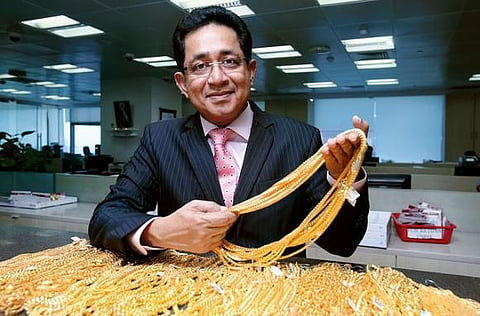
He appears unassuming even when he’s the only person in a suit – “worn specially for the Friday photo session” – on the floor of the Joyalukkas corporate office in Deira, Dubai. But the moment Joy Alukkas, chairman and managing director of the eponymous jewellery group, walks into the office, every one of around 40 staff stand up waiting for his next command.
It’s an open-plan office, a deliberate ploy according to the 55-year-old. “I want to see everybody, and everybody to see me.” He smiles as the staff take their seats and resume work as if he’d given a sign that excused them.
Although he’s ranked 81 on the Forbes’ richest Indians list and is number 1,342 on Forbes’ list of billionaires, it’s difficult to identify him as such. If he was seated in a huddle with his employees in his office, you might walk by and not realise at first glance that he was the boss because, out of the suit, he appears to be one of them. And he doesn’t raise his voice. Ever.
But look carefully and you’ll spot him: he’s the one usually dressed in a plain white open-necked shirt and smiling. And why not? He has plenty to celebrate. To say he is a success would be an understatement. Joy’s group has 85 outlets spread over nine countries including India, the UAE, Oman, Qatar, the UK and Singapore. He will be opening stores in the US and Malaysia soon. “This year we’ll be opening 18 outlets in northern India as well,” he says.
Joy enjoys leaving people awestruck with his success. What stands out about him is not so much what he says as how he says it. His sentences don’t end with exclamations. What he wants is to make you exclaim at his achievements. And therein lies his success.
He credits his achievement to his father Varghese Alukkas. “He opened a gold store in 1956 in Thrissur, Kerala, which was a huge success. He influenced me a lot,’’ says Joy.
“I used to enjoy being with him. In fact at the age of 15, I left school to work at my father’s shop as a salesman and learnt a lot from him – most importantly the ability to take quick decisions and stick by them.’’
Joy was born into a large family of 18 siblings. “Fifteen of my siblings – 10 sisters and five brothers – are still alive,’’ he says.
He learnt most of his lessons from working rather than school. “The time I spent at school was minimal,” he says. “All I learned in business I did from my father. I’ve never been to college and I’ve never felt that I missed anything.’’
Middle Eastern money
A major factor that helped him in business is foresight. In 1987 when Joy and his five brothers who initially comprised the Alukkas jewellery group in Kerala were still a team, he was intrigued by the wealth that expatriates in the Middle East were sending back to Kerala.
Sensing a lucrative market, he made a trip to the UAE, gauged the gold-buying potential of Indian expats here and managed to convince his more conservative brothers to make a foray into the region. “Instead of sending the money back to India, I felt we could encourage people to invest in gold,’’ says Joy.
Hoping he would have better luck in another emirate, Joy closed shop in Abu Dhabi and moved to Dubai in 1988. But the Gulf War broke out in 1990 and the markets went into turmoil.
Sure the markets would recover in a few years, Joy chose to return to India and concentrate on the businesses there, and sure enough, he came back to Dubai in 1995.
“I decided to revive the Dubai shop as my licence hadn’t been cancelled,” he says. “I didn’t have much jewellery, so I walled off half the shop to reduce the space so customers wouldn’t realise my shop didn’t have much stock. Besides, it gave the impression that the shop was always crowded, and that attracts people.” The move was a success and as his revenue increased, he began to open more outlets.
Family values
While the business was growing, Joy’s family was growing apart. Initially one of his siblings decided to go his own way, then another, and by 1999 the family business broke up and all five of his brothers established independent retail jewellery and textile chains in India.
Joy and his wife Jolly, 53, make sure their children – John Paul, 28, Mary Jenny, 25, and Elsa, 19 – are just as focused as they are.
“I also tell my children the importance of having a target and staying focused,’’ he says.
Not wanting to have all his eggs in one basket, in 2003 Joy started diversifying and now has five more divisions that he manages simultaneously – a textile division called Jolly Silks, set up in 2003; a jet charter division called Joy Jets, set up in 2006, which will soon have three aircraft and a helicopter; a money exchange firm set up in 2006 called Joyalukkas Money Exchange that operates in the UAE, Oman, Kuwait and India; a chain of eight wedding malls called Mall of Joy in India and a real estate division, Joyalukkas Lifestyle Developers. “Our staff are an asset,” he says. “I have around 4,500 staff at present. It will increase to 6,000 by the year end.”
Quick on the draw
Joy’s close associates say a major reason for his success is his ability to take lightning-quick decisions. “When I have to take decisions, I don’t consult anybody,” he says. “That’s why I’m able to take decisions fast. They are not knee-jerk decisions, but are based on logical, business and financial considerations. And though I have made a few mistakes along the way, by and large I have been right. It saves me a lot of time, and in my kind of business time means money.”
As if on cue, a telephone call comes through from Ramanathapuram, southern India. It’s the landlord of his new showroom in the city. He’s concerned because the neighbours are opposing Joy’s plans of building an extension to the showroom. Without missing a beat, Joy tells him, “Go ahead and build. If there are any legal complications, I’ll deal with them later.”
Joy is also a stickler for detail, insisting his staff are well groomed and presentable. He personally supervises the decor, lighting and displays in his stores and ensures they are just right to attract customers.
He also insists that all senior vacancies in his companies are filled by staff he’s trained over the years. “Very few staff choose to leave us because we treat them well,” he says.
On the brink of achieving his dream of 100 showrooms in 10 countries, is there anything left for him to conquer?
“I am growing older. I plan to retire in 2015 and hand over everything to my son,” he says.
But Joy won’t be retiring without a flourish. “I am building a 500-bed cancer speciality hospital in Thrissur, India, within walking distance from my home,” he says. “I’d like to spend my retirement managing the hospital along with my wife. I’ll quit all my business commitments. I’ve already started making my son John Paul the authorised signatory for most of my business ventures in the Middle East.”
Joy thinks it’s important to retire before getting too old. “I am now quite healthy and still able to work,” he says. “If I thought of doing this at 70, I may not live to see it work.
The stresses of running a hospital might not be the average person’s idea of a relaxing retirement, but Joy is not your average person.


