Seoul contenders: South Korea's motoring resurgence
Some of the most exciting new cars on the road come from least expected source
As the great Yogi Berra observed, "It's tough to make predictions, especially about the future". If you had been asked ten years ago to predict which country would be producing some of the most exciting cars on the road today, how many would have picked South Korea?
Yet, that is exactly what's happening. This nation of 50 million people, set between China to the north and west, and Japan to the east, is turning the global car market on its head with a seemingly endless stream of evermore funky and appealing cars, and achieving extraordinary double-digit monthly growth in sales.
How is this possible? Ten years ago there was little outside evidence it was going to happen. Korea's largest carmaker, Hyundai, was churning out forgettable small saloons mostly for the domestic market. But it was a large, well-run company with diversified interests and a healthy balance sheet.
KIA was not so lucky. Hyundai's rival had expanded aggressively into new plants and facilities in response to several good years of growth, but was brought to its knees by the economic downturn of the late 1990s. Salvation came in the form of a merger with Hyundai, and in the process, the world's fifth-largest carmaker was born.
The defining characteristic of the new company, then and now, is ambition and ruthless determination. The will to succeed, whatever it takes. And in fact, what it takes is ultimately great-quality products, cars that are well designed, comprehensively equipped and competitively priced. But that requires an awful lot of skill to deliver, and the achievements of the Hyundai KIA Motor Company over the past ten years is a textbook case of how to run a car company.
Make no mistake, the cars currently coming out of Korea are real contenders, beating their Japanese rivals in the world's biggest market, America, and topping the Germans for build quality in their home country. Hyundai edged out local manufacturers BMW and Audi, and eclipsed its rival Toyota to take the prestigious AutoBild magazine's 2010 ‘Best Quality Car' award based on analysis of reliability, long-term quality and customer satisfaction.
The AutoBild survey is considered by many to be one of the most respected in the industry, and shows just how far the Korean carmaker has come in consistently improving the quality of its products, service and support provided to owners.
Likewise in North America, Hyundai's new Sonata has been ripping up the record books. The company shifted more than 530,000 cars in the US, and another 110,000 in Canada in 2010 alone. With more than 90,000 more cars sold this year, the Sonata is achieving faster growth in sales than any other car.
And the Koreans aren't shy about the future, either. Plenty of wacky concepts at the big car shows, for sure, but they have an enviable record for putting the concepts into production, so there's plenty more for us to look forward to. You'd be a brave person to bet on anyone stealing their crown in the next ten years.
Oullim Motors
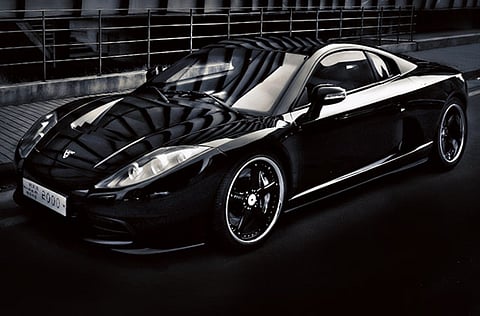
Han-chal Kim is the creator of the Spirra, Korea's first legitimate supercar, a hand-build exotic based on a carbon-fibre tub and tubular space-frame. Power comes from a mid-mounted, Hyundai-sourced 2.7-litre V6 producing 175 horsepower and 181 pound-feet of torque in the base form. The Spirra S adds a small turbocharger, resulting in 330 hp and 347 lb-ft, and Spirra T uses a larger turbo that ups output to 400 hp and 362 lb-ft. At the top end is the Spirra EX with a twin-turbo V6 pushing out a full 500 hp and 398 lb-ft, making this car capable of competing with the likes of Lamborghinis and Ferraris. All models are fitted with a 6-speed manual transmission, and power is sent solely to the rear wheels.
Veloster
Reckoned by industry experts to be a Sirocco rival, the Hyundai Veloster is a smart coupe/hatchback based on the company's i30 platform. Expected to be powered by a 1.6 litre direct-injection turbo, the Veloster is due to reach these shores around the latter part of this year. It will be the first car to feature the new twin-clutch gearbox. There's also a rally version to raise its profile on the world stage.
Genesis Coupe
In many ways the car that did most to shift perceptions about the company, Hyundai's original Coupé proved it understood the wishes of enthusiastic drivers. It has evolved considerably since then, and this new version sits on the modern Genesis platform, complete with muscular 3.8 litre V6 promising a 0-100kph time of just 6.5 seconds. It also features Brembo brakes, sticky tyres and sports suspension.
Kia, Soul
Proof that you still can create a completely new shape, KIA's funky Soul offers a new way to roll. Compact, economical but still fun to drive, the Soul is unlike anything else on the road. Which other car comes as standard with speakers that pulse red in time with the music? The interior glows with LEDs, and the whole lot is pushed along by a punchy 1.6 litre engine with 124bhp driving the front wheels.
Cadenza V6
KIA's take on the large luxury sedan, the Cadenza continues the evolution of ex-Audi man Peter Schreyer's design language. When asked why he went to KIA, Schreyer said he saw in the company the same opportunity as at his previous employer, the chance to direct the future form and function of an entire range of cars. The Cadenza stands easy comparison with the best from Europe.
New Sportage
Continuing with the modern design theme, the comprehensively reworked Kia Sportage is now a thoroughly contemporary contender in the compact SUV sector. With a choice of 2- and 4-wheel drive versions, the Sportage offers a compact 4-cylinder engine producing 176bhp, a surprisingly spacious interior and plenty of storage space. Rivals had better watch out.
Hyundai Sonata
The one that all the fuss is about, the all-new Sonata is the most accomplished expression yet of Hyundai's new ‘fluidic sculpture' design language. Inside you'll find comfy, well-bolstered seats, a panoramic sunroof, and paddle shifters behind the wheel to control the standard 6-speed automatic gearbox. And it's cheaper than all the equivalents from the likes of Honda, Toyota and Nissan.


