Alfred Neubauer
This influential race chief led Mercedes-Benz to the top of the racing world in the Fifties
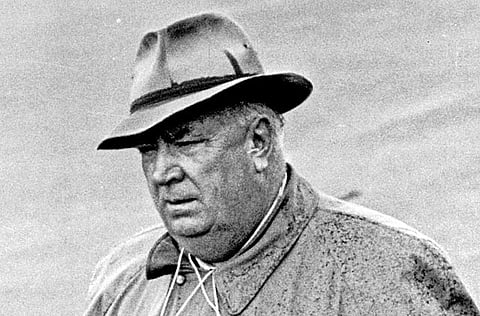
The cobblestones of Europe had been trampled on by Roman Ballistae, Genghis Khan’s horses, Napoleon’s cannons, and then, Germany’s Silver Arrows. A new weapon had arrived, a demonstration of industrial power, engineering brilliance, and physical prowess; motor racing. We didn’t need to kill each other any more to prove our dominance over one another, we merely had to beat the other guy around a lethal road course in a supercharged straight-eight rear-engined racing car with 500bhp-per-tonne and knobbly tyres. OK, so every once in a while people did kill each other jostling for the line through the Masta Kink.
But then the human urge for devastation and despair took over once again, and Europe’s cobblestones resonated to the rhythmic steps of marching soldiers during the Second World War. No racing. Devastation and despair for every motorsport fan in the world…
We would have to wait until 1950 for Germany’s return to the racing circuits, but by then the Auto Unions and Stuttgart’s Silver Arrows weren’t so effortlessly dominant with their kompressors and V16s. A little island across the channel honed its engineering skills in the frenzied need of wartime advancement, and by 1950 Britain’s lightweight racing cars were well poised to take on the competition.
Germany had to get back to its dominant tack form of the Thirties however, and Mercedes-Benz led the way by re-establishing its racing department, signing Karl Kling on as a factory driver, and leaving the whole thing in the capable hands of Alfred Neubauer. The well-fed Neubauer attempted to compete with defunct 20-year-old W154s powered by supercharged V12s, the cars being surprisingly competitive at first but perhaps only due to the mastery of Kling and Juan-Manuel Fangio.
Legendary sportscars followed (Rudolf Uhlenhaut’s Gullwing and Roadster) but the top-tier Grand Prix cars weren’t ready until 1953, at which point Neubauer’s strong influence within Mercedes-Benz resulted in a racing department some 500-employees strong, an unheard of amount at the time when most racing teams had a staff of perhaps a dozen.
In 1955 Neubauer’s venture paid off, as his drivers Fangio and Stirling Moss piloted their pair of 300 SLRs to the front lines. Neubauer’s perfectionism meant his account of that year was gloomy at mid-point: “The only disappointment was the likely failure to win the racing sports car championship, the Constructors’ Prize. This championship, introduced only in 1953, is awarded not to the winning drivers but to the manufacturer that makes their cars. Ferrari was well ahead in the standings, and it was going to take a miracle to overtake them.”
A miracle is what he got. Moss won in Northern Ireland, and a full assault on the title-decider, the Targa Florio, followed, with Neubauer consigning eight racing cars, eight heavy-duty trucks and 15 passenger cars with a support team of 45 mechanics.
Neubauer said, “I had never planned a race so carefully and thoroughly. For that 1955 Targa Florio, I drew one last time on all my knowledge and experience, all my tricks and my love of the game.”
His pit strategies and driver-changes, as well as Neubauer’s famous introductions of pit-to-driver communications by means of boards and flags, ensured that Moss won the Targa that year and Fangio came in five minutes behind him in second. The Silver Arrows were back at the top, and in 1955, Europe’s cobbles crumbled under the weight of Alfred Neubauer.


