Gadget of the week: Smartest of them all
From the just-concluded Mobile World Congress in Barcelona, David Tusing picks five top gadgets showcased at the largest annual mobile exhibition
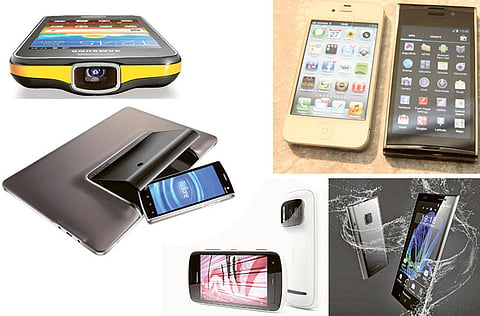
Samsung Galaxy Beam
The buzzword about three years ago, when smartphones were starting to dominate our collective imagination, was convergence. Since then, device makers have been too busy outdoing each other with their operating systems and what-nots.
Samsung’s Galaxy Beam, with an in-built pico projector, is here to remind us of what we, the consumers, really want our devices to be: true all-in-ones. With a 15-lumens lamp, the quality of the projector is not great by projector standards but images, or any content from your phone, can be projected to up to 50 inches. There’s even a focus function built into the volume buttons to adjust the projection.
The Galaxy Beam is not the first smartphone to come with a projector, neither is it Samsung’s first. But it’s the first Android-powered (2.3 Gingerbread) phone to do so and the first smartphone with projector that actually looks like one and not a mini projector.
The phone will be available in the UK in July and we’re hoping in the UAE not too long after.
Panasonic Eluga Power
Looks who’s trying to be a smartphone player too. After a few years’ gap, the Japanese company is back in the reckoning with the Eluga Power, its 5-inch Android 4.0 Ice Cream Sandwich offering that’s an improvement on its already-existing 4.3-inch Eluga. Certified to be both dust- and water-proof (up to 1 metre), the Eluga Power comes with an 8-megapixel rear-facing camera, a 1080p full HD recording capability and 8GB of internal memory expendable via a micro SD slot.
Panasonic also said the phone will feature something called a “superfast” charging feature, which will power it up to 50 per cent in 30 minutes. At 9mm thick, it’s one of the thinnest smartphones out there.
No word on pricing yet, but the Eluga Power is expected to be available later in the year.
Nokia 808 PureView
We've got to hand it to Nokia. After losing its No 1 manufacturer crown, the company has been working very hard to introduce hit devices.
The 41-megapixel, yes 41, PureView phone comes with a 4-inch AMOLED screen, 512MB of RAM and 16GB of internal memory. Although powered by Symbian and not Windows Phone, it's the megapixel with Carl Zeiss optics that Nokia is hoping will attract attention — and it did at the MWC. But while the 41 megapixel will not necessarily result in high-quality photos (it's a bit more technical, so deserving of a column on its own), suffice it to say that it is revolutionary in that it will let you capture images even in trying (read dark) environments.
Nokia says the 808 PureView also features Rich Recording for great sound — and will hit shop shelves in Europe in May for about €450 (Dh2,203).
Asus PadFone
Amid all that tablet warring recently, Asus, which once revolutionised the netbook (remember those?) market, launched the Eee Pad Transformer, which locked its tablet to a keyboard, turning it into some kind of a laptop/netbook. With the PadFone, it wants to take things a step further.
Part phone, part tablet and part laptop, the PadFone features a 4.3-inch Android (4.0) smartphone, which can dock into a tablet and transform the phone into a full-on tablet. Confused? Don't be.
Essentially, there are two devices to this. First, there is a phone, with an 8-megapixel camera and high-resolution AMOLED display. Then there is a tablet, with a 10.1-inch screen. The phone can be docked into the back of the tablet so you can utilise both its powers simultaneously. The third element is the keyboard dock, which also can be attached to turn your device into a full-on laptop. And one more thing, the stylus also turns into a Bluetooth headset.
The Asus PadFone is expected to hit shop shelves globally in April. No word on pricing.
Lumigon T2
There's enough space for more high-end designer smartphones — at least that's what a little-known Copenhagen-based manufacturer is trying to tell us. But the Lumigon T2 has enough and more up its sleek sleeve to convince us.
First, it's a beautifully designed device, which is obviously its main selling point. Mostly glass and stainless steel, this 3.8-inch screen beauty's minimalist look is a seller at first glance. Then there are all the niceties, including Bang & Olufsen audio technology, an 8MP rear-facing camera capable of 1080p Full HD video recording, Near Field Communication (NFC) to talk to other Android phones nearby and, yes, it has Android 4.0 Ice Cream Sandwich on-board.
But our favourite feature is that it comes with an infrared blaster, which lets you turn it into an universal remote control. The in-built app lets you input command and you can basically use the phone to control your entire living room. Convergence, didn't we say? The Lumigon T2 is expected to be available in the first half of this year for about $670 (Dh2,461).


