Will iTV be the next big thing?
After dominating the music and smartphone industries, Apple aims to conquer the television sector with integrated sets, expected to hit the markets in the second half of next year, that respond to gestures and voice
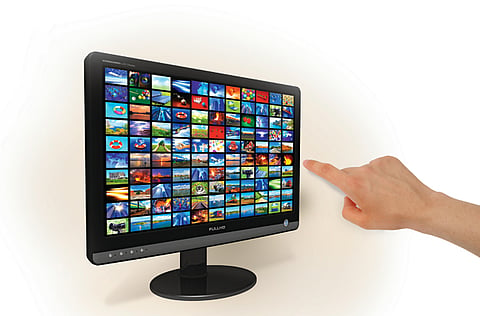
Having transformed the music and mobile phone industries with its iPod and iPhone, Apple is planning an ‘iTV' to turn couch surfing into a hi-tech experience.
The Japanese firm Sharp has been asked to begin commercial production of Apple TV screens in February, with the sets available in the second half of 2012, says analyst Peter Misek at the American bank Jefferies.
"Other TV manufacturers have begun a scrambling search to identify what iTV will be and do," Misek says. "They hope to avoid the fate of other industries and manufacturers who were caught flat-footed by Apple."
An internet-connected TV offering seamless links to cloud services to download films as well as a new level of interactivity could threaten other manufacturers as well as taking viewers away from pay-TV giants such as BSkyB. Senior engineer Jeff Robbin, who built the iTunes service and helped to create the iPod, is reported to be overseeing the project. Speculation reached new heights when the TV project was mentioned in a biography published soon after the death of Apple's founder Steve Jobs in October.
Jobs told his biographer: "I'd like to create an integrated television set that is completely easy to use. It would be seamlessly synced with all of your devices and with iCloud. It will have the simplest user interface you could imagine. I finally cracked it."
In October the US patent office published a filing by Apple for "real-time video process control using gestures", which describes using infrared, motion and other sensors to read the user's movements. Gestures could edit video, or "throw" it from one device to another, that is to transfer a film from a mobile phone to a bigger screen.
The patents mention facial recognition to tag individuals within videos so that home videos can be grouped according to who features in them. This autumn the iPhone was updated with a highly accurate voice control software called Siri, and some observers believe it will feature on the TV sets.
What sounds like science fiction is already in use by niche products. Chinese manufacturer Hisense unveiled an internet TV last month that runs on Google's Android software and allows the viewer to issue commands with a wave of the hand.
Microsoft's Kinect, which links the Xbox games console to TV sets, acts as a digital video recorder and reads voice and gesture commands. Users can rewind, fast-forward, call up menus, or select games and channels without having to find the remote control. Thanks to four microphones, it separates the user's voice from other noises in the room and users must say Xbox before speaking a command.
The venture is a risky one for Apple, whose previous foray into the world of television resulted in a rare failure. Apple TV, introduced in 2007, is a box that can store video and connect the TV to the internet or to the laptop to view photos. However, its latest model is thought to have sold no more than two million units, compared to 40 million iPads since March 2010.
Apple TV already incorporates some gesture commands, using the iPhone as a remote: users can flick it left or right or drag two fingers across its screen to fast-forward or rewind, and tap to play.
Misek says the iTV could have an initial production run of five million to 10 million units and will use liquid crystal displays. The company declined to comment.
Apple has taken over an entire Sharp factory to make its latest generations of phones and tablet computers, which will appear next year with brighter, less battery-draining screens. It is estimated to have spent $500 million (Dh1,836 million) to $1 billion buying manufacturing equipment for the plant, and retooling of a production line is believed to be under way to produce TV screens.
Technology researcher Benedict Evans at Enders Analysis was sceptical about how revolutionary an iTV could be. He said that accidental gestures could disrupt viewing. "It would be like sitting in Sotheby's and desperately not moving so you don't accidentally make a bid for 10 million," says Evans.
The project will open a new front in Apple's battle with the South Korean consumer electronics giant Samsung, which already makes internet-connected TV sets and has been competing against the US group to produce high-end tablet computers and smartphones. The two are locked in an international patent disputes, with some 20 court cases around the world.
— Guardian News & Media Ltd


