A concrete plan
A waste recycling plant in Navi Mumbai, India, shows the way to deal with the 2,250 tonnes of construction debris that the metropolis generates every day
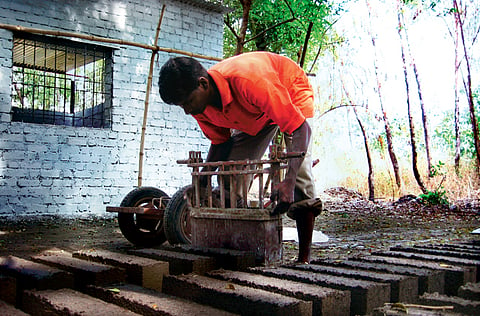
What began as an experiment in construction debris has now become a fine example of efficient recycling of waste material. Yuva Centre, the joint effort of an NGO and the town planning agency City and Industrial Development Corporation of Maharashtra (CIDCO), converts three tonnes of construction debris into concrete blocks every day at its 3,500-square metre facility in Navi Mumbai, India. And this is just the beginning of a recycling revolution.
"Mumbai alone generates 7,500 tonnes of solid waste everyday, a good 33 per cent of which constitutes construction debris. Recycling plants such as these, if set up at different locations across the metropolis, will not only put the construction waste to good use, but also help preserve the soil and fuel that go into the making of mud bricks in conventional kilns," says Ashis Biswas, CEO, Yuva Collective. They also provide a solution to the challenge of finding spaces where the construction debris can be dumped, since debris is not allowed to be disposed at the city's waste dumping grounds.
Giving an idea about the amount of debris that is generated in the metropolis, Biswas says that the repairing of the external structure of a 20-storey building alone generates 200 truckloads of debris. With old buildings being pulled apart or repaired in every part of the city, recycling plants are assured of the raw material — the debris — for years to come.
Break and build
After starting on an experimental basis way back in 2002, the recyling project has been fine-tuned over the years, and the portfolio of the recycled products has also been increased.
"Besides concrete blocks, we also manufactured solid blocks, hollow blocks, paver blocks, tiles and road dividers from the construction debris. The quality of the material produced at the recycling plant is at par with the best in the business," says Dhanraj Shirsale, Field Assistant, CIDCO, adding that besides builders in Navi Mumbai, CIDCO itself has also used the concrete products from the Yuva facility for its different housing projects for varying income groups across the satellite city of Navi Mumbai.
Even in terms of technology, the recycling plant runs on a basic electric-powered machine that's usually used in the pharmaceutical and chemical industries. The debris is sourced from construction sites and is broken down into particles of 30 to 40 millimetres in diameter. The particles are then powdered by a pulverising machine and special screens enable the machine to grind the particles to desired levels of fineness. Coarse aggregates require screens with larger gaps.
"The dust controller sections of the machine filter out unwanted light materials such as wood particles and other organic items. Cement and water is then added to the pulverised material to mould it to a brick-like shape and these moulded bricks are then cured (hardened by repeated wetting and drying) for 14 days and then sun-dried, before they are ready for dispatch to the sites," reveals Shirsale. The recycling plant can also supply fine sand, as an alternative to the conventional sand that is dredged from the seabed at the cost of upsetting the fragile ecosystem under water. "The sand produced from construction debris has similar strength and can serve the purpose," Shirsale says.
Economically feasible
The economic feasibility of the concept makes it suitable for replication in other parts of the city. "A recycled concrete block costs Rs21 (about Dh1.7) vis-à-vis the Rs28 for a block made from fresh material. Moreover, the recycled blocks have good tensile strength, making them a viable alternative to conventional bricks," says Biswas.
On their part, the developers are only too keen to source the produce from the waste recycling plant. "While the concrete blocks are used extensively for the walls, we use the paver blocks for flooring in the external areas of our buildings," says Ashok Agarwal, Director of Navi Mumbai-based Agarwal Group.
Even as CIDCO and Mumbai's Brihanmumbai Municipal Corporation (BMC) are now planning to scale the operations to other parts of the metropolis, it will be sometime before the debris recycling project will see the light of day in the UAE.
S. Prakash, Chief Architect, ETA Star Group, says, "Debris being recycled into building blocks is a welcome idea. But ensuring the continuous availability of debris in close proximity can be a hitch, as well as a crucial factor to the viability of the project.
However, this can be a good regional attempt, similar to manufacturing of fly ash bricks near thermal power plants."


