Bowled over by Singapore
GN Focus Editor Keith J. Fernandez eats his way across the island and finds that it lives up to its reputation as a food paradise
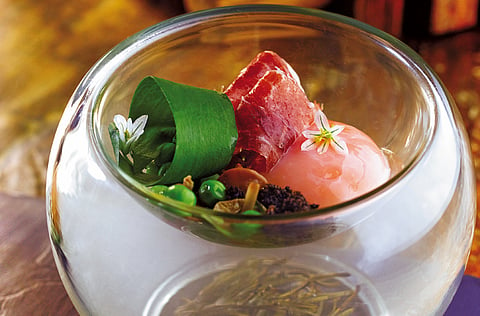
It’s the eggs that steal the show. Nearly a month later, the abiding food memory is of rosemary-smoked runny eggs and a crisp, flavour-packed slice of cured meat. Eggs are a staple of any brunch, but ones like this I've never had.
At Singapore's highest restaurant, how fitting that the eating should be stratospheric. I'm lunching in company at Jaan, an intimate 40-seater dedicated to artisanal French food, with the magnificent view of the new Marina Bay development and the Singapore Flyer being only outdone by chef Julien Royer's fabulous meal. Situated on the 70th floor of the Swissotel The Stamford, Jaan has an 85 per cent rating on hungrygowhere.com - the peer review site every Singaporean hits up before booking a table anywhere in the city state - and the rating is clearly well deserved (We first wanted brunch at the much pricier Ku De Ta on the roof of the Marina Bay Sands hotel, but the terrible reviews on this website drove us to Jaan).
Over nearly three hours, we were served seven courses, each seeking to top the one that went before. Among the delights were a lentil and chestnut hummus, a ceps sabayon (wonderfully intense mushroom soup that really does deserve the Frenchified name), and some summery petits fours that, thanks to a wad of dry ice, sent waves of cold smoke across the table (an old trick, perhaps, but impressive nonetheless). All competed furiously with the eggs, but it was those silky, runny organic eggs that won us over. Poached in their shells at 55 degrees for 64 minutes, they came served in their shells, sitting in a little egg carton. At the table, each was poured into a shallow, high glass bowl that filled with crisp porcini, chanterelles, cured Iberian meat and Jerusalem artichokes. Delicate rosemary smoke wafted gently upwards from under the bowl, ensuring the dish worked on several levels at once.
For S$108++ (Dh324++), it was definitely money well spent - and far better value than one might find here in the Emirates.
But then that's Singapore, where eating is quite simply the national obsession. The island may be a little red dot on the map, but it has an outsize, rather disproportionate reputation as a food capital. (In fact, my culinary adventure begins at the airport itself, where I stop at Toast Box, a chain restaurant that serves kaya, a divine Malaysian coconut custard jam, on crisp, buttered toast.)
The city's discerning residents will object strenuously to anything they consider unfairly priced and simply vote with their feet. When they do find a dish or restaurant that appeals, they will promote it at dinner parties and in the blogosphere with a uniquely Singlish phrase: "Die, die, must try!"
Over the course of my week there, I found it easy to eat well at prices that would buy little more than a couple of shawarmas here in Dubai and certainly not of the same quality. Most apartment complexes have food courts whose hawkers serve complete meals from about $5 and almost every single one of these mirrors the country's ethnic diversity.
At Smith Street, for instance, an old alley in Chinatown nicknamed food street for the many hawkers there, Malay Nasi Lemak (rice cooked with coconut milk and accompanied by curry, vegetables, anchovies, peanuts and pickles) is available alongside Cantonese Hor Fun (flat rice noodles with beef or chicken), Indian Roti Prata (fried, layered flatbread served with curry) and German bratwurst. For an occasion such as an iftar during Ramadan, or Hari Raya as it is referred to here, a group of Singaporean friends might gather at just such a street, the Muslims choosing halal dishes, the Hindus steering clear of beef.
My personal food court favourite, which I devoured on at least five different occasions over the week, is Char Siu or barbecued meat, the most famous Cantonese export. Whether on the street or in posh hotels, it's difficult to eat badly in this Asian food paradise.
Influx of cultures
Singapore's status as a British trading post in the 19th century drew immigrants and indentured labourers from across Asia, who came to work on its rubber plantations and in its tin mines. Others came as prisoners and were set to work clearing the jungles for settlement and early public works.
Today, investors and white-collar executives move to the island state to benefit from its favourable tax rates and first-world lifestyle. Each successive wave of immigrants brought its own culture and cuisine with it, and this Asian melting pot has celebrated and internalised each one. There are as many different types of restaurants as there are days in the year, many of them fascinating new hybrids spawned by the immigrant experience.
One classic is fish head curry, a dish created by Singapore’s Malayali Indian residents and influenced by Malay and Chinese cuisines. Fish heads, the tastiest but perhaps most visually uninspiring cuts, are stewed in a spicy coconut and tamarind curry with vegetables such as okra and aubergines, and served with rice or bread. Another curry is Kari Debal, whose roots are discernibly Portuguese, Asian and Peranakan (a term used for 15th- and 16th-century Chinese settlers in the area comprising modern-day Malaysia, Indonesia and Singapore). Among its various constituents are chicken, sausage, cabbage and other odds and ends.
Consequently, there's something for every palate and wallet in Singapore. The White Rabbit, which is set in a beautifully restored old chapel near Dempsey Hill, an entire neighbourhood taken over by eating joints, offers European comfort food such as tournedos Rossini and crepe Suzette, which are flambeed tableside. At The Glass House, a modern Asian bistro set in the lush greenery of Fort Canning Park, signature dishes include fried vermicelli locally known as fried mee siam, reinvented with Boston lobster and other fusion delights such as laksa spaghetti, tom yam fried rice and spicy seafood lasagne.
Food and history
The National Museum of Singapore, a stone's throw from the Swissotel, dedicates a small but adequate exhibit to the Lion City's cuisine. On display are utensils such as tiffin carriers, the Raj-era Indian multi-compartment boxes used to carry the many different courses of a single meal, and old-school Asian cake moulds in the form of large paddles that bring to mind medieval torture devices. Also explained are the origins of such island classics as Bak Kut Teh (a savoury herbal meat soup) and Hainanese Chicken Rice (a piece of boiled chicken served on fragrant oily rice with sliced cucumber and chilli and soy dipping sauces), which was first called Communist Chicken by Wang Yiyuan, the ethnic Hiananese immigrant hawker who first brought it to the country.
Another Hainanese man was responsible for that other famous export, the Singapore Sling. A turn-of-century bartender at the nearby Raffles Hotel, Ngiam Tong Boon created the cocktail for ladies who could not be seen to be drinking, hence the bright pink colour. Middle Eastern visitors will be delighted to hear a non-alcoholic version is also available, made using pineapple juice, cherry juice and ginger ale.
The hotel, which was named a national monument in the eighties and has since established outposts of its own around the world, including here in Dubai, is the best place to stop at for a taste of the colonial experience. Its Tiffin Room restaurant recreates the atmosphere of a 1930s curry buffet, as served at the original Raffles Tiffin Rooms since the 1890s. For most of a century, mild chicken curry has been a mainstay of the menu, but the upscale lunch buffet (S$60++) now features such classics as succulent, slow-cooked mutton rogan josh, delightfully fragrant chicken biryani and a dessert buffet to rival any Indian sweet shop.
One more dish has come to be associated with Singapore more than any other and there's only one place to go. Jumbo Seafood, now a national chain, is reputedly the best exponent of chilli crab (around $70++ at its outlet on Dempsey Hill), although other restaurateurs will vociferously disagree. Whoever you side with, the crab I put away on my last evening in this foodie heaven was a massive, fleshy beast that was sweet, juicy and tangy. Like those 55-degree eggs, it's a special whose memory will bring me back to Singapore sooner rather than later.


