Treasures from the tundra
The oil sands industry of Fort McMurray is a major contributor to the economy
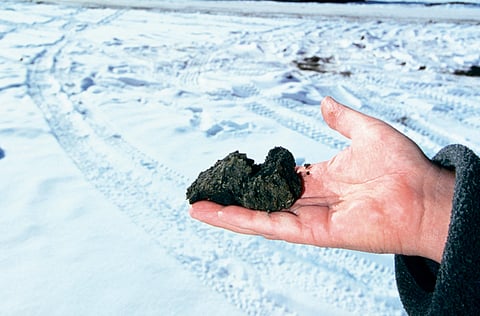
A cold wind blows through the snow-covered streets of Fort McMurray, a small town on the banks of the Athabasca River in northern Alberta, Canada. At first sight, it is one of the settlements in the northern hemisphere not everyone would like to move to voluntarily. Temperature in the subarctic winter can drop to minus 25 degrees Celsius; people appear to be constantly sulky and there are no other attractions lining the main street besides a shabby movie theatre, a few restaurants and bars, a casino and a couple of petrol stations.
The smell of oil that wafts across from a nearby oil sand field makes the town different. Located at the nerve centre of Canada's crude bitumen exploitation, Fort McMurray, in a way, has become a boom town.
Since the oil companies started to dig up the frozen tundra grounds of northern Alberta to extract a thick, black substance called oil sand, the population of the remote town grew from 15,000 to more than 100,000 in the past 13 years. The town attracted oil workers from all over the world on the search for quick money in exchange for a few years of exhausting work. This was not easy considering a life full of deprivation close to the polar circle. They were prone to constant fatigue in winter with only a few hours of sunlight a day and exposed to insomnia in summer with 20-hour daylight cycles.
Bitumen deposits
The oil sands are Canada's hidden treasures with a large deposit of bitumen or extremely dense and heavy crude oil. The Athabasca oil sands are the largest reservoir of crude bitumen in the world, resting under more than 50,000 square miles of sparsely populated land. It is estimated that the reservoir contains around 1.7 trillion barrels of bitumen, of which 10 per cent can be recovered in a profitable way. This is almost the amount of reserves that are estimated to be still recoverable from the world's largest oilfield, Ghawar in Saudi Arabia, or from other known oilfields and reserves in Venezuela, Russia, the North Sea and the Gulf of Mexico.
The impact of the oil sand industry on Canada's economy is impressive. The business contributes $2.1 trillion (Dh7.71 trillion) to Canada's GDP, according to figures presented by Greg Stringham, Vice-President of the Canadian Association of Petroleum Producers (CAPP) during a speech at the Wilton Park Energy Conference in the UK in June this year. He said the industry has created 75,000 jobs last year alone and will create up to 900,000 jobs by 2035, including opportunities for the indigenous people from the First Nation groups in northern Canada. Government revenues from taxes will amount to more than $780 million in this period, he added.
Energy-intensive process
Exploitation of oil sands is, however, a process that is more complicated and costlier than pumping crude oil from the ground. The bitumen is enclosed in an ore, which means the ore has to be collected within an open-pit mining process and then crushed to separate the crude bitumen. In an energy-intensive process using natural gas, the oil is then extracted from the base material.
Local private companies such as Canadian Natural Resources, Suncor, Syncrude, and international majors such as Shell, ConocoPhillips, Total, Chevron, ExxonMobil, China's Sinopec, Hong Kong's Husky Energy and Korea's KNOC are investing heavily into the oil sand exploitation. All of them have their own ‘claims' as well as large areas of allocated oil sand fields.
One of the largest projects is the Canadian Natural Resources' Horizon field with an overall investment of more than $10 billion. The company estimates that the properties hold 14.3 billion barrels of bitumen, and have gross reserves of 2.9 billion barrels of synthetic crude oil. After the project completion in late 2011, planned production will be at approximately 500,000 barrels per day. This will make the Horizon field the highest yielding among the comparably large Suncor and Syncrude fields nearby and Shell's Albian Sands project north of Fort McMurray.
John Puckering, site manager of the Horizon project, gives us an impression of the size of the entire operation: The airfield of the project has been constructed to handle a Boeing 737 that can fly in weekly with workers and equipment. Its cabins can accommodate more than 2,000 workers and is the size of a small village. "We are in the oil business, and when we do something, we do it in a proper way," he told GN Focus during an earlier site visit.
The Canadian oil sands have a large political impact as well. They reduce North America's reliance on oil from other sources such as the Arabian Gulf, Venezuela, Nigeria or Russia — a plan that fits into the goal of US president Barack Obama to reduce oil deliveries from outside North America. Canadian oil is pumped to US refineries in the Midwest and Texas, with more projected pipelines. The $7 billion Keystone XL pipeline from Edmonton in Canada to Houston in Texas, are under construction, although disputed due to the negative impact it will have on the environment.
Environmental impact
Oil sand mining has sparked debate in Canada on how open-pit operations affect the environment in a negative way, by destructing forests, agricultural land and polluting groundwater resources. The burning of natural gas to process bitumen into synthetic crude harms the environment by releasing greenhouse gases into the atmosphere.
CAPP Vice-President, Stringham, said attempts to address these problems are under way by using new extracting technologies as well as a $3 billion government investment in capturing CO2 emissions. Oil sand companies are also asked to reduce their ecological footprint by reclaiming land after the mining process is completed as well as to incorporate the use of modern water-recycling technology. n


