Mercury falling
Ever thought about how people kept their cool in arid deserts or in temperatures that could shatter thermometers before the AC was invented? Read on to find out...
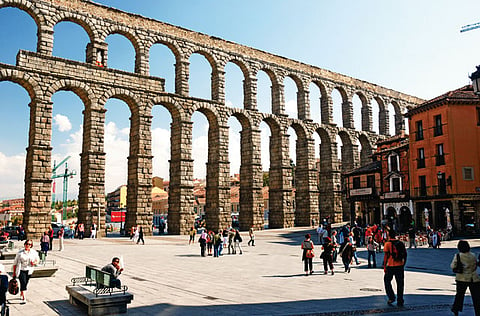
The idea of air conditioning dates back quite a few centuries. It is unclear if it was first used in ancient Rome or China. However, the Romans let cool aqueduct water circulate through the walls of their houses in order to cool the brickwork and lower the room temperature.
In China, cooling methods such as fountain systems were used until an early inventor named Ding Huane created a manually operated fan in the second century, which was also able to run on hydel power. Tang Dynasty Emperor Xuanzong in the eighth century had the aptly named Cool Hall built in his palace, containing water-powered rotary fans as well as water issuing up in jets from fountains.
In the water-scarce Middle East, people used the power of the wind for cooling purposes. At first, simple wind scoops or catchers were used, channelling cool air into rooms.
Later, in medieval Persia, wind towers came up, which were able to capture prevailing winds and used internal vanes to funnel cooler air into the buildings and suck warm air out. In some cases, water was added to the equation via pools of collected rainwater that further lowered the temperature of the air flowing over them as they evaporated. Such towers are still used in the Middle East, albeit more as an architectural feature than for their initial purpose.
Examples of wind towers can also be found in traditional Persian influenced architecture throughout the Middle East, Pakistan and Afghanistan. Most buildings are made of very thick ceramic with extremely high insulation values. Furthermore, towns centred on desert oases tend to be packed very closely together with high walls and ceilings, maximising shade at ground level. The heat of direct sunlight was and still is minimised with small windows that do not face the sun. One of the most interesting examples of an entire town that relies on community wind towers to cool it is Yazd, in Iran.
The emergence of traditional Gulf-style wind towers arose as people migrated from Iran to the Gulf countries with the growth of the pearl trade. With their new wealth,
merchants built houses of note in the 18th and 19th centuries. The people of Ahvaz in Iran, for example, came and brought with them new architectural designs, which were then adapted and further spawned a new breed of local versions, each with its own distinctive decorative motifs.
In Dubai, wind towers were built in summer and taken down in winter. They were mounted on poles in public areas for square distribution of air.
Barajeels or wind towers are the most distinctive element of the architecture in the UAE, says Carlos Zeballos, Peruvian architect and expert on Middle East architecture.
These towers extracted the hot air by conduction and produced a refreshing breeze within the house. A ventilation system was mandatory, given the high temperatures and extreme humidity of Dubai. Today, the architectural blueprint of wind towers can be found interpreted in certain developments such as Madinat Jumeirah or in Downtown Dubai.
Wind towers are still used in some less developed regions around the Gulf, especially in Iran, Pakistan, and Afghanistan as they are cost-effective.
Wind towers have also been incorporated into western architecture as a modern and sustainable architectural element.
However, unlike their ancient counterparts, some of these modern wind towers are made out of aluminium to provide a larger upwind scoop, creating a more powerful flow.
The Burj Al Taqa, a zero-emission and zero-energy tower in Dubai, was to be built using the cooling system of a wind tower and turbine on its roof as an example of the use of an ancient technology to make modern buildings more sustainable. However, the breaking ground for the tower has been delayed due to the property downturn.
The first existing modern tower that integrates the wind tower concept as well as wind turbines into its design is the Bahrain World Trade Center, which opened in 2008 in Manama.

