Starwood to double regional footprint in 5 years
Company has 45 hotels open and 31 in the pipeline in Mideast
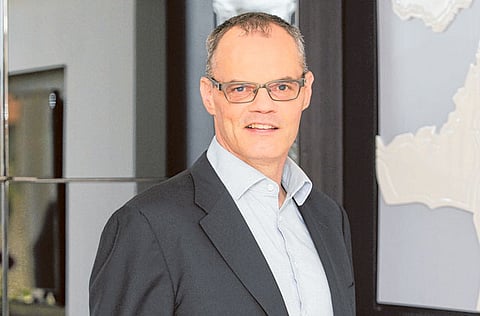
In less than 48 hours of arriving in Dubai, Frits van Paasschen, a fit 51-year-old President and CEO of Starwood Hotels & Resorts Worldwide, managed to do an extensive three-hour cycling trip with more runs and biking planned for the next one month that he would spend in Dubai, the company’s new headquarter for a month. The American hotel and leisure company headquartered in Stamford, Connecticut, with brands such as Le Meridien, Sheraton, Westin, W, among others in its portfolio, Starwood has 14 hotels in Dubai, second only to New York as a city, with another six confirmed projects.
From now until April 5, van Paasschen and the company’s top executives will conduct day-to-day business from Dubai as part of a month-long relocation of its global headquarters to Dubai.
In an exclusive interview with Gulf News, van Paasschen shares how crucial a role Dubai and the Middle East play in Starwood’s overall performance. With the region comprising 45 hotels, of the total 1,140 hotels, van Paasschen says he is confident of doubling the footprint here. As he says: ‘The month will go by quickly.’
What’s the idea behind relocating Starwood’s headquarters to Dubai? You did a similar stint in China in June 2011.
The really exciting part about Dubai is it is a crossroads for so many different things, and I mean that both physically from East to West and North to South, as I do from a standpoint of capital flows, raw materials, development, becoming increasingly a global gathering place. And that’s the rationale for choosing Dubai.
In terms of what we learn, the best decisions that you make as a company and as a business leader, when you have a collection of people around the table having an open discussion, with similar goals and similar values but with different perspectives and different areas of expertise, you arrive at the best decision through that kind of discussion. And it’s harder to do that when you’re not around the table but you’re around the world.
Any potential acquisitions or financial deals you plan to sign while you’re in Dubai?
From the standpoint of acquisitions, no. This is a business wherein we bring the global brands and the operating expertise, and we look for local partners to provide capital because the real estate investment is inherently local, and our business is inherently globa.
Similar to your recent tie-up with Delta Air Lines, are you in active talks with any of the Gulf carriers, for a potential rewards programme partnership?
In principal we would love to have a partner here as well to do something similar with. We have had a very favourable reception to the partnership — crossover rewards — that we just announced with Delta. And we would look forward to having similar partnership exclusively in the regions around the world, and certainly that would include this area.
What is the pipeline looking like for Starwood hotels in the Middle East?
Globally, as a company today we have about 1,140 hotels, and we have 400 hotels in the pipeline and maybe 300 announced or definitive deals. To put that in perspective for the Middle East, we have 45 hotels open and 31 in the pipeline. The 31 is the strong percentage of the 300 we have confirmed around the world.
How much does the Middle East contribute to Starwood’s bottom line?
I think of us as being a three business — a timeshare business which is less than 15 per cent of our total, the owned hotel business is another 25 per cent — between the two, they are probably 37 per cent, and our fee business is the remaining 63 per cent. In the Middle East with 45 hotels, out of the total 1,140 hotels, we have larger hotels here and more hotels that are in the higher end category. And I am confident that we will double our footprint here in five years.
Of Starwood’s global portfolio of 9 brands, there is only one missing in this market — the Element. When do you plan to bring it here?
We are working on that and are in discussions. We haven’t announced anything yet but there is a demand for the extended stay format. And there is now a great awareness and appetite for Westin which is the sister brand to Element. So it’s a question of time. We should be able to bring it here in about 3-4 years’ time. And when we do that [and with the W also open], we will have all 9 brands in Dubai. And so far there is only city in the world that has all nine, and that’s New York.
Starwood is not present in the budget segment of the market, which is clocking in strong growth here as well as globally. Are you not missing out?
I see that as a challenge for somebody else, maybe. We consider ourselves a global high end hospitality company. Budget hotels are a wonderful business but it’s not the business that we are in. Operationally, it’s a very different business. So I agree there is a big opportunity but it’s not the opportunity we are pursuing. Our own view is that we are quite busy with the business that we focussed on.
So are you saying, in effect, Starwood would never look at that [budget] segment of the market?
I am careful not to say ‘never’. The higher end hotel business is a global business. When you get to budget, I am not so sure it’s as much a branded business, brand matters less, because people by definition, are segmenting and choosing on the basis of price. But it’s also unclear to me that there, at least today, is a global budget lower mid market brand in the hotel industry. Whereas, at the high end it’s clearly a global branded business.
Do you think Dubai’s luxury hotels segment is saturated?
The simple way I look at that is I look at the occupancy levels in our properties, and I would say no. I actually think that the mid-market, or at the four-star level, there is an opportunity for more development. This is the market which is very much developed at the high end, and at least from the perspective of our own hotels, that supply has created its own demand and those hotels are doing well. I think there is more opportunity for four-star hotels, and that’s true not just of Dubai, but throughout the GCC and in Saudi Arabia as well.
From a global perspective, what are some of the key learnings for the region’s hotel industry? What is lacking in the industry here?
Actually, I don’t think very much. In some interesting respects, in spite of the extraordinary growth here and the dynamism, there is still not a universal perception of what’s really happening here. And when I think about why I came here, one of the other reasons was to draw attention to the extraordinary development here in the creation of what is a world city of the 21st century. And there are people in Europe and North America who haven’t come to realize that yet.
Do you think the hotels market here has fully recovered since the economic downturn?
There was a point before the crisis that the market here was so hot that you couldn’t find a hotel room and there were rates that went artificially high because of that – a real short term supply-demand imbalance. So to speak technically, have we reached that peak again? No. I don’t consider that a realistic measure of the health of the market. If you look today at how much bigger our footprint of hotels is, even since then, the levels of occupancies that we are talking about, I would tell you that this market has recovered and gone beyond what it was. In that respect it’s a comeback much more strongly than we would have imagined.


