The case of Citruss TV in UAE
Blazing a trail in TV shopping
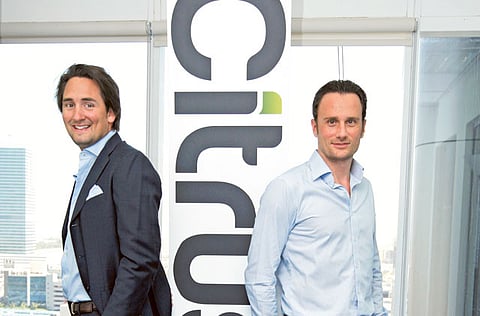
Michael Trueschler (M) and Nicolas Bruylants (N) met while kite surfing in Dubai and started Citruss, a TV home shopping network in 2005. The face of Citruss are the product promotions seen 24/7 on TV. Behind the scenes Citruss designs, scripts, and produces the promotions, and sources and manages the supply chain of products from around the world to the doors of the customers.
How did Citruss start?
M: I came to Dubai from Germany to start a business after my MBA. I had never been here before. Dubai was getting a lot of positive press coverage in Germany - about the infrastructure, economic dynamism, and zero tax.
TV Shopping from home was a successful business in US, Europe, and Asia. The Middle East did not have a TV network for shopping from home. So I said, ‘Wow, let me tap the possibility here.’ The idea was to develop TV shopping programs and broadcast them on different channels and share revenues.
I needed to go to work with existing companies and channels. I did not know anyone in Dubai. Using the internet I identified the big TV channels in this region. Taking initiative, called the operators and asked to be connected to somebody in business development or marketing. Before coming from Germany I had fixed appointments with TV, call centre, and logistics companies.
I explained to them that home shopping did not exist here, and I wanted to do it. They had the TV and the studio. They could do the presentation, something I didn’t know how to do, and couldn’t do. I would do the back office stuff – sourcing, selling, delivery, and collection. I was presenting an investment proposal. They had to invest in the business. It would be a company we set up together. There was no discussion on shareholding.
Everyone I met was friendly. People were listening but nothing tangible came out of the discussions. I sensed a low appetite for risk or change. I realized that profit was not a motive for Government TV channels.
After 3-4 months of running around I had to adapt.
N: I met Michael while kite surfing on the beach and learnt about his TV shopping idea. I accompanied him on his meetings. People had a poor perception of TV shopping. They looked at our idea as an infomercial - TV programs made in US or Europe dubbed in Arabic for cheap products from China. The economy was booming in 2004. No TV channel wanted additional revenue from home shopping programs on their channels.
I suggested to Michael the possibility of creating a channel to broadcast the programs. We started looking into producing TV shopping programs and owning a TV channel. I helped Michael put together a business plan.
M: Everything was turning out different from the way anticipated. At the end of the day I said let me go ahead because I didn’t come to Dubai, blue eyes and dreaming.
Every channel said no and you decided to create a channel.
N: This was a big decision. Two factors helped. One, we didn’t have much fear at that time. Fear comes when you have a family. And two, we didn’t know. We didn’t know the business we were getting into. Maybe if we knew how difficult it is, we would not have done it at that time.
How did the partnership happen?
N: I returned to Belgium after my work finished in Dubai. I had this business plan in my hands. I was happy in Belgium, but was missing Dubai. Dubai gives you a push to do things. Here everything seems possible. Rules are strict in Europe. One has to do many things to be a broadcaster. Taxes are even more complex. I thought, ‘I have this business plan. If I can raise finance from amongst the people I know, who are venture capitalists, add my personal finances, maybe I can put together what is required to build this business.’ I started meeting investors. In a month I had raised some money.
I called Michael and said, ‘If you are still keen and you can bring a percentage of the required capital, I will come and bring the rest.’ He readily agreed. I moved back to Dubai, and Citruss TV started.
How was the start?
M: We had no knowledge of the TV business when we started the business. We had to go on air in mid-April 2005 and had 4-5 months to fill 24 hours of programming every day. The task was daunting. We needed knowhow and people with experience in this field. We did not realize the enormity of the challenge when we started. We didn’t know how the business worked. If we knew the TV business and had established connections, we would not have done what we managed to do. Had we known what the business involves when we started we would not have done it with the amount of capital we raised.
N: We had to do incredible amount of learning. I knew nothing about – products, promotions, programming, and photography. We learned by trial and error. The channels were helpful. They were guiding us to access infrastructure – studio, cameras, directors and presenters – to implement the idea.
When did you know Citruss was working?
M: We had set up the complete infrastructure – products, warehouse, call centre, and TV programming - but people didn’t start to order. Sales didn’t start and grow as expected. People were not used to buying from TV.
N: We had not put in the ‘equation’ that even if we had a successful plan to create viewership, customer trust takes time. We needed capital to pay our employees and for marketing, for the time it takes to create trust. This was the most stressful part.
M: The startup is stressful. We also had to get used to unforeseen things happening that had to be managed. The company running our call centre became insolvent. They gave us a week’s warning before closing. We would be dead with no one taking orders. Stress became more manageable in 2009 when we reached breakeven point and we finally could fund ourselves.
How did you decide which products to sell?
M: TV shopping works for products where product demonstration enables customer understanding and choice. A brick and mortar retailer cannot explain and demonstrate a kitchen appliance or a beauty product to all customers walking through a shop.
Based on global experience we started with cosmetics. We then added kitchenware and jewellery. We have now added electronics - laptops and computers. Kitchen and beauty are our main categories.
N: It sometimes happens by chance. I was sitting next to a Lebanese lady at a dinner in the Belgian Embassy. We got talking about what we were starting. She told me, ‘You should sell whitening products. Europeans and Lebanese like to look tanned. Here they want to be fair.’ We found a high quality whitening product from Spain and sold it very successfully.
Today product selection is structured. To sell a coffee machine we search for the best coffee machine. We select five, test them, and put our guarantee stamp on it. Then we present coffee machines to our viewers.
In TV shopping I can test products. After deciding on an item, we do a program, put it on TV and get a direct response. We gauge the uncertainty and can tweak our product, presentation, and / or message to answer all customer questions. Citruss is full of surprises. We have dud products and great surprises too. We had a big hit in a ‘joint cream.’ I had joint problem in my knee, imported a joint cream from Belgium, used it for two weeks and got rid of the pain. We had a customer from the US who had a stiff shoulder. I gave him the product and he gained movement of his shoulder. He was effusive about the product. I decided to sell the product. I would never have thought and expected to sell cream for joints on TV.
How challenging was the product sourcing?
M: We first tried to get everything on consignment. Only 1 in 10 suppliers would agree. We started the business getting the goods on consignment, paying only for what we sold. This approach narrowed down possibility of attracting suppliers.
N: The supply side is the difficult part for any business - how does one find a unique product that the customer wants? We also want it at the best price and good payment conditions. Even now every contract is a challenge. It was more difficult when we started. We didn’t have the sales numbers to justify requests. Getting brands to trust us was tough. Now when we open negotiations, we have success stories to narrate.
M: Suppliers now want to work with us. We have been in business for 8 years and are the biggest players.
You don’t know Arabic. How do you create programs?
N: People wonder how we know what is happening on TV because we broadcast in Arabic. I first make sure that the team understands our idea. We make a story board of the message. The team brings their cultural experience and it is translated into Arabic. We then test it to see whether people understand what we want to tell.
It took a long time - for the team to learn what was in our mind and for us to learn the cultural differences. It is a lot of trial and error. TV shopping has an advantage. We have a direct response to what we are doing. We listen to the phone calls and understand what the customer is thinking. This helps us develop. We go back to producers and presenters, and recalibrate our message; what was good, what people liked and what needs to change.
What about logistics, the other backbone of your business?
M: We started with Al Futtaim and moved to Aramex in four months. We needed to manage the last mile - deliveries and payment. Deliveries require speed and accuracy which requires easily understood address systems. These are non-existent. The delivery system had to be capable of receiving cash on delivery. People don’t use credit cards to buy on TV.
How did you price products?
M: We have a pricing structure and strategy – introductory price for a majority of products in the first month when we show a product. The final price is 10-20% higher than the introductory price. After that there is no change except the specials that we run e.g. during the Ramadan when we have bundled offers with gifts. We don’t like giving discounts.
N: We have a basket size of US $ 150 compared to $60 in Europe. This is a very high basket size. We discovered a low sensitivity to price in the region. Pricing is benchmarked with products in the market.
Potential of Citruss?
M: In early 2010 we integrated TV and e-commerce through the website. We are seeing more customers getting used to buying on the TV and online. Electronic retailing is important, and home shopping is part of it. Our advantage is that we can show a video of the product unlike a static presentation on a website.
HR challenges?
M: We have sixty employees. Recruiting and getting the right skill-set has been a challenge. We were not familiar with the names of the Universities. If I saw a name on a CV I couldn’t connect it with anything I knew. I use a more direct approach. I look for logical thinkers. If I give a person a task, his way of thinking should be practical and intelligent, and he must show enthusiasm for the job.
We had to get used to a different work ethic from Europe. Cultural differences are real. In trying to balance work and family life, I sense people here give a greater emphasis to family life.
What worries you about the business?
M: Political instability of the region. Europe and the US have economic uncertainty and political stability. Some Mena (Middle East and North Africa) countries targeted by Citruss have political and economic uncertainty.
N: I did not know that as a CEO and co-owner of business I will never stop thinking about it. I find it difficult to get away from work. Wherever I am, I always want to know whether we have the new product launched, how we did today, what is the feedback, did we get a ready feedback from customers who received goods, and did they post the review, and so on. I am interested in the business all the time, not only because I am in a business that I have learned to love TV shopping network and what I do.
How have you changed as a person while implementing the business?
M: I have had to adapt to the mentality of people. We took a conscious decision to adapt to the local culture by doing local content. To do this I had to work with a lot of Arabs to understand them and the culture. I have learnt that I can’t expect German precision at work; I can’t get things done in time and in detail that I want the first time round. It was important to learn to be more relaxed. There were many problems we have had to solve, and there will be more to come. But you have to give it time and deal with problems one by one. Don’t stress yourself too much and make sure you also have a private life. So as a person I am surely more laid-back than I used to be.
N: When I started the company I had no real experience of managing people. This is what I do most of the time. We have great people in key roles in the company and I spend an awful lot of time in making sure we manage them right. I did not have the faintest notion about this when I started. I thought it will be my job to decide, let people know what to do. This is totally wrong. I have changed completely

