Samsung scours Chinese countryside for best deals
Focuses on extending distribution reach and winning price battles
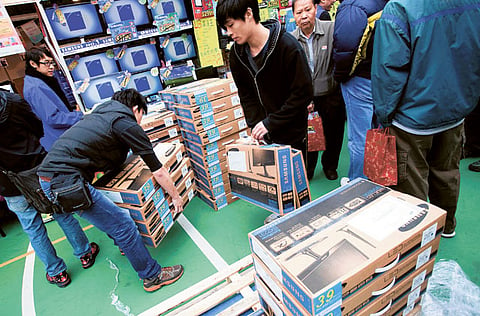
Taipei and Seoul: For two weeks last month, Kim Young-ha, chief executive of Samsung Electronics China, was unavailable for meetings at his Beijing office. He was instead travelling 5,000km by road through rural China, visiting Samsung stores in cities as far-flung as Mianyang in the west and Xinhui, to the south.
Kim's road trip is part of his efforts, since becoming chief executive two years ago, to localise Samsung's operations in China and to extend the South Korean company's sales and distribution networks far into the Chinese countryside.
It is a strategy that has paid off spectacularly, with Samsung last year taking the biggest market share in China for mobile phones, smartphones, and televisions. In smartphones in particular, Samsung has a big lead over Apple with a 30 per cent share in the world's biggest smartphone market compared with Apple's 10 per cent, says Song Jong-ho, analyst at Daewoo Securities.
Stunning demand
Tim Cook, Apple chief executive, has singled out China as having the most potential for growth, saying demand there has been "mind-boggling".
For Samsung, China accounts for 9 per cent of brand business revenues, currently $9.6 billion (Dh35.25 billion), and that proportion will rise to 20 per cent by the end of this decade, Kim told the Financial Times.
To achieve that, Kim has sought to make Samsung, in the words of one of his colleagues, "more like a Chin-ese company than a Korean" one. Two years ago, only one-fifth of the department heads at Samsung's China operations were Chinese. Now, 70 per cent are locals.
Kim says one of the key decisions he made was to wrest control over Samsung's distribution network in China back from national retailers such as Gome and Suning, which Samsung had relied upon.
It also allowed Samsung to more easily expand beyond large metropolises such as Shanghai and Guangdong, markets that Kim says have become saturated. He complains that Samsung was "late to the mid-sized cities", because it had to follow national retailers' pace of expansion.
Analysts say it is that distribution strength in China that sets Samsung apart from other foreign competitors. "Samsung boasts strong retail sales networks while Apple and LG Electronics still struggle in China because of that," says Greg Roh, analyst at HMC Investment Securities.
Brand recognition
By going to the countryside, Samsung will be moving in on domestic rivals able to compete on price. But analysts say its strong brand identity has given Samsung an advantage, at least for now.
Samsung's relatively long history in China — since 1992 — and its vertically- integrated business model also give it an edge in adapting its products and services to suit the local market. Apple's iPhones, for example, are still not yet sold through China Mobile, the world's biggest mobile carrier, because it does not support TD-SCDMA, China's 3G standard used by China Mobile.
By contrast, Samsung's chipmaking unit helped China Mobile develop the TD-SCDMA. Its flagship Galaxy phones in China also come with features popular with local consumers, such as dual-SIM cards and a library of pre-installed apps.
Analysts warn that Samsung may face greater competition in the low-end phone market from Chinese rivals, which are fast upgrading their models. But Kim is confident Samsung will be able to stay a step ahead. The local brands "are afraid of Samsung's plans", he says.
— Financial Times

