Cooling global demand fails to dent steel prices
Regional producers, logistics help insulate Mideast construction industry from impact of shipping costs on final pricing
Dubai: There is nothing like the present to launch a project, or so it seems. Prices of key building materials have been holding up since the start of the year, largely by a marked drop in demand from China.
For a commodity such cement, new capacities are coming up in the Gulf and the immediate neighbourhood, which would be able to feed a major portion of the region's demand in the medium term.
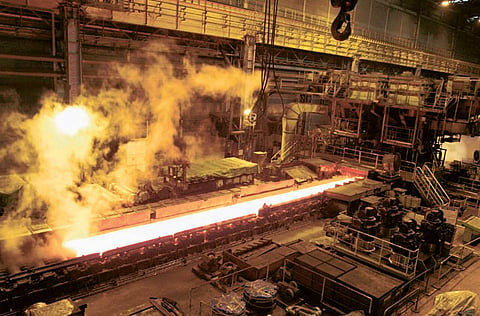
And when it comes to that other key building material, steel, the capacities — and massive ones at that — are already there.
"Steel prices have not firmed up remarkably this year; there are slight variations of up to 2 per cent which is normal," said Farouk K. Toukan of Abu Dhabi based Cicon.
"This has nothing to do with the China market. Steel prices in the GCC — and particularly in the UAE — are determined by the regional producers like Emirates Steel Industries, Sabic, Qatar Steel Company and the many Turkish steel mills."
Toukan has a point — if the average price of steel shipped in from Turkey last year was $675 (Dh2,479) per tonne (for cargo and freight), it is now at $670 a tonne. "Though it is difficult to predict, we expect steel prices could be in the level of $675 a tonne [plus or minus 2 per cent] for the rest of the year barring any unexpected development," said Toukan, who was recently named Ernst & Young's ‘UAE Entrepreneur of the Year'.
His company has steel cutting and bending fac-ilities in Abu Dhabi and Dubai with a capacity of 60,000 tonnes a month. There are plans to raise the capacity at the Qatar plant from the current 10,000 tonnes a month.
While building material prices are favourable, this has — at least in the year to date — not manifested itself into heightened project activity in the UAE's construction sector.
But there is a lot of hope vested in the second half of the year, principally from the new expansion at The Dubai Mall and all of the associated tenders that this will entail.
"From a project cost basis, the present represents an ideal phase for principals to go in for tendering and get some competitive bids on them," said the regional head at an architectural firm.
All-round stability
"With China deciding to cool down its housing market and very little project activity taking place in Europe, there's all-round stability in commodity prices. And it should last."
According to Toukan, project-related work in Saudi Arabia, Qatar and Oman is on track and as for the UAE "we are optimistic as all the indications are guiding us to this direction." On the logistics side of things too, the trends are positive.
Given that most of the steel transportation in the Gulf is by road, shipping costs do not have as much of an impact on the final pricing.
Even on the raw material side, "local steel mills import billets from Turkey and East Europe to manufacture steel and the average shipping cost was $39 a tonne in 2011," said Toukan.
"This year, up to April 15, the cost was $37 a tonne. "For the rest of the year, the cost could be between $38 and $40 a tonne excluding any unexpected global development."
Credit periods: Stretched to the limit
Any increase in new project activity will need to come at a price for the contractors. Credit has always been elastic and right now they are being stretched to the limits.
"Suppliers prefer to have the payment in hand [at the soonest] … at least within 60 days," said Farouk Toukan of Cicon. "Unfortunately, due to the special situation of this market, we may have to extend the credit terms between 90 to 120 days."


