Brazil lures record bids at energy auction
Petrobras, Galp, OGX, Total, Chevron among winning bidders
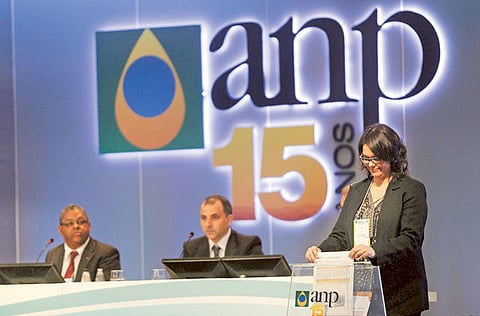
Rio De Janeiro: Brazil’s first auction for oil and gas rights in five years attracted a record amount of money on Tuesday, alleviating fears that government intervention and growth in new global supplies might dampen enthusiasm for the country’s oil sector.
By late Tuesday afternoon, with the auction still in full swing, global energy companies had already ponied up 2.77 billion reais ($1.38 billion) in winning bids, surpassing the previous record of 2.1 billion reais set at an auction in 2007.
Offers for the most sought-after blocks were nearly 40 times the minimum values and the ravenous bidding helped speed along an event, now likely to wrap up by day’s end, that was initially expected to last into Wednesday.
The auction comes one day after state-run energy company Petroleo Brasileiro SA, or Petrobras, successfully sold $11 billion worth of global debt despite heavy criticism from investors in recent years because of missed production targets and sagging profits.
Demand for the bonds, coupled with the strong showing at Tuesday’s auction, indicate investors remain eager to be in Brazil following discoveries of massive new offshore reserves in 2007.
The appetite shows “pent up demand,” said Thore Kristiansen, president of the Brazil unit of Norway’s Statoil ASA, one of the participants. “Companies would really like to expand their role in the country, including ourselves.”
After an anxious lead-up to the auction, Brazil’s government expressed joy over the soaring bids. “We never saw anything like this,” Marco Antonio Martins Almeida, Brazil’s oil secretary, said in an interview.
The auction kicked off with the sale of onshore blocks in the northeastern Parnaiba basin, followed by offshore blocks in the Foz do Amazonas basin, near the mouth of the Amazon river, and in the Barreirinhas basin further south.
Petrobras, Portugal’s Galp Energia SGPS SA and OGX Petroleo e Gas SA, the oil startup controlled by Brazilian billionaire Eike Batista, won early onshore blocks.
OGX, which has lost nearly 90 percent of its market value since the company failed to meet initial production targets, aggressively charged into the auction, securing rights to 13 blocks so far, onshore and off, through bids totalling about 375 million reais.
Britain’s BP Group Plc and France’s Total SA were among the successful bidders for the offshore Amazon blocks, located just south of a major 2012 oil discovery off the coast of French Guyana. Other successful bidders included Statoil, BG Group Plc, Chevron Corp, Exxon Mobil Corp and Australia’s BHP Billiton Plc , until now not a big player in Brazilian oil.
On offer are rights to 289 onshore and offshore exploration and production blocks that add up to an area roughly the size of Bangladesh, or about 150,000 square kilometres (60,000 square miles).
The blocks, in regions outside the offshore swath near Rio de Janeiro where the big recent reserves were discovered, are estimated to contain at least 35 billion barrels of oil, or just over a year’s worth of global crude oil demand.
A changed landscape
Though a record number of participants signed up to take part in the auction, government officials, industry suppliers and others were unsure before the sale how much the 64 Brazilian and international companies that registered would be willing to bet on Brazilian oil and gas.
Officials were eager to know whether interest would remain strong among major multinational energy companies or whether smaller, adventuresome investors would prove more willing than bigger competitors.
Doubts ahead of the auction reflect what is a dramatically different energy landscape compared with the last time oil and gas rights were sold in Brazil, a promising oil frontier where production has nonetheless fallen in recent years as the government halted sales of new blocks and reworked the rules for its most promising reserves.
For starters, the world appears to have more oil than what investors believed five years ago. A shale-oil boom in the United States - and increasingly successful efforts to extract once hard-to-reach oil in Canada, Venezuela and elsewhere - mean bidders no longer see an industry defined by dwindling supplies.
And Brazil has startled many investors since the huge reserves near Rio were discovered. Seeking greater control over future concessions, and a greater share of oil produced in the so-called subsalt region where the big new discoveries lie, the government upended a regulatory model that had proven popular with foreign investors since the 1990s.
‘The size of the prize’
Still, the potential for profit appears to be motivating bidders, many of whom are used to operating in countries far less investor-friendly than Brazil. In addition to whatever upside the blocks on auction this week offer, many investors are eager to gain or increase exposure in a country that could still boast vast undiscovered reserves.
“The size of the prize in the country is really too big for companies to ignore,” said Ruaraidh Montgomery, a Latin America analyst for energy consultancy Wood Mackenzie. “The opportunity’s just too great.”
Oil companies are being selective, though.
While they bid fiercely for the offshore Amazon blocks, in promising deepwater fields, bidders showed little interest in more speculative blocks. Only two companies, for instance, made bids for three of 26 blocks offered in shallow water closer to shore in the same basin.
Brazilian companies are taking part despite production delays and sluggish development of new fields. Petrobras, for instance, in the second quarter of 2012 posted its first quarterly loss since 1999 and this year has struggled to ramp up output.
OGX, meanwhile, symbolizes the mundane new reality for Batista, the once high-flying commodities and energy magnate who has lost billions of dollars in net worth over the past year as investors sold off shares in the oil company and other ventures, which are taking longer to pay returns than initially promised.
Most blocks being sold are in frontier regions, or under explored areas with little or no existing oil or gas output.
The blocks, mostly in north and northeast Brazil, have been broken into four onshore and seven offshore zones across 11 sedimentary basins.
In November, Brazil plans to sell blocks in what it has dubbed the “subsalt polygon,” which includes Lula, the big field discovered in 2007, and other major nearby finds. The term subsalt is used to denote the deep beds, beneath layers of salt under the ocean floor, where the big recent discoveries lie.
But the polygon also includes much oil, including that currently produced in the well-known Campos and Santos basins, that does not lie in subsalt reservoirs. Campos and Santos together account for more than 80 percent of Brazil’s existing production.


